


 一键配货
一键配货
化合物详情
CAS82558-50-7
分子式C18H24N2O4
分子量332.39 g/mol
非危品
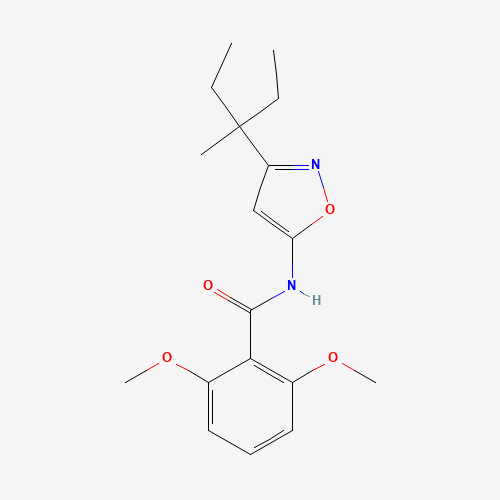
Isoxaben is a benzamide obtained by formal condensation of the carboxy group of 2,6-dimethoxybenzoic acid and the amino group of 3-(3-methylpentan-3-yl)-1,2-oxazol-5-amine. It has a role as a herbicide and a cellulose synthesis inhibitor. It is a member of benzamides and a member of isoxazoles.
科学粮草官-词典编辑部,修订于:2026-07-06
Toxicity
ToxicityEPA Ecotoxicity
Pesticide Ecotoxicity Data from EPA: 69
Ecotoxicity Values
LC50 Colinus virginianus (Northern bobwhite, 12 days old) dietary >5000 ppm/8 days
Fate Summary
ATMOSPHERIC FATE: According to a model of gas/particle partitioning of semivolatile organic compounds in the atmosphere(1), isoxaben, which has a vapor pressure of 4.13X10⁻⁹ mm Hg at 25 °C(2), is expected to exist solely in the particulate phase in the ambient atmosphere. Particulate-phase isoxaben may be removed from the air by wet and dry deposition(SRC). Aqueous solution of isoxaben have be shown to be susceptible to photodegradation(2).
Soil Adsorption / Mobility
The Koc of isoxaben is estimated as 3,300(SRC), using a log Kow of 3.94(1) and a regression-derived equation(2). According to a classification scheme(3), this estimated Koc value suggests that isoxaben is expected to have slight mobility in soil.
Environmental Biodegradation
AEROBIC: Reported half-lives of isoxaben in soil range from 2.07 to 6.6 months with the largest half-lives noted in soils treated with various fertilizers such as green manure, cow manure and pig slurry: 4.03, 4.75 and 6.6 months, respectively(1). The main biodegradation metabolite of isoxaben was demethoxyisoxaben(2). When applied to soil at rates of 0.56, 0.84, and 1.12 kg/hectare, 50% of isoxaben remained after 3 months, 6 months, and 3 months, respectively(3).
Environmental Bioconcentration
An estimated BCF of 215 was calculated for isoxaben(SRC), using a log Kow of 3.94(1) and a regression-derived equation(2). According to a classification scheme(3), this BCF suggests the potential for bioconcentration in aquatic organisms is high(SRC), provided the compound is not metabolized by the organism(SRC).
Volatilization from Water / Soil
The Henry's Law constant for isoxaben is 1.27X10⁻⁹ atm-cu m/mole(1). This Henry's Law constant indicates that isoxaben is expected to be essentially nonvolatile from moist soil and water surfaces(SRC). Isoxaben is not expected to volatilize from dry soil surfaces(SRC) based upon its vapor pressure(1).
Environmental Abiotic Degradation
Isoxaben is not expected to undergo hydrolysis in the environment due to the lack of functional groups that would hydrolyze under environmental conditions(1). Aqueous solutions of isoxaben have be shown to be susceptible to photogradation(2).
Effluent Concentrations
Isoxaben has been found in the runoff water from containerized plant production facilities 4 days after application. The other pesticides in this study, trifluralin, chlorpyrifos and thiophanate methyl, were primarily only detected on the day of application(1).
Artificial Pollution Sources
Isoxaben's production may result in its release to the environment through various waste streams; it's use as a herbicide(1) will result in its direct release to the environment(SRC).
Probable Routes of Human Exposure
Occupational exposure to isoxaben may occur through dermal contact with this compound at workplaces where isoxaben is produced or used. The most likely route of exposure to the general public is through dermal contact with soil treated with this compound, a herbicide. (SRC)
Environmental Fate / Exposure Summary
Isoxaben's production may result in its release to the environment through various waste streams; it's use as an herbicide will result in its direct release to the environment. If released to air, a vapor pressure of 4.13X10⁻⁹ mm Hg at 25 °C indicates isoxaben will exist solely in the particulate phase in the atmosphere. Particulate-phase isoxaben will be removed from the atmosphere by wet and dry deposition. Aqueous solutions of isoxaben have been shown to be susceptible to photodegradation. If released to soil, isoxaben is expected to have slight mobility based upon an estimated Koc of 3,300. Volatilization from moist soil surfaces is not expected to be an important fate process based upon a Henry's Law constant of 1.27X10⁻⁹ atm-cu m/mole. Isoxaben is not expected to volatilize from d...
Effect Level
collection=toxvaldb&kind=^EL$
Target Organs
Urinary
Lethal Dose
collection=toxvaldb&kind=^LD$
Toxicity Data
LC50 (rat) > 1,990 mg/m3
Adverse Effects
Occupational hepatotoxin - Secondary hepatotoxins: the potential for toxic effect in the occupational setting is based on cases of poisoning by human ingestion or animal experimentation.
Screening Level
collection=toxvaldb&kind=^SL$
Effect Concentration
collection=toxvaldb&kind=^EC$
Lethal Concentration
collection=toxvaldb&kind=^LC$
RAIS Toxicity Values
Oral Chronic Reference Dose Reference: IRIS Current
Carcinogen Classification
No indication of carcinogenicity to humans (not listed by IARC).
Non-Human Toxicity Values
LD50 Rabbit dermal >2000 mg/kg
Reference and Risk Values
collection=toxvaldb&kind=^RRV$
Non-Human Toxicity Excerpts
/LABORATORY ANIMALS: Chronic Exposure or Carcinogenicity/ EL-107 (85% isoxaben) /was administered to/ B6C3F1 mice /at concentrations/ of 0, 100, 1000, and 12,500 ppm in diet for 2 years to 60 mice/sex/group [two replicate studies with 30/sex/group]. Possible adverse effects /include/ increased incidence and multiplicity of hepatocellular adenomas in 12,500 ppm males and females. Increased hepatocellular hyperplasia at that level in both sexes, also cytomegaly at that level (particularly in males). No increases in hepatocellular carcinomas. NOEL = 100 ppm, based primarily upon increased incidence and degree of hepatocellular vacuolation in males and females at 1000 ppm and 12,500 ppm.
1 or Cancer Risk Level 1E-06
Fraction of Contaminant Absorbed Dermally from Soil: 0.1
Antidote and Emergency Treatment
Advanced treatment: Consider orotracheal or nasotracheal intubation for airway control in the patient who is unconscious, has severe pulmonary edema, or is in respiratory arrest. Positive pressure ventilation techniques with a bag valve mask device may be beneficial. Monitor cardiac rhythm and treat arrhythmias as necessary ... . Start an IV with D5W /SRP: "To keep open", minimal flow rate/. Use lactated Ringer's if signs of hypovolemia are present. Watch for signs of fluid overload. Consider drug therapy for pulmonary edema ... . For hypotension with signs of hypovolemia, administer fluid cautiously. Watch for signs of fluid overload ... . Treat seizures with diazepam (Valium) ... . Use proparacaine hydrochloride to assist eye irrigation ... . /Poison A and B/
Hazard Quotient Level 3 or Cancer Risk Level 1E-04
Fraction of Contaminant Absorbed Dermally from Soil: 0.1









