


 一键配货
一键配货
化合物详情
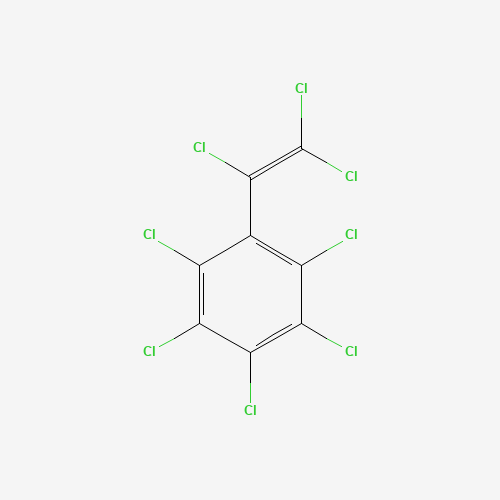
CAS29082-74-4
分子式C8Cl8
分子量379.71 g/mol
非危品
Physical Description | Octachlorostyrene (OCS) is a by-product of the normal industrial chemical processes such as PVC recycling activities, Aluminum refining operations, metal-chlorinated solvent degreasing operations and many others. These materials are known to be highly toxic and when released to the environment are extremely persistent.
科学粮草官-词典编辑部,修订于:2026-07-06
Toxicity
ToxicityBody Burden
Octachlorostyrene was detected in the blood of 136 residents of Schhleswig-Holstein, Germany who ate contaminated fish from the River Elbe at concn ranging from less than 0.5 to 9.2 ng/l with an average of 1.5 ng/l(1). Human adipose tissue of 36 autopsy patients from Windsor and 21 autopsy patients from B Cornwall, Canada were both found to contain octachlorostyrene with an 8% frequency of occurrence(2). Octachlorostyrene was listed as a contaminant found in the adipose tissue and/or milk of non-occupationally exposed humans(3,4). The mean concn of octachlorostyrene in Canadian adipose tissue was 1 ng/g wt wet (N=108; max, 44 ng/g)(5). Human milk (497 samples) representing donors from across Canada were analyzed for octachlorostyrene(6); the mean concn of octachlorostyrene in whole milk...
Fate Summary
ATMOSPHERIC FATE: According to a model of gas/particle partitioning of semivolatile organic compounds in the atmosphere(1), octachlorostyrene, which has an estimated vapor pressure of 1.3X10⁻⁵ mm Hg at 25 °C(SRC), determined from a fragment constant method(2), will exist in both the vapor and particulate phases in the ambient atmosphere(SRC). Vapor-phase octachlorostyrene is degraded in the atmosphere by reaction with photochemically-produced hydroxyl radicals(SRC); the half-life for this reaction in air is estimated to be 15 days(SRC), calculated from its rate constant of 1.1X10⁻¹² cu cm/molecule-sec at 25 °C(SRC) that was derived using a structure estimation method(3). Particulate-phase octachlorostyrene may be removed from the air by wet and dry deposition(SRC).
Soil Adsorption / Mobility
The Koc for octachlorostyrene ranges from 200,000 to 10,000,000 for sediments from the St. Clair River(1). According to a classification scheme(2), these Koc values suggest that octachlorostyrene will be immobile in soil(SRC).
Environmental Biodegradation
Data regarding the biodegradation of octachlorostyrene in either soil or aquatic systems not available. (SRC)
Environmental Bioconcentration
A field BCF of 1,400,000 for octachlorostyrene was determined from the average concn contained in the tissues of 10 Lake Ontario rainbow trout (Salmo gairdneri) and the average octachlorostyrene concn in Lake Ontario water(1). However dietary uptake also contributed to this field BCF value(SRC). Experimental BCF values of 8,100 and 33,000 have been reported for octachlorostyrene in rainbow trout (Salmo gairdneri)(1) and fathead minnow (Pimephales promelas), respectively(2). According to a classification scheme(3), these BCFs suggest bioconcentration in aquatic organisms is very high(SRC). The BCF for oligochaetes was 16(4).
Volatilization from Water / Soil
The Henry's Law constant for octachlorostyrene is estimated as 2.3X10⁻⁴ atm-cu m/mole(SRC) using a fragment constant estimation method(1). This Henry's Law constant indicates that octachlorostyrene is expected to volatilize from water surfaces(2). Based on this Henry's Law constant, the volatilization half-life from a model river (1 m deep, flowing 1 m/sec, wind velocity of 3 m/sec)(2) is estimated as 13 hours(SRC). The volatilization half-life from a model lake (1 m deep, flowing 0.05 m/sec, wind velocity of 0.5 m/sec)(2) is estimated as 10 days(SRC). Octachlorostyrene's Henry's Law constant indicates that volatilization from moist soil surfaces may occur(SRC). However, volatilization from moist soil water surfaces is expected to be attenuated by adsorption(SRC). The estimated volatili...
Environmental Abiotic Degradation
The rate constant for the vapor-phase reaction of octachlorostyrene with photochemically-produced hydroxyl radicals has been estimated as 1.1X10⁻¹² cu cm/molecule-sec at 25 °C(SRC) using a structure estimation method(1). This corresponds to an atmospheric half-life of about 15 days at an atmospheric concentration of 5X10+5 hydroxyl radicals per cu cm(1). Octachlorostyrene is not expected to undergo hydrolysis in the environment due to the lack of hydrolyzable functional groups(2). Octachlorostyrene weakly adsorbs UV light between 295 and 310 nm with slow photolysis(3). Heptachlorostyrene and two isomers of hexachlorostyrene were identified as the major transformation products of photolysis(3). Minor photolytic transformation products include pentachlorostyrene and tetrachlorostyrene(3).
Environmental Water Concentrations
SURFACE WATER: Octachlorostyrene was detected at 9 of 13 sampling stations along the St. Clair River at concns ranging from 1 to 2 ng/l(1). Octachlorostyrene was listed as a contaminant present in the waters of Lakes Ontario, Erie, Huron and St. Clair(2). St. Clair River water contained octachlorostyrene ranging in concns from 0.02 to 7.20 ng/l with an average concn of 1.0 ng/l for 20 samples(3). The average octachlorostyrene concn for 8 offshore water samples from Lake Ontario was 4.6 ng/l(4). Octachlorostyrene was detected in the surface film water of the Frierfjord, S Norway(5). Octachlorostyrene was detected at concns ranging from 0.013 to 0.063 ng/l for 6 of 13 samples from the St. Clair River on Aug 7, 1985(6). Octachlorostyrene was detected at concns ranging from 0.011 to 0.085 n...
Milk Concentrations
Octachlorostyrene was listed as a contaminant found in the milk of non-occupationally exposed humans(1,2). Human milk (497 samples) representing donors from across Canada were analyzed for octachlorostyrene(3); the mean concn of octachlorostyrene in whole milk and milk fat were 0.05 and 2.16 ng/g, respectively, with a frequency of 7% for the 497 samples(3).
Animal Concentrations
The concn of octachlorostyrene ranged from 7.5 to 31 ng/g dry weight for oligochaete worms taken from the bottom sediments of Lake Ontario near the Niagara River(1). Mayflies and caddisflies of the St. Clair and Detroit Rivers were found to contain octachlorostyrene at concn ranging from 6.10 to 415.4 ug/kg dry weight(2). The concn of octachlorostyrene in eggs of ivory gulls (Pagophila eburnea) from Seymour Island, Northwest Territories, Canada were 0.007 mg/kg wet wt in 1976 and 0.008 +/- 0.002 mg/kg wet wt in 1987(3). Between 1987 and 1992 at Hamilton Harbor (Ontario, Canada), the level of octachlorostyrene in eggs of herring gull, Canada goose, double-crested cormorant, black-crowned night-heron, common tern, and Caspian tern ranged from 0.1-0.2, 0.00, 0.02, 0.01-0.02, 0.01-0.03, and...
Effluent Concentrations
Two of six sewers from the Dow Chemical plant along the St. Clair River contained octachlorostyrene in their waste water effluents at concns of 0.038 and 0.16 ug/l(1). Treated leachate from the Dow Scott Rd landfill at Sarnia, Canada, Dow Chemical's disposal site for chlorinated tars, contained octachlorostyrene at a concn of 0.21 ug/l(2). Waste water from an Esso refinery contained octachlorostyrene at a concn of 0.002 ug/l(4). Octachlorostyrene was identified as a constituent in the fly ash of waste incinerators(2).
Atmospheric Concentrations
REMOTE: The mean concn of octachlorosytrene in air samples taken from Egbert, Ontario, Canada from Jul 1988 to Sept 1989 was 0.71 pg/cu m (range, <0.1 (detection limit)-31 pg/cu m; 48 of 143 samples >0.1 pg/cu m)(1).
Fish/Seafood Concentrations
Fresh water clams of the St. Clair River contained octachlorostyrene at concn ranging from 2.9 to 192.7 ug/kg dry weight with an average 35.9 ug/kg for 6 samples(1). Fresh water clams of the Detroit River contained octachlorostyrene at concns ranging from 31.3 to 57.3 ug/kg dry weight with an average 48.7 ug/kg for 4 samples(1). Fresh water clams of St. Clair River contained octachlorostyrene at concns ranging from 2.0 to 154.0 ug/kg dry weight with an average 43.3 ug/kg for 62 samples(1). Within 3 weeks the average octachlorostyrene concn among introduced clams ranged from 1 to 55 ng/g wet weight for 10 of 13 sites along the St. Clair River(2). Within 3 weeks the average octachlorostyrene concn among introduced clams ranged from trace amounts to 4 ng/g wet weight for 22 of 27 sites alo...
Artificial Pollution Sources
Octachlorostyrene is not produced commercially for any application(1). In addition to the lower chlorinated styrenes, octachlorostyrene is mainly an accidental by-product of high temperature industrial processes involving chlorine such as the electrolytic production of chlorine gas or magnesium, the refining and degassing of an aluminum smelt, and the chlorination and distillation processes of niobium and tantalum production(1,2). Release of octachlorostyrene into the environment has been shown to occur largely through the waste water effluents of these operations(1-3). Octachlorostyrene has also been released to ground water via leachate from a landfill where chlorinated tars were deposited(4). Waste incinerators can emit fly ash containing octachlorostyrene to the atmosphere(5).
Sediment/Soil Concentrations
SOILS: The concentration of octachlorostyrene in River Elbe (Germany) floodplain soils ranged from 1-696 ug/kg(1).
Probable Routes of Human Exposure
Occupational exposure to octachlorostyrene may occur through inhalation of dust and dermal contact with this compound at workplaces where octachlorostyrene is produced indirectly(SRC). Foundry workers, who use hexachloroethane as a degassing agent for aluminum, are exposed to octachlorostyrene which is formed by complex reactions(2). A greater than 70-fold increase of mean octachlorostyrene in blood was found among exposed subjects compared with controls (control, 0.7 ng/g lipid; exposed, 54.6 ng/g lipid)(2). Monitoring data indicate that the general population may be exposed to octachlorostyrene via ingestion of fish and seafood containing octachlorostyrene(SRC).
Environmental Fate / Exposure Summary
Octachlorostyrene is not produced commercially for any application. In addition to the lower chlorinated styrenes, octachlorostyrene is mainly an accidental by-product of high temperature industrial processes involving chlorine. Documented release of octachlorostyrene into the environment has largely occurred via waste water effluents from chlorine gas, magnesium, niobium and tantalum production and the smelting of aluminum. Release of octachlorostyrene to the environment has also been reported as leachate from an industrial landfill and fly ash from waste incinerators. If released to air, an estimated vapor pressure of 1.3X10⁻⁵ mm Hg at 25 °C indicates octachlorostyrene will exist in both the vapor and particulate phases in the ambient atmosphere. Vapor-phase octachlorostyrene will be...
Adverse Effects
Occupational hepatotoxin - Secondary hepatotoxins: the potential for toxic effect in the occupational setting is based on cases of poisoning by human ingestion or animal experimentation.
Non-Human Toxicity Excerpts
IN ACUTE STUDY, MALE RATS WERE GIVEN BY GAVAGE SINGLE DOSES OF OCTACHLOROSTYRENE AT 1300, 1690, 2190, 2850, OR 3710 MG/KG & KILLED 14 DAYS LATER. DOSES GREATER THAN OR EQUAL TO 1690 MG/KG CAUSED INCREASED LIVER WT, HEPATIC MICROSOMAL ANILINE HYDROXYLASE & AMINOPYRINE DEMETHYLASE ACTIVITIES, SERUM CHOLESTEROL, & URIC ACID LEVELS. ONLY MILD HISTOLOGICAL CHANGES WERE SEEN IN THE THYROID OF TREATED ANIMALS. IN SUBACUTE STUDY, MALE & FEMALE RATS WERE FED DIETS CONTAINING 0.5, 5.0, 50, OR 500 PPM OCTACHLOROSTYRENE FOR 28 DAYS. GROWTH RATES & FOOD CONSUMPTION WERE NOT AFFECTED BY TREATMENT. LIVER HYPERTROPHY & HEPATIC MICROSOMAL ENZYME INDUCTION WERE OBSERVED IN ANIMALS FED AMOUNTS GREATER THAN OR EQUAL TO 50 PPM. ELEVATIONS IN SERUM CHOLESTEROL, TOTAL PROTEIN, POTASSIUM, & SORBITOL DEHYDROGEN...
Antidote and Emergency Treatment
Advanced treatment: Consider orotracheal or nasotracheal intubation for airway control in the patient who is unconscious or in respiratory arrest. Positive pressure ventilation techniques with a bag valve mask device may be beneficial. Monitor cardiac rhythm and treat arrhythmias if necessary ... Start an IV with D5W /SRP: "To keep open", minimal flow rate/. Use lactated Ringer's if signs of hypovolemia are present. Watch for signs of fluid overload. Consider drug therapy for pulmonary edema ... . Treat seizures with diazepam (Valium) ... . Use proparacaine hydrochloride to assist eye irrigation ... . /Aromatic hydrocarbons and related compounds/









