

 一键配货
一键配货
化合物详情
CAS3486-66-6
分子式C19H14NO4•1/2H2SO4
分子量369.32 g/mol g/mol
非危品
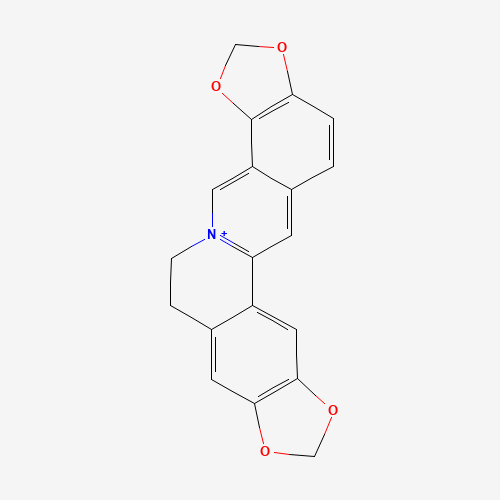
Coptisine is a natural product found in Coptis japonica. It has a role as a metabolite.
科学粮草官-词典编辑部,修订于:2026-07-06
Toxicity
ToxicityFate Summary
ATMOSPHERIC FATE: According to a model of gas/particle partitioning of semivolatile organic compounds in the atmosphere(1), coptisine, which has an estimated vapor pressure of 1.1X10⁻⁹ mm Hg at 25 °C(SRC), determined from a fragment constant method(2), is expected to exist solely in the particulate phase in the ambient atmosphere. Particulate-phase coptisine may be removed from the air by wet and dry deposition(SRC). Coptisine contains chromophores that absorb at wavelengths >290 nm(3) and, therefore, may be susceptible to direct photolysis by sunlight(SRC).
Soil Adsorption / Mobility
Using a structure estimation method based on molecular connectivity indices(1), the Koc of coptisine can be estimated to be 270,000(SRC). According to a classification scheme(2), this estimated Koc value suggests that coptisine is expected to be immobile in soil.
Environmental Bioconcentration
An estimated BCF of 3 was calculated in fish for coptisine(SRC), using an estimated log Kow of 2.5(1) and a regression-derived equation(1). According to a classification scheme(2), this BCF suggests the potential for bioconcentration in aquatic organisms is low(SRC).
Volatilization from Water / Soil
The Henry's Law constant for coptisine is estimated as 7.4X10⁻¹⁹ atm-cu m/mole(SRC) using a fragment constant estimation method(1). This Henry's Law constant indicates that coptisine is expected to be essentially nonvolatile from water and moist soil surfaces(2). Coptisine is not expected to volatilize from dry soil surfaces(SRC) based upon an estimated vapor pressure of 1.1X10⁻⁹ mm Hg(SRC), determined from a fragment constant method(1).
Environmental Abiotic Degradation
Coptisine is not expected to undergo hydrolysis in the environment due to the lack of functional groups that hydrolyze under environmental conditions(1). Coptisine contains chromophores that absorb at wavelengths >290 nm(1) and, therefore, may be susceptible to direct photolysis by sunlight(SRC).
Plant Concentrations
[Table#8338]: IkdlbnVzIHNwZWNpZXMiLCJGYW1pbHkiLCJDb21tb24gbmFtZShzKSIsIlBhcnQiCiJBcmdlbW9uZSBtZXhpY2FuYSIsIlBhcGF2ZXJhY2VhZSIsIlByaWNrbHkgUG9wcHkiLCJTZWVkIgoiQ2hlbGlkb25pdW0gbWFqdXMiLCJQYXBhdmVyYWNlYWUiLCJDZWxhbmRpbmUiLCJQbGFudCIKIkNvcHRpcyBqYXBvbmljYSIsIlJhbnVuY3VsYWNlYWUiLCJIdWFuZy1MaWVuLCBIdWFuZy1MaWE7IEh1YW5nLUxpYW47IEphcGFuZXNlIEdvbGR0aHJlYWQiLCJSaGl6b21lIgoiQ29wdGlzIGNoaW5lbnNpcyIsIlJhbnVuY3VsYWNlYWUiLCJDaGluZXNlIEdvbGR0aHJlYWQ7IEh1YW5nLUxpZW47IEh1YW5nLUxpYW4iLCJSaGl6b21lIgoiQ29wdGlzIHNwcCIsIlJhbnVuY3VsYWNlYWUiLCJHZW5lcmljIEdvbGR0aHJlYWQiLCJSaGl6b21lIgoiQ29yeWRhbGlzIHNwcCIsIlBhcGF2ZXJhY2VhZSIsIkZ1bWV3b3J0IiwiUmhpem9tZSIKIkVzY2hzY2hvbHppYSBjYWxpZm9ybmljYSIsIlBhcGF2ZXJhY2VhZSIsIkNhbGlmb3JuaWEgUG9wcHkiLCJTdGVtLCBSb290LCBMZWFmIgoiTWFjbGVheWEgY29yZGF0YSIsIlBhcGF2ZXJhY2VhZSIsIlBsdW0gUG9...
Natural Pollution Sources
Coptisine is a constituent present in a number of plant families including Papaveraceae, Ranunculaceae and Berberidaceae(1). It is from the root of Coptis japonica Makino (Ranunculaceae)(1,2) and also C. chinensis Franch(3).
Artificial Pollution Sources
Coptisine's production and use as an anti-inflammatory medication(1) may result in its release to the environment through various waste streams(SRC).
Probable Routes of Human Exposure
Occupational exposure to coptisine may occur through dermal contact with this compound at workplaces where coptisine is extracted or used. Use data indicate that the general population may be exposed to coptisine via its medicinal use. (SRC)
Environmental Fate / Exposure Summary
Coptisine's production and use as an anti-inflammatory medication may result in its release to the environment through various waste streams. Coptisine is a constituent present in a number of plant families including: Papaveraceae, Ranunculaceae and Berberidaceae. If released to air, an estimated vapor pressure of 1.1X10⁻⁹ mm Hg at 25 °C indicates coptisine will exist solely in the particulate phase in the atmosphere. Particulate-phase coptisine will be removed from the atmosphere by wet and dry deposition. Coptisine contains chromophores that absorb at wavelengths >290 nm and, therefore, may be susceptible to direct photolysis by sunlight. If released to soil, coptisine is expected to have no mobility based upon an estimated Koc of 270,000. Volatilization from moist soil surfaces is no...
Toxicity Summary
IDENTIFICATION AND USE: Coptisine, a cytotoxic alkaloid found in Chinese goldthread, is related to berberine. It is used in biochemical studies and has been tested as experimental therapy. HUMAN EXPOSURE AND TOXICITY: Cytotoxicity evaluation of coptisine was conducted on a panel of human and murine cell lines in comparison with the established antitumor drugs mitoxantrone, doxorubicin (Dx), and cisplatin (CDDP). Coptisine was cytotoxic on LoVo and HT-29 and less potent on L-1210, and it was partially crossresistant on the human tumor colon cell line resistant to Dx, LoVo/Dx, whereas it was not significantly crossresistant on the murine leukemia cell line resistant to CDDP, L-1210/CDDP. Coptisine prevents vascular smooth muscle cell proliferation selectively at lower concentrations compa...
Human Toxicity Excerpts
/ALTERNATIVE and IN VITRO TESTS/ To study the effect of cholesterol and 25-OH-cholesterol on cholesterol metabolism in HepG2 cells and the effect of coptisine (Cop) extracted from Coptidis Rhizoma (CR) in reducing and regulating cholesterol. In this study, TC, TG, LDL-c, and HDL-c were measured by biochemical analysis; mRNA and protein expressions of LDLR, HMGCR, and CYP7A1 were detected by qRT-PCR and Western blot. According to the results, cholesterol and 25-OH-cholesterol inducing could decrease in mRNA and protein expressions of LDLR and CYP7A1, so as to increase TC and LDL-c contents. However, Cop could up-regulate mRNA and protein expressions of LDLR and CYP7A1 and down-regulate that of HMGCR, so as to reduce TC and LDL-c levels. These findings suggested that Cop has potential pha...
Non-Human Toxicity Values
LD50 Mice oral 852.12 mg/kg
Non-Human Toxicity Excerpts
/ALTERNATIVE and IN VITRO TESTS/ The crude extract (80% MeOH in water) of Chelidonii herba exhibited very interesting cytotoxicity against brine shrimp (Artemia salina Leach) nauplii and cultured human tumor cell in vitro, the colon carcinoma HT 29 (144 hr treatment). Fractionation of the crude extract and bioassay-guided procedures showed that the cytotoxic and the antitumor activities were concentrated in the basic extract. On the basis of IR, MS, and (1)H NMR the compound responsible of the cytotoxic activity was determined to be coptisine. Cytotoxicity evaluation of coptisine was next extended to a panel of human and murine cell lines in comparison with the established antitumor drugs mitoxantrone, doxorubicin (Dx) and cisplatin (CDDP). Coptisine was cytotoxic on LoVo and HT-29 and...
Antidote and Emergency Treatment
/SRP:/ Advanced treatment: Consider orotracheal or nasotracheal intubation for airway control in the patient who is unconscious, has severe pulmonary edema, or is in severe respiratory distress. Positive-pressure ventilation techniques with a bag-valve-mask device may be beneficial. Consider drug therapy for pulmonary edema ... . Consider administering a beta agonist such as albuterol for severe bronchospasm ... . Monitor cardiac rhythm and treat arrhythmias as necessary ... . Start IV administration of D5W TKO. Use 0.9% saline (NS) or lactated Ringer's (LR) if signs of hypovolemia are present. For hypotension with signs of hypovolemia, administer fluid cautiously. Watch for signs of fluid overload ... . Treat seizures with diazepam (Valium) or lorazepam (Ativan) ... . Use proparacaine...