


 一键配货
一键配货
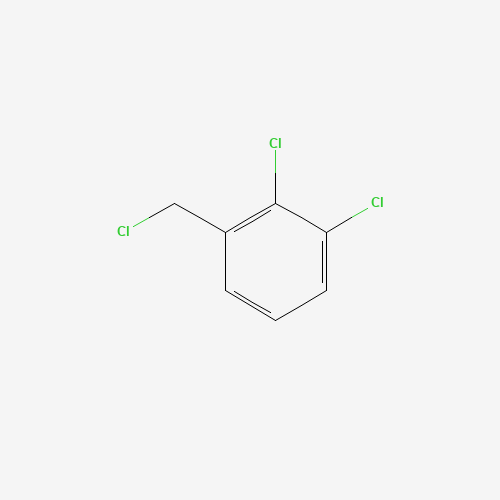
化合物详情
CAS3290-01-5
分子式C7H5Cl3
分子量195.47 g/mol
非危品
科学粮草官-词典编辑部,修订于:2026-07-06
Toxicity
ToxicityFate Summary
ATMOSPHERIC FATE: According to a model of gas/particle partitioning of semivolatile organic compounds in the atmosphere(1), dichlorobenzyl chloride, which has estimated vapor pressures for the six isomers ranging from 0.024 to 0.033 mm Hg at 25 °C(2,SRC), is expected to exist solely as a vapor in the ambient atmosphere. Vapor-phase dichlorobenzyl chloride is degraded in the atmosphere by reaction with photochemically-produced hydroxyl radicals(SRC); estimated half-lives for this reaction in air range from 12 to 21 days for the six isomers(3,SRC).
Soil Adsorption / Mobility
Using a structure estimation method based on molecular connectivity indices(1), the Koc for dichlorobenzyl chloride can be estimated to be about 1,400(SRC). According to a classification scheme(2), this estimated Koc value suggests that dichlorobenzyl chloride is expected to have low mobility in soil(SRC). Hydrolysis of dichlorobenzyl chloride is expected in moist soils(SRC), based upon a reported hydrolysis half-life of 15 hours for the structural analog benzyl chloride(3).
Environmental Bioconcentration
Based upon the rapid hydrolysis of the structurally similar benzyl chloride in aqueous environments(1), bioconcentration of dichlorobenzyl chloride in aquatic organisms is not expected to be an important fate process(SRC).
Volatilization from Water / Soil
Based upon the rapid hydrolysis of the structurally similar benzyl chloride in aqueous environments(1), volatilization of dichlorobenzyl chloride from water and moist soil surfaces is not expected to be an important fate process(SRC). Dichlorobenzyl chloride is not expected to volatilize from dry soil surfaces based upon estimated vapor pressure for the six isomers ranging from 0.024 to 0.033 mm Hg(SRC), determined from a fragment constant method(2).
Environmental Abiotic Degradation
Rate constants, estimated using a structure estimation method(1), for the vapor-phase reaction of the six isomers of dichlorobenzyl chloride with photochemically-produced hydroxyl radicals range from 7.8X10⁻¹³ to 1.4X10⁻¹² cu cm/molecule-sec at 25 °C(SRC). These rate constants correspond to atmospheric half-lives ranging from 12 to 21 days at an atmospheric concentration of 5X10+5 hydroxyl radicals per cu cm(1,SRC). Hydrolysis is expected to be an important removal process(SRC), based upon a reported hydrolysis half-life of 15 hours at 25 °C and pH 7 for the structural analog benzyl chloride(2).
Artificial Pollution Sources
Dichlorobenzyl chloride's production and use as an intermediate for organic chemicals, pharmaceuticals, and dyes, and as an insecticide(1) may result in its release to the environment through various waste streams(SRC).
Probable Routes of Human Exposure
Occupational exposure to dichlorobenzyl chloride may occur through inhalation and dermal contact with this compound at workplaces where dichlorobenzyl chloride is produced or used. (SRC)
Environmental Fate / Exposure Summary
Dichlorobenzyl chloride's production and use as an intermediate for organic chemicals, pharmaceuticals, and dyes, and as an insecticide intermediate may result in its release to the environment through various waste streams. If released to air, estimated vapor pressures for the six isomers range from 0.024 to 0.033 mm Hg at 25 °C indicating dichlorobenzyl chloride will exist solely as a vapor in the ambient atmosphere. Vapor-phase dichlorobenzyl chloride will be degraded in the atmosphere by reaction with photochemically-produced hydroxyl radicals; estimated half-lives for this reaction in air range from 12 to 21 days for the six isomers. If released to soil, dichlorobenzyl chloride is expected to hydrolyze in moist soils. Adsorption and volatilization from soil are not expected to be i...
Non-Human Toxicity Values
LD50 Rat male oral 1080 mg/kg
Non-Human Toxicity Excerpts
It is a moderate irritant to rabbit eyes - According to Draize Test
Populations at Special Risk
/Individuals who suffer from/ skin, liver, kidney, or chronic respiratory disease, will be at an increased risk if they are exposed to chlorobenzenes. /Chlorobenzenes/









