


 一键配货
一键配货
化合物详情
CAS4151-50-2
分子式C10H6F17NO2S
分子量527.2 g/mol
危化品
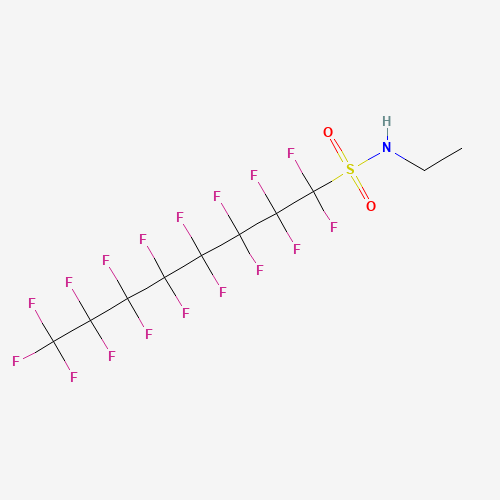
Sulfluramid is a sulfonamide obtained by the formal condensation of perfluorooctane-1-sulfonic acid with ethylamine. It has a role as an acaricide, an insecticide, a xenobiotic and an environmental contaminant. It is functionally related to an ethylamine and a perfluorooctane-1-sulfonic acid.
科学粮草官-词典编辑部,修订于:2026-07-06
Toxicity
ToxicityBody Burden
UNREVIEWED | Sulfluramid was not detected (<0.050 ng/mL) in 24 pooled serum samples from men, age 40 to 50 years, representing 1977 to 2006(1).
EPA Ecotoxicity
Pesticide Ecotoxicity Data from EPA: 12
Ecotoxicity Values
LD50; Species: Colinus virginianus (Bobwhite quail) oral 473 mg/kg
Fate Summary
ATMOSPHERIC FATE: According to a model of gas/particle partitioning of semivolatile organic compounds in the atmosphere(1), sulfluramid, which has a vapor pressure of 4.28X10⁻⁷ mm Hg at 25 °C(2), will exist in both the vapor and particulate phases in the ambient atmosphere. Vapor-phase sulfluramid is degraded in the atmosphere by reaction with photochemically-produced hydroxyl radicals(SRC); the half-life for this reaction in air is estimated to be 1.8 days(SRC), calculated from its rate constant of 8.8X10⁻¹² cu cm/molecule-sec at 25 °C(SRC) that was derived using a structure estimation method(3). Particulate-phase sulfluramid may be removed from the air by wet or dry deposition(SRC). The maximum absorption for sulfluramid is near 204 nm(4) and, therefore, is not expected to be suscepti...
Soil Adsorption / Mobility
Using a structure estimation method based on molecular connectivity indices(1), the Koc of sulfluramid can be estimated to be 7.9X10+5(SRC). According to a classification scheme(2), this estimated Koc value suggests that sulfluramid is expected to be immobile in soil(SRC).
Environmental Biodegradation
As a class, perfluorinated organic compounds, such as sulfluramid, are resistant to microbial degradation(1). Similar to other perfluorinated sulfonamide derivatives, the potential exists for the conversion of the sulfonamide functional group to a sulfonic acid functional group via microbially-mediated hydrolysis(2). However, sulfonamides cannot be characterized as readily biodegradable(3).
Environmental Bioconcentration
An estimated BCF of 1.3X10+4 was calculated in fish for sulfluramid(SRC), using an estimated log Kow of 6.8(1) and a regression-derived equation(2). According to a classification scheme(3), this BCF suggests the potential for bioconcentration in aquatic organisms is very high(SRC), provided the compound is not metabolized by the organism(SRC).
Volatilization from Water / Soil
The Henry's Law constant for sulfluramid is estimated as 5.4 atm-cu m/mole(SRC) using a fragment constant estimation method(1). This Henry's Law constant indicates that sulfluramid is expected to volatilize rapidly from water surfaces(2). Based on this Henry's Law constant, the volatilization half-life from a model river (1 m deep, flowing 1 m/sec, wind velocity of 3 m/sec)(2) is estimated as 6.7 hours(SRC). The volatilization half-life from a model lake (1 m deep, flowing 0.05 m/sec, wind velocity of 0.5 m/sec)(2) is estimated as 9.1 days(SRC). However, volatilization from water surfaces is expected to be attenuated by adsorption to suspended solids and sediment in the water column. The volatilization half-life from a model pond is about 24 years when adsorption is considered(3). Sulfl...
Environmental Abiotic Degradation
The rate constant for the vapor-phase reaction of sulfluramid with photochemically-produced hydroxyl radicals has been estimated as 8.8X10⁻¹² cu cm/molecule-sec at 25 °C(SRC) using a structure estimation method(1). This corresponds to an atmospheric half-life of about 1.8 days at an atmospheric concentration of 5X10+5 hydroxyl radicals per cu cm(1). Hydrolysis is not expected to be an important environmental fate process since due to the presence of high-energy carbon-fluorine bonds(2). The maximum absorption for sulfluramid is near 204 nm(3) and, therefore, is not expected to be susceptible to direct photolysis by sunlight(SRC).
Environmental Water Concentrations
SEAWATER: Perfluoroalkyl acids are ubiquitous contaminants of marine as well as freshwater and terrestrial, environments. The slow and long-range transport from source areas in the Northern Hemisphere is suggested as one of the major pathways contributing to perfluoroalkyl acid conamination in remote marine environments(1). /Perfluoroalkylacids/
Animal Concentrations
Sulfluramid was detected in five narwhal (Monodon monoceros) and five beluga whales (Delphinapterus leucas) sampled from the Arctic at 0.5-6.9 and 0.1-11.7 ng/g wet weight, respectively(1).
Atmospheric Concentrations
INDOOR: Sulfluramid was detected in 40 indoor air samples from Oslo, Norway households at 0.30 to 95 pg/cu m(1). Sulfluramid was detected in 52 of 59 indoor air samples collected the winter of 2002 to 2003 from homes in Ottawa, Canada at concentrations of 5.94 to 646 pg/cu m(2).
Fish/Seafood Concentrations
Sulfluramid was detected in five zooplankton, five clam (Mya truncata; Serripes groenlandica, five shrimp (Pandalus borealis; Hymenodora glacialis) and three Arctic cod (Boreogadus saida) samples at not detected to 0.65, 1.9 to 85.9, not detected to 44.8 and 9.6 to 144.6 ng/g, respectively(1). Sulfluramid was not detected in redfish (Sebastes mentella). Fish and shrimp samples were collected from Davis Strait, Nunavut, Canada, Oct of 2000 and 2001(1). Clams and zooplankton samples were collected from Frobisher Bay, Nunavut, Canada, May 2002(1).
Artificial Pollution Sources
Sulfluramid's production may result in its release to the environment through various waste streams; its use as an insecticide(1) will result in its direct release to the environment(SRC).
Probable Routes of Human Exposure
Occupational exposure to sulfluramid may occur through inhalation and dermal contact with this compound at workplaces where sulfluramid is produced or used. Monitoring data indicate that the general population may be exposed to sulfluramid via inhalation of ambient air and ingestion of food. (SRC)
Other Environmental Concentrations
Sulfluramid was detected in 41 dust samples from Norwegian households at 0.26 to 33 ng/g(1). Sulfluramid was not detected in 66 dust samples from households in Ottawa, Canada, samples were collected the winter of 2002 to 2003(2).
Environmental Fate / Exposure Summary
Sulfluramid's production may result in its release to the environment through various waste streams; its use as an insecticide will result in its direct release to the environment. If released to air, a vapor pressure of 4.28X10⁻⁷ mm Hg at 25 °C indicates sulfluramid will exist in both the vapor and particulate phases in the atmosphere. Vapor-phase sulfluramid will be degraded in the atmosphere by reaction with photochemically-produced hydroxyl radicals; the half-life for this reaction in air is estimated to be 1.8 days. Particulate-phase sulfluramid will be removed from the atmosphere by wet or dry deposition. The maximum absorption for sulfluramid is near 204 nm and, therefore, is not expected to be susceptible to direct photolysis by sunlight. If released to soil, sulfluramid is expe...
Effect Level
collection=toxvaldb&kind=^EL$
Lethal Dose
collection=toxvaldb&kind=^LD$
Toxicity Data
LC50 (rat) > 4,400 mg/m3/4h
Non-Human Toxicity Values
LD50 Rat dermal 1250mg/kg
Reference and Risk Values
collection=toxvaldb&kind=^RRV$
Non-Human Toxicity Excerpts
/GENOTOXICITY/ Under the conditions of this assay, OX-071 /sulfluramid/ was found to be negative for induction of sister chromatid exchange in Chinese Hamster ovary cells, both with and without metabolic activation, at concentrations up to 1000 ug/mL. However, this top concentration did not result in at least a 50% reduction in the second mitosis.
Evidence for Carcinogenicity
Cancer Classification: No Data Available
Antidote and Emergency Treatment
/SRP:/ Advanced treatment: Consider orotracheal or nasotracheal intubation for airway control in the patient who is unconscious, has severe pulmonary edema, or is in severe respiratory distress. Positive-pressure ventilation techniques with a bag valve mask device may be beneficial. Consider drug therapy for pulmonary edema ... . Consider administering a beta agonist such as albuterol for severe bronchospasm ... . Monitor cardiac rhythm and treat arrhythmias as necessary ... . Start IV administration of D5W /SRP: "To keep open", minimal flow rate/. Use 0.9% saline (NS) or lactated Ringer's if signs of hypovolemia are present. For hypotension with signs of hypovolemia, administer fluid cautiously. Watch for signs of fluid overload ... . Treat seizures with diazepam or lorazepam ... . Use...









