


 一键配货
一键配货
化合物详情
CAS4373-41-5
分子式C30H48O4
分子量472.7 g/mol g/mol
非危品
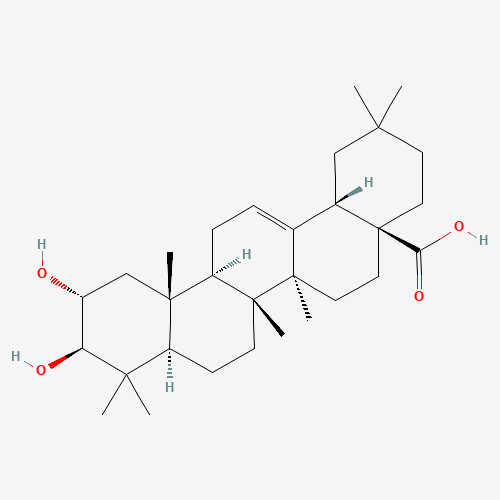
Maslinic acid is a pentacyclic triterpenoid that is olean-12-ene substituted by hydroxy groups at positions 2 and 3 and a carboxy group at position 28 (the 2alpha,3beta stereoisomer). It is isolated from Olea europaea and Salvia canariensis and exhibits anti-inflammatory, antioxidant and antineoplastic activity. It has a role as an antioxidant, an antineoplastic agent, an anti-inflammatory agent and a plant metabolite. It is a pentacyclic triterpenoid and a dihydroxy monocarboxylic acid. It derives from a hydride of an oleanane.
科学粮草官-词典编辑部,修订于:2026-07-06
Toxicity
ToxicityFate Summary
ATMOSPHERIC FATE: According to a model of gas/particle partitioning of semivolatile organic compounds in the atmosphere(1), maslinic acid, which has an estimated vapor pressure of 2.3X10⁻¹⁵ mm Hg at 25 °C(SRC), determined from a fragment constant method(2), is expected to exist solely in the particulate phase in the ambient atmosphere. Particulate-phase maslinic acid may be removed from the air by wet and dry deposition(SRC).
Soil Adsorption / Mobility
The Koc of maslinic acid is estimated as 1270(SRC), using an estimated log Kow of 6.82(1) and a regression-derived equation appropriate for an ionizable compound(1). According to a classification scheme(2), this estimated Koc value suggests that maslinic acid is expected to have low mobility in soil. The estimated pKa of maslinic acid is 4.81(3), indicating that this compound will exist partially in anion form in the environment and anions generally do not adsorb more strongly to soils containing organic carbon and clay than their neutral counterparts(4).
Environmental Bioconcentration
An estimated BCF of 56 was calculated in fish for maslinic acid(SRC) using an estimated log Kow of 6.82(1) and a regression-derived equation(1). According to a classification scheme(2), this BCF suggests the potential for bioconcentration in aquatic organisms is moderate(SRC).
Volatilization from Water / Soil
The Henry's Law constant for maslinic acid is estimated as 3.5X10⁻¹¹ atm-cu m/mole(SRC) using a fragment constant estimation method(1). This Henry's Law constant indicates that maslinic acid is expected to be essentially nonvolatile from water surfaces(2). Maslinic acid's Henry's Law constant indicates that volatilization from moist soil surfaces is not expected to occur(SRC). Maslinic acid is not expected to volatilize from dry soil surfaces(SRC) based upon an estimated vapor pressure of 2.3X10⁻¹⁵ mm Hg(SRC) determined from a fragment constant method(1).
Environmental Abiotic Degradation
The rate constant for the vapor-phase reaction of maslinic acid with photochemically-produced hydroxyl radicals has been estimated as 1.3X10⁻¹⁰ cu cm/molecule-sec at 25 °C(SRC) using a structure estimation method(1). This corresponds to an atmospheric half-life of about 3 hours at an atmospheric concentration of 5X10+5 hydroxyl radicals per cu cm(1). Maslinic acid is not expected to undergo hydrolysis in the environment due to the lack of functional groups that hydrolyze under environmental conditions(2). Maslinic acid contains a cyclic olefin and cyclic olefins can undergo sensitized photo-oxidation in surface waters exposed to sunlight via reaction with hydroxyl, singlet oxygen and RO2 radicals with half-lives on the order of 13 to 40 days at the water surface(3); therefore, photo-oxi...
Plant Concentrations
The occurrence of triterpene pentacyclic acids in plants is extensive, but little is known about their availability in commercial extracts. A simple GC-MS method for the simultaneous determination of betulinic, corosolic, maslinic, oleanolic and ursolic acids was developed and applied to 38 different commercial plant extracts sold as ingredients for dietary supplements. ... Lagerstroemia speciosa was rich in maslinic acid (4958 mg/kg) ... Lower quantities of triterpenic acids were identified in dried extracts of Harpagophyton procumbens root, propolis, Punica granatum root, Styrax benzoin, Vaccinium myrtillus fruits and Vitis vinifera seeds. Decoctions and fluid extracts lacked or contained very low amounts of triterpenic acids. ...
Natural Pollution Sources
Maslinic acid is found in a number of natural sources, most notably pomace olive oil (orujo)(1). Maslinic acid occurs in red dates, olives, camellia, pomegranate and sage(2).
Artificial Pollution Sources
Maslinic acid's production and use as a dietary supplement and as an ingredient in consumer products such as olive oil and skin care lotion products(1) may result in its release to the environment through various waste streams(SRC).
Probable Routes of Human Exposure
Occupational exposure to maslinic acid may occur through dermal contact with this compound at workplaces where maslinic acid is produced or used. The general population is exposed to maslinic acid via ingestion of dietary supplements and foods containing maslinic acid, especially olive oil, and dermal contact with this compound in consumer products containing maslinic acid such skin care lotion products. (SRC)
Environmental Fate / Exposure Summary
Maslinic acid's production and use as a dietary supplement and as an ingredient in consumer products such as olive oil and skin care lotion products may result in its release to the environment through various waste streams. Maslinic acid is found in a number of natural sources, most notably pomace olive oil, and other plants such as red dates, camellia, pomegranate and sage. If released to air, an estimated vapor pressure of 2.3X10⁻¹⁵ mm Hg at 25 °C indicates maslinic acid will exist solely in the particulate phase in the atmosphere. Particulate-phase maslinic acid will be removed from the atmosphere by wet and dry deposition. If released to soil, maslinic acid is expected to have low mobility based upon an estimated Koc of 1760. The pKa of maslinic acid is 4.81, indicating that this c...
Human Toxicity Excerpts
/ALTERNATIVE and IN VITRO TESTS/ Bioactivity-guided fractionation of apple peels was used to determine the chemical identity of bioactive constituents. Thirteen triterpenoids were isolated, and their chemical structures were identified. Antiproliferative activities of the triterpenoids against human HepG2 liver cancer cells, MCF-7 breast cancer cells, and Caco-2 colon cancer cells were evaluated. Most of the triterpenoids showed high potential anticancer activities against the three human cancer cell lines... All triterpenoids tested showed antiproliferative activity against Caco-2 cancer cells, especially 2alpha-hydroxyursolic acid, maslinic acid, 2alpha-hydroxy-3beta-{[(2E)-3-phenyl-1-oxo-2-propenyl]oxy}olean-12-en-28-oic acid, and 3beta-trans-p-coumaroyloxy-2alpha-hydroxyolean-12-en-...
Non-Human Toxicity Excerpts
/LABORATORY ANIMALS: Chronic Exposure or Carcinogenicity/ Maslinic acid (MA) is a pentacyclic triterpene used as a feed additive to stimulate growth, protein-turnover rates, and hyperplasia in fish. To further our understanding of cellular mechanisms underlying the action of MA, /the authors/ have used 2-DE coupled with MS to identify proteins differentially expressed in the livers of juvenile gilthead sea bream (Sparus aurata) grown under fish-farm conditions and fed with a 100 mg/kg MA-enriched diet (MA100) /for 210 days/. After the comparison of the protein profiles from MA100 fed fish and from control, 49 protein spots were found to be altered in abundance (> or = 2-fold). Analysis by MALDI-TOF/TOF allowed the unambiguous identification of 29 spots, corresponding to 19 different pro...
Antidote and Emergency Treatment
/SRP:/ Advanced treatment: Consider orotracheal or nasotracheal intubation for airway control in the patient who is unconscious, has severe pulmonary edema, or is in severe respiratory distress. Positive-pressure ventilation techniques with a bag valve mask device may be beneficial. Consider drug therapy for pulmonary edema ... . Consider administering a beta agonist such as albuterol for severe bronchospasm ... . Monitor cardiac rhythm and treat arrhythmias as necessary ... . Start IV administration of D5W /SRP: "To keep open", minimal flow rate/. Use 0.9% saline (NS) or lactated Ringer's if signs of hypovolemia are present. For hypotension with signs of hypovolemia, administer fluid cautiously. Watch for signs of fluid overload ... . Treat seizures with diazepam or lorazepam ... . Use...









