


 一键配货
一键配货
化合物详情
CAS77-53-2
分子式C15H26O
分子量222.37 g/mol g/mol
危化品
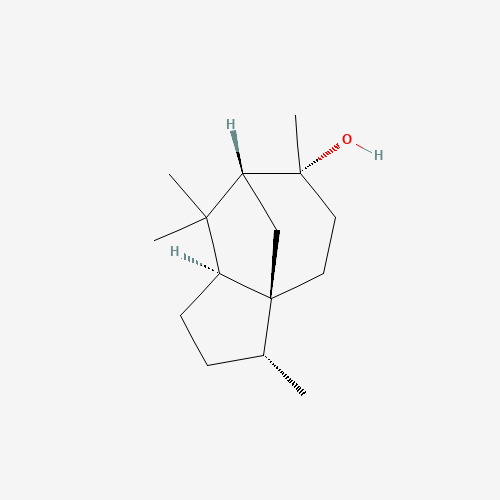
Cedrol is a tertiary alcohol and a cedrane sesquiterpenoid.
科学粮草官-词典编辑部,修订于:2026-07-06
Toxicity
ToxicityFate Summary
ATMOSPHERIC FATE: According to a model of gas/particle partitioning of semivolatile organic compounds in the atmosphere(1), cedrol, which has an estimated vapor pressure of 8.6X10⁻⁵ mm Hg at 25 °C(SRC), determined from a fragment constant method(2), will exist in both the vapor and particulate phases in the ambient atmosphere. Vapor-phase cedrol is degraded in the atmosphere by reaction with photochemically-produced hydroxyl radicals(SRC); the half-life for this reaction in air is estimated to be 19 hours(SRC), calculated from its rate constant of 2.0X10⁻¹¹ cu cm/molecule-sec at 25 °C(SRC) that was derived using a structure estimation method(2). Particulate-phase cedrol may be removed from the air by wet and dry deposition(SRC). Cedrol does not contain chromophores that absorb at wavele...
Soil Adsorption / Mobility
Using a structure estimation method based on molecular connectivity indices(1), the Koc of cedrol can be estimated to be 1230(SRC). According to a classification scheme(2), this estimated Koc value suggests that cedrol is expected to have low mobility in soil.
Environmental Biodegradation
AEROBIC: Cedrol, present at 100 mg/L, reached 88% of its theoretical BOD in 4 weeks using a sludge inoculum at 30 mg/L in the OECD 301F method (Manometric Respirometry) which classifies cedrol as readily biodegradable; a primary half-life of 2.9 days was determined from the screening results(1).
Environmental Bioconcentration
An estimated BCF of 330 was calculated in fish for cedrol(SRC), using an estimated log Kow of 4.33(1) and a regression-derived equation(1). According to a classification scheme(2), this BCF suggests the potential for bioconcentration in aquatic organisms is high, provided the compound is not metabolized by the organism(SRC).
Volatilization from Water / Soil
The Henry's Law constant for cedrol is estimated as 1.8X10⁻⁶ atm-cu m/mole(SRC) using a fragment constant estimation method(1). This Henry's Law constant indicates that cedrol is expected to volatilize from water surfaces(2). Based on this Henry's Law constant, the volatilization half-life from a model river (1 m deep, flowing 1 m/sec, wind velocity of 3 m/sec)(2) is estimated as 31 days(SRC). The volatilization half-life from a model lake (1 m deep, flowing 0.05 m/sec, wind velocity of 0.5 m/sec)(2) is estimated as 230 days(SRC). Cedrol's Henry's Law constant indicates that volatilization from moist soil surfaces may occur(SRC). Cedrol is not expected to volatilize from dry soil surfaces(SRC) based upon an estimated vapor pressure of 8.6X10⁻⁵ mm Hg at 25 °C(SRC), determined from a frag...
Environmental Abiotic Degradation
The rate constant for the vapor-phase reaction of cedrol with photochemically-produced hydroxyl radicals has been estimated as 2.0X10⁻¹¹ cu cm/molecule-sec at 25 °C(SRC) using a structure estimation method(1). This corresponds to an atmospheric half-life of about 19 hours at an atmospheric concentration of 5X10+5 hydroxyl radicals per cu cm(1). Cedrol is not expected to undergo hydrolysis in the environment due to the lack of functional groups that hydrolyze under environmental conditions(2). Cedrol does not contain chromophores that absorb at wavelengths >290 nm(2) and, therefore, is not expected to be susceptible to direct photolysis by sunlight(SRC).
Plant Concentrations
[Table#8249]: IkdlbnVzIHNwZWNpZXMiLCJGYW1pbHkiLCJDb21tb24gbmFtZSIsIlBhcnQiLCJDb25jbiAocHBtKSIKIkp1bmlwZXJ1cyBjb21tdW5pcyBMLiIsIkN1cHJlc3NhY2VhZSIsIkNvbW1vbiBKdW5pcGVyLCBKdW5pcGVyIiwiTGVhZiIsIjIsMTAwIgoiU2F0dXJlamEgb2RvcmEgKEdSSVMuKSBFUEwuIiwiTGFtaWFjZWFlIiwiU2NlbnRlZCBQYW1wYSBTYXZvcnkiLCJTaG9vdCIsIjAtNTI1IgoiSnVuaXBlcnVzIGNvbW11bmlzIEwuIiwiQ3VwcmVzc2FjZWFlIiwiQ29tbW9uIEp1bmlwZXIsIEp1bmlwZXIiLCJXb29kIiwiMjAwIgoiQWxveXNpYSBjaXRyb2RvcmEgUEFMQVUiLCJWZXJiZW5hY2VhZSIsIkxlbW9uIFZlcmJlbmEiLCJQbGFudCIsIjciCiJUZXVjcml1bSBveHlsZXBpcyBzdWJzcC4gbWFyaWFudW0gUlVJWiBERSBMQSBUT1JSRSIsIkxhbWlhY2VhZSIsIiIsIlNob290IiwiMC0xLjY1IgoiVGV1Y3JpdW0gb3h5bGVwaXMgc3Vic3AuIG94eWxlcGlzIiwiTGFtaWFjZWFlIiwiIiwiU2hvb3QiLCJub3QgcmVwb3J0ZWQiCiJUZXVjcml1bSBzYWx2aWFzdHJ1bSBTQ0hSRUJFUiIsIkxhbWlhY2VhZSIsIiIsIlNob290Iiwibm90IHJ...
Natural Pollution Sources
Cedrol occurs naturally in the wood of several conifers, particularly cypress and cedar (Cedrus atlantica, Cupressus sempervirens, Juniperus virginiana and others)(1). Cedrol occurs naturally in cedar wood oil from Texas (Juniperus mexicana) and China (Cupressus funebris)(2).
Artificial Pollution Sources
Cedrol's production and use as a feedstock for the manufacture of perfumery compounds(1) and use as a flavoring compound in foods(2) may result in its release to the environment through various waste streams(SRC). Its use as a perfumery compound and odorant for disinfectants(3) will result in its direct release to the environment(SRC).
Probable Routes of Human Exposure
NIOSH (NOES Survey 1981-1983) has statistically estimated that 6,301 workers (4,257 of these were female) were potentially exposed to cedrol in the US(1). Occupational exposure to cedrol may occur through inhalation and dermal contact with this compound at workplaces where cedrol is produced or used. Monitoring and use data indicate that the general population may be exposed to cedrol via inhalation of ambient air, ingestion of food, and dermal contact with consumer products containing cedrol(SRC).
Other Environmental Concentrations
Cedrol was detected in the emissions from the burning of incense(1); concentration in the emissions and backround air ranged from 299-1080 pg/cu m(1). Cedrol was identified in the volatile biogenic emissions from pine trees(2). Cedrol was identified as a volatile emission compound emitted by microbial activity of Penicillium italicum, a fungi commonly found in indoor environments(3). Cedrol was identified in the volatile emissions of leaves from Juniperus excelsa plant(4). The compound is found in Texas and Virginia cedarwood oil, present at 19.0 and 15.8%, respectively(5).
Environmental Fate / Exposure Summary
Cedrol's production and use as a feedstock for the manufacture of perfumery compounds and use as a flavoring compound in foods may result in its release to the environment through various waste streams. Its use as a perfumery compound and odorant for disinfectants will result in its direct release to the environment. Cedrol occurs naturally in cedarwood oil and cypress wood oil. If released to air, an estimated vapor pressure of 8.6X10⁻⁵ mm Hg at 25 °C indicates cedrol will exist in both the vapor and particulate phases in the atmosphere. Vapor-phase cedrol will be degraded in the atmosphere by reaction with photochemically-produced hydroxyl radicals; the half-life for this reaction in air is estimated to be 19 hours. Particulate-phase cedrol will be removed from the atmosphere by wet a...
Lethal Dose
collection=toxvaldb&kind=^LD$
Toxicity Summary
IDENTIFICATION AND USE: Cedrol forms colorless crystals. It is found in the wood of cypresses and cedars such as Cedrus atlantica, Cupressus sempervirens, and Juniperus virginiana. It is used in fragnances and as a flavor ingredient in foods and traditional medicine. HUMAN EXPOSURE AND TOXICITY: In an exposure study, odorized and blank air was presented to 26 healthy adult volunteers. A constant concentration of cedrol was presented for 10 minutes with 8 minute blank air intervals. Cedrol caused a relaxant effect with decreased heart rate, respiratory rate, systolic and diastolic blood pressure and increased baroreflex activity. Parasympathetic activity was increased and sympathetic activity was decreased. In another exposure study, a maximization test was carried out with 8% cedrol in...
Human Toxicity Excerpts
/ALTERNATIVE and IN VITRO TESTS/ Cedrol, beta-cedrene, and thujopsene are bioactive sesquiterpenes found in cedar essential oil and exert antiseptic, anti-inflammatory, antispasmodic, tonic, astringent, diuretic, sedative, insecticidal, and antifungal activities. These compounds are used globally in traditional medicine and cosmetics. The aim of this study was to investigate the inhibitory effects of cedrol, beta-cedrene, and thujopsene on the activities of eight major human cytochrome P-450 (CYP) enzymes using human liver microsomes to assess potential beta-cedrene-, cedrol-, and thujopsene-drug interactions. Cedrol, beta-cedrene, and thujopsene were found to be potent competitive inhibitors of CYP2B6-mediated bupropion hydroxylase with inhibition constant (Ki) values of 0.9, 1.6, and...
Non-Human Toxicity Values
LD50 Rabbit Dermal > 5g/kg
Non-Human Toxicity Excerpts
/OTHER TOXICITY INFORMATION/ Evidence of microsomal enzyme induction in mice and rats exposed to cedarwood bedding. Animals exhibited reductions in hexobarbitone and pentobarbitone sleeping times and elevated activities of hepatic microsomal enzymes. /Cedarwood bedding/
Antidote and Emergency Treatment
/SRP:/ Advanced Treatment: Consider orotracheal or nasotracheal intubation for airway control in the patient who is unconscious, has severe pulmonary edema, or is in severe respiratory distress. Positive-pressure ventilation techniques, with a bag-valve-mask device, may be beneficial. Consider drug therapy for pulmonary edema ... . Monitor cardiac rhythm and treat arrhythmias as necessary ... . Start IV administration of D5W /SRP: "To keep open", minimal flow rate/. Use 0.9% saline (NS) or lactated Ringer's (LR) if signs of hypovolemia are present. For hypotension with signs of hypovolemia, administer fluid cautiously. Consider vasopressors if patient is hypotensive with a normal fluid volume. Watch for signs of fluid overload ... . Monitor for signs of hypoglycemia (decreased LOC, tach...









