


 一键配货
一键配货
化合物详情
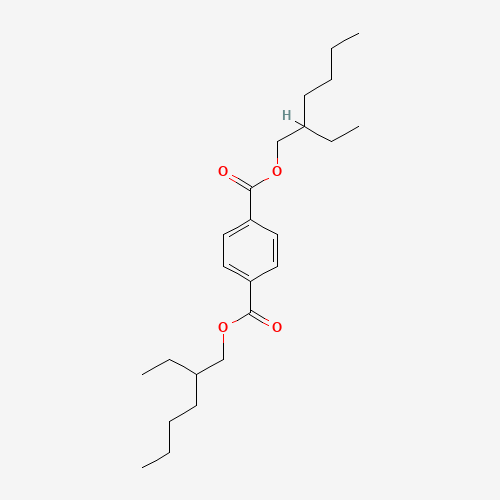
CAS6422-86-2
分子式C24H38O4
分子量390.56 g/mol g/mol
危化品
科学粮草官-词典编辑部,修订于:2026-07-06
Toxicity
ToxicityFate Summary
ATMOSPHERIC FATE: According to a model of gas/particle partitioning of semivolatile organic compounds in the atmosphere(1), bis(2-ethylhexyl) terephthalate, which has an estimated vapor pressure of 2.1X10⁻⁵ mm Hg at 25 °C(SRC), determined from a fragment constant method(2), will exist in both the vapor and particulate phases in the ambient atmosphere. Vapor-phase bis(2-ethylhexyl) terephthalate is degraded in the atmosphere by reaction with photochemically-produced hydroxyl radicals(SRC); the half-life for this reaction in air is estimated to be 18 hours(SRC), calculated from its rate constant of 2.2X10⁻¹¹ cu cm/molecule-sec at 25 °C(SRC) that was derived using a structure estimation method(3). Particulate-phase bis(2-ethylhexyl) terephthalate may be removed from the air by wet or dry d...
Soil Adsorption / Mobility
The Koc of bis(2-ethylhexyl) terephthalate is estimated as 2,000(SRC), using a water solubility of 4 mg/L(1) and a regression-derived equation(2). According to a classification scheme(3), this estimated Koc value suggests that bis(2-ethylhexyl)terephthalate is expected to have slight mobility in soil.
Environmental Biodegradation
Biodegradation data on bis(2-ethylhexyl) terephthalate were not available(SRC, 2008); however, bis(2-ethylhexyl) phthalate, a structurally similar compound, is reported to undergo aerobic(1,2) and possibly anaerobic biodegradation(3,4). Therefore, biodegradation is likely to be an important fate process for bis(2-ethylhexyl) terephthalate.
Environmental Bioconcentration
An estimated BCF of 25 was calculated in fish for bis(2-ethylhexyl) terephthalate(SRC), using an estimated log Kow of 8.39(1) and a regression-derived equation(2). According to a classification scheme(3), this BCF suggests the potential for bioconcentration in aquatic organisms is low(SRC).
Volatilization from Water / Soil
The Henry's Law constant for bis(2-ethylhexyl) terephthalate is estimated as 1.0X10⁻⁵ atm-cu m/mole(SRC) using a fragment constant estimation method(1). This Henry's Law constant indicates that bis(2-ethylhexyl) terephthalate is expected to volatilize from water surfaces(2). Based on this Henry's Law constant, the volatilization half-life from a model river (1 m deep, flowing 1 m/sec, wind velocity of 3 m/sec)(2) is estimated as 7.3 days(SRC). The volatilization half-life from a model lake (1 m deep, flowing 0.05 m/sec, wind velocity of 0.5 m/sec)(2) is estimated as 59 days(SRC). Bis(2-ethylhexyl) terephthalate's Henry's Law constant indicates that volatilization from moist soil surfaces may occur(SRC). Bis(2-ethylhexyl) terephthalate is not expected to volatilize from dry soil surfaces...
Environmental Abiotic Degradation
The rate constant for the vapor-phase reaction of bis(2-ethylhexyl) terephthalate with photochemically-produced hydroxyl radicals has been estimated as 2.2X10⁻¹¹ cu cm/molecule-sec at 25 °C(SRC) using a structure estimation method(1). This corresponds to an atmospheric half-life of about 18 hours at an atmospheric concentration of 5X10+5 hydroxyl radicals per cu cm(1). A base-catalyzed second-order hydrolysis rate constant of 0.16 L/mole-sec(SRC) was estimated using a structure estimation method(2); this corresponds to half-lives of 1.4 years and 51 days at pH values of 7 and 8, respectively(2). Bis(2-ethylhexyl) terephthalate does contain chromophores that absorb at wavelengths >290 nm(3) and therefore may be susceptible to direct photolysis by sunlight(SRC).
Effluent Concentrations
Bis(2-ethylhexyl) terephthalate's possible use in the formulation of PVC waterstops, the sealing materials used in concrete construction joints at dams, water and wastewater treatment facilities(1), may have resulted in its direct contact with water resulting in release to the environment via effluent(SRC).
Artificial Pollution Sources
Bis(2-ethylhexyl) terephthalate's production and subsequent use as a plasticizer(1) may result in its release to the environment through various waste streams(SRC).
Probable Routes of Human Exposure
Occupational exposure to bis(2-ethylhexyl) terephthalate may occur through inhalation of aerosols and dermal contact with this compound at workplaces where bis(2-ethylhexyl) terephthalate is produced or used. Use data indicate that the general population may be exposed to bis(2-ethylhexyl) terephthalate via dermal contact from products containing this compound. (SRC)
Environmental Fate / Exposure Summary
Bis(2-ethylhexyl) terephthalate's production and subsequent use as a plasticizer may result in its release to the environment through various waste streams. If released to air, an estimated vapor pressure of 2.1X10⁻⁵ mm Hg at 25 °C indicates bis(2-ethylhexyl) terephthalate will exist in both the vapor and particulate phases in the atmosphere. Vapor-phase bis(2-ethylhexyl) terephthalate will be degraded in the atmosphere by reaction with photochemically-produced hydroxyl radicals; the half-life for this reaction in air is estimated to be 18 hours. Particulate-phase bis(2-ethylhexyl) terephthalate will be removed from the atmosphere by wet or dry deposition. Bis(2-ethylhexyl) terephthalate does contain chromophores that absorb at wavelengths >290 nm and therefore may be susceptible to dir...
Non-Human Toxicity Excerpts
/LABORATORY ANIMALS: Acute Exposure/ No deaths occured following inhalation exposure of mice for 4 hr to "saturated" vapors; however, mucosal irritation, loss of coordination and decreased mobility were noted. Recovery occured in 24 hours.









