

 一键配货
一键配货
化合物详情
CAS6440-58-0
分子式C7H12N2O4
分子量188.18 g/mol g/mol
危化品
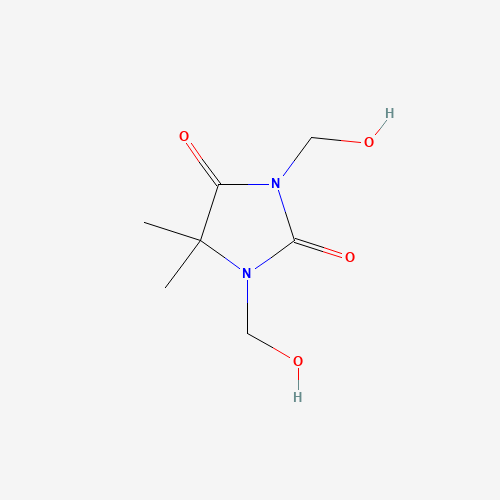
1,3-Dimethylol-5,5-dimethylhydantoin (DMDM hydantoin) is an antimicrobial formaldehyde releaser preservative with the trade name Glydant. DMDM hydantoin is an organic compound belonging a class of compounds known as hydantoins. It is used in the cosmetics industry and found in products like shampoos, hair conditioners and skin care products. (L1896)
科学粮草官-词典编辑部,修订于:2026-07-06
Toxicity
ToxicityEPA Ecotoxicity
Pesticide Ecotoxicity Data from EPA: 6
Fate Summary
ATMOSPHERIC FATE: According to a model of gas/particle partitioning of semivolatile organic compounds in the atmosphere(1), 1,3-dimethylol-5,5-dimethylhydantoin, which has a vapor pressure of 9X10⁻⁸ mm Hg at 25 °C(2), will exist in both the vapor and particulate phases in the ambient atmosphere. Vapor-phase 1,3-dimethylol-5,5-dimethylhydantoin is degraded in the atmosphere by reaction with photochemically-produced hydroxyl radicals(SRC); the half-life for this reaction in air is estimated to be 13 hours(SRC), calculated from its rate constant of 3.0X10⁻¹¹ cu cm/molecule-sec at 25 °C(SRC) that was derived using a structure estimation method(3). Particulate-phase 1,3-dimethylol-5,5-dimethylhydantoin may be removed from the air by wet or dry deposition(SRC). Based on direct photolysis test...
Soil Adsorption / Mobility
Using OECD Guideline 121 (Estimation of the Adsorption Coefficient (Koc) on Soil and on Sewage Sludge using High Performance Liquid Chromatography (HPLC)), the Koc of 1,3-dimethylol-5,5-dimethylhydantoin was determined to be <17.8(1). According to a classification scheme(2), this estimated Koc value suggests that 1,3-dimethylol-5,5-dimethylhydantoin is expected to have very high mobility in soil.
Environmental Biodegradation
AEROBIC: Using OECD Guideline 301 A (new version) (Ready Biodegradability: DOC Die Away Test), 1,3-dimethylol-5,5-dimethylhydantoin was found to be readily biodegradable in activated sludge with 75% degradation in 10 days and 95% degradation in 28 days(1). The degradation product of 1,3-dimethylol-5,5-dimethylhydantoin, 5,5-dimethylhydantoin, was found to be readily biodegradable via OECD Guideline 301 B (Ready Biodegradability: CO2 Evolution Test) with 87% CO2 evolution within 28 days of incubation and >60% degradation in 10 days(1). 5,5-Dimethylhydantoin was steadily biodegraded using OECD Guideline 308 (Aerobic and Anaerobic Transformation in Aquatic Sediment Systems) with half-lives of 13-24 days(1).
Environmental Bioconcentration
An estimated BCF of 3 was calculated in fish for 1,3-dimethylol-5,5-dimethylhydantoin(SRC), using a log Kow of -2.9(1) and a regression-derived equation(2). According to a classification scheme(2), this BCF suggests the potential for bioconcentration in aquatic organisms is low(SRC). Dimethylhydantoin (DMT), a degradation product of 1,3-dimethylol-5,5-dimethylhydantoin, has a BCF of 0.08(1).
Volatilization from Water / Soil
The Henry's Law constant for 1,3-dimethylol-5,5-dimethylhydantoin is estimated as 2.9X10⁻¹⁴ atm-cu m/mole(SRC) derived from its vapor pressure, 9.0X10⁻⁸ mm Hg(1), and water solubility, 7.73X10+5 mg/L(2). This Henry's Law constant indicates that 1,3-dimethylol-5,5-dimethylhydantoin is expected to be essentially nonvolatile from water surfaces(3). 1,3-Dimethylol-5,5-dimethylhydantoin's estimated Henry's Law constant indicates that volatilization from moist soil surfaces is not expected to occur(SRC). 1,3-Dimethylol-5,5-dimethylhydantoin is not expected to volatilize from dry soil surfaces(SRC) based upon its vapor pressure.
Environmental Abiotic Degradation
The rate constant for the vapor-phase reaction of 1,3-dimethylol-5,5-dimethylhydantoin with photochemically-produced hydroxyl radicals has been estimated as 3.0X10⁻¹¹ cu cm/molecule-sec at 25 °C(SRC) using a structure estimation method(1). This corresponds to an atmospheric half-life of about 13 hours at an atmospheric concentration of 5X10+5 hydroxyl radicals per cu cm(1). Aqueous hydrolysis tests conducted pH 4, pH 7 and pH 9, determined respective hydrolysis half-lives of >1 year, <1 day and < 1 day at 25 °C(2). A 2009 hydrolysis study using OECD Guideline 111 (Hydrolysis as a Function of pH) at 35 °C, determined half-lives of 10.7 hours and <1 hour at respective pH's of 7 and 9(2); no hydrolysis was observed at pH 4(2); 5,5-dimethylhydantoin and formaldehyde were identified as the h...
Artificial Pollution Sources
1,3-Dimethylol-5,5-dimethylhydantoin's production and use as an antimicrobial in adhesives, air fresheners, caulking compounds, clay slurries, cleansers, coatings, dispersed colors, resin emulsions, fabric softeners, hydraulic fluids, inks, latex, liquid detergents, metal working cutting fluids, paints (emulsion, latex, water-based), paper/paperboard coatings, polishes, polymers (synthetic), powdered detergents, sealants, carpet shampoos, soap, stains (preservative incorporation), starch solutions, textiles, and wax(1) may result in its release to the environment through various waste streams(SRC). Its use in numerous household products, such as antibacterial hand soaps, shampoos, moisturizing creams, body washes, conditioners, hair care products(2) and its use as an inert ingredient in...
Probable Routes of Human Exposure
Data provided by FDA in 2002 indicated that DMDM Hydantoin was being used in 963 cosmetic products. Current use concentration data indicate slightly lower maximum use concentration of 0.8%, compared to the 1% maximum use concentration that was reported in 1981 ... patch test results for DMDM Hydantoin in large populations of patients with suspected allergic contact dermatits indicated that the frequency of allergic reactions to DMDM Hydantoin has not increased over time(1).
Environmental Fate / Exposure Summary
1,3-Dimethylol-5,5-dimethylhydantoin's production and use as an antimicrobial preservative may result in its release to the environment through various waste streams. Its use in numerous household products, such as antibacterial hand soaps, shampoos, moisturizing creams, body washes, conditioners, and hair care products and its use as an inert ingredient in pesticide formulations may result in its direct release to the environment. If released to air, a vapor pressure of 9.0X10⁻⁸ mm Hg at 25 °C indicates 1,3-dimethylol-5,5-dimethylhydantoin will exist in both the vapor and particulate phases in the atmosphere. Vapor-phase 1,3-dimethylol-5,5-dimethylhydantoin will be degraded in the atmosphere by reaction with photochemically-produced hydroxyl radicals; the half-life for this reaction in...
Symptoms
DMDM hydantoin may cause contact dermatitis. (A2882)
Toxicity Data
LD50: 2.0-3.65 g/kg (Oral, Rat) (A718)
Health Effects
DMDM hydantoin releases formaldehyde, a known human carcinogen. (L962, L1896)
Adverse Effects
Skin Sensitizer - An agent that can induce an allergic reaction in the skin.
Exposure Routes
Oral (L962); inhalation (L962); dermal (L962)
Toxicity Summary
DMDM hydantoin is a formaldehyde releaser. It is likely that formaldehyde toxicity occurs when intracellular levels saturate formaldehyde dehydrogenase activity, allowing the unmetabolized intact molecule to exert its effects. Formaldehyde is known to form cross links between protein and DNA and undergo metabolic incorporation into macromolecules (DNA, RNA, and proteins). (L962, L1896)
Carcinogen Classification
1, carcinogenic to humans (for formaldehyde). (L135)
Non-Human Toxicity Values
LD50 Rat oral 3.72 +/- 0.5 g/kg
Antidote and Emergency Treatment
/SRP:/ Advanced treatment: Consider orotracheal or nasotracheal intubation for airway control in the patient who is unconscious, has severe pulmonary edema, or is in severe respiratory distress. Positive-pressure ventilation techniques with a bag valve mask device may be beneficial. Consider drug therapy for pulmonary edema ... . Consider administering a beta agonist such as albuterol for severe bronchospasm ... . Monitor cardiac rhythm and treat arrhythmias as necessary ... . Start IV administration of D5W TKO /SRP: "To keep open", minimal flow rate/. Use 0.9% saline (NS) or lactated Ringer's (LR) if signs of hypovolemia are present. For hypotension with signs of hypovolemia, administer fluid cautiously. Watch for signs of fluid overload ... . Treat seizures with diazepam or lorazepam...