


 一键配货
一键配货
化合物详情
CAS6484-52-2
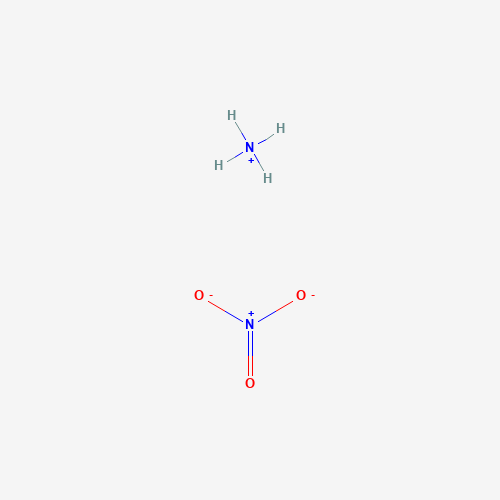
分子式H4N2O3
分子量80.04 g/mol
危化品
Physical Description | Ammonium nitrate is commercially available both as a colorless crystalline solid and processed into prills for specific applications. Soluble in water. Does not readily burn but will do so if contaminated with combustible material. Accelerates the burning of combustible material. Produces toxic oxides of nitrogen during combustion. Used to make fertilizers and explosives, and as a nutrient in producing antibiotics and yeast.
科学粮草官-词典编辑部,修订于:2026-07-06
Toxicity
ToxicityFate Summary
Ammonium nitrate is quite soluble in water (250 g/100 mL at 20 °C). Thus, if precipitation occurs prior to clean up, or if water is used to disperse the spilled chemical, the solution of ammonium nitrate produced can infiltrate the soil and migrate downward.
Soil Adsorption / Mobility
When spilled on soil, the liquid form of ammonium nitrate will spread on the surface and penetrate into the soil at a rate dependent on the soil type and its water content.
Environmental Biodegradation
Ammonium nitrate will be taken up by bacteria. Nitrate is more persistent in water than /the/ ammonium ion; nitrate degradation is fastest in anaerobic conditions.
Volatilization from Water / Soil
The immediate loss of fertilizer nitrogen as nitrous oxide (biochemical & microbiological) into the atmosphere was determined by in situ measurements of the nitrous oxide evolution rates from uncultivated Eolian sand. The net loss was equivalent to 0.1% of the applied fertilizer for ammonium chloride, 0.05% for ammonium nitrate & 0.01% for sodium nitrate. The total immediate loss of nitrous oxide-nitrogen after application of mineral fertilizer is estimated to be 0.004-1.2 teragram/yr.
ICSC Environmental Data
Avoid release to the environment in circumstances different to normal use.
Atmospheric Concentrations
The total suspended particulate in the ambient aerosol in the 24 hr period measurements exceeds the Federal secondary standard, 150 ug/cu m, 10% of the time. The maximum 4 hr mass measurements for the total mass and fine mass fractions are 307 and 204 ug/cu m, respectively. The fine fraction of the total suspended particulate with diameter less than 2.5 mu consisting of organic carbon 23.7; ammonium nitrate 20.0, elemental carbon 16.8, ammonium sulfate 13.6, & others constitutes 42 to more than 50% of the aerosol.
Sediment/Soil Concentrations
The effects of nitrogen sources on nitrates and ammonium concentration in leachate & runoff from golf greens were studied. All profiles were equipped with subsurface tile drains over a plastic sheet and were treated sequentially with the ammonium nitrate, ureaformaldehyde, 12-12-12, Milorganite & isobutylenediurea (IBDU). Nitrate concentration in leachate from sand, mixed & soil greens fertilized with quick release materials ranged from 45-326, 8-314 & 8-170 mg/L, respectively & remained in this range for a 3-wk period. Nitrate nitrogen losses from various sources were in the order of ammonium nitrate greater than 12-12-12 greater than Milorganite greater than IBDU greater than ureaformaldehyde. Soluble sources, ammonium nitrate and 12-12-12 exhibited leaching within 5 days after applic...
Probable Routes of Human Exposure
As a result of the blasting agent used in mines, ammonium nitrate, workers are subjected to air pollution in mines which poses an occupational health hazard.
Symptoms
Nitrate and nitrite poisoning causes methemoglobinemia. Symptoms include cyanosis, cardiac dysrhythmias and circulatory failure, and progressive central nervous system (CNS) effects. CNS effects can range from mild dizziness and lethargy to coma and convulsions. (L1137)
Treatment
Methemoglobinemia can be treated with supplemental oxygen and methylene blue 1% solution administered intravenously slowly over five minutes followed by IV flush with normal saline. Methylene blue restores the iron in hemoglobin to its normal (reduced) oxygen-carrying state. (L1613)
Interactions
... The objective of our study was to examine how realistic, sublethal environmental levels of ammonium nitrate fertilizer (0, 10, 20 mg/L and ammonium chloride control) and the common insecticide carbaryl (0 or 2.5 mg/L) individually and interactively affect the development, size, and survival of green frog (Rana clamitans) tadpoles. /The authors/ reared tadpoles for 95 days in outdoor 1,000-L polyethylene ponds. /They/ found that the combination of carbaryl and nitrate had a negative effect on development and mass of tadpoles compared to the positive effect that either contaminant had alone. Presence of carbaryl was generally associated with short-term increases in algal resources, including ponds exposed to both carbaryl and nitrate. However, with exposure to nitrate and carbaryl, ta...
Toxicity Data
LD50: 2217 mg/kg (Oral, Rat) (A675) LC50: >88.8 mg/L over 4 hours (Inhalation, Rat) (A675)
Health Effects
Nitrate and nitrite poisoning causes methemoglobinemia. Nitrites may cause pregnancy complications and developmental effects. They may also be carcinogenic. (L1137)
Adverse Effects
Methemoglobinemia - The presence of increased methemoglobin in the blood; the compound is classified as secondary toxic effect
Exposure Routes
Oral (L1137); inhalation (L1137)
Toxicity Summary
Nitrate's toxicity is a result of it's conversion to nitrite once in the body. Nitrite causes the autocatalytic oxidation of oxyhemoglobin to hydrogen peroxide and methemoglobin. This elevation of methemoglobin levels is a condition known as methemoglobinemia, and is characterized by tissue hypoxia, as methemoglobin cannot bind oxygen. (A2450, L1613)
Carcinogen Classification
Ingested nitrate or nitrite under conditions that result in endogenous nitrosation is probably carcinogenic to humans (Group 2A). (L135)
Non-Human Toxicity Values
LC50 Rat inhalation >88.8 mg/L/4 hr
Populations at Special Risk
... Gastroenteritis can increase the rates of production and absorption of nitrites in young infants and aggravate methemoglobinemia. /Nitrates and Nitrites/









