

 一键配货
一键配货
化合物详情
CAS7005-72-3
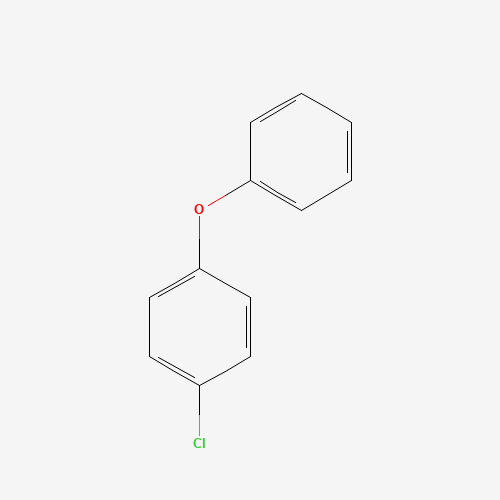
分子式ClC6H4OC6H5
分子量204.65 g/mol g/mol
危化品
Physical Description | 4-chlorophenyl phenyl ether appears as liquid. Density 1.193 g / cm3. Insoluble or slightly soluble in water.
科学粮草官-词典编辑部,修订于:2026-07-06
Toxicity
ToxicityFate Summary
AQUATIC FATE: It is not possible to determine the most probable aquatic fate for 4-chlorophenyl phenyl ether from available data. This pollutant is reported to be rapidly degraded by acclimated sewage sludge, but biodegradation data from river water die away experiments indicate that this cmpd has a potential for persistence in natural surface waters. Sorption by organic rich sediments & bioaccumulation in fish have been demonstrated. Although photolysis may make a minor contribution to the degradation of this pollutant near the air water surface, oxidation & hydrolysis are probably not important as fate processes. The role of volatilization is uncertain.
Soil Adsorption / Mobility
... The polar nature of the ether bond & the carbon-halogen bond, coupled with the cmpd's miscibility with most lipophilic material ensures sorption of 4-chlorophenyl phenyl ether by organic detritus. Adsorption by clay particles is also thought to be highly probable, inasmuch as the polarity & planar geometry of this molecule should facilitate its intercalation within the layered clay structure. Evidence for sorption by suspended organic material is given by a sediment to water distributional ratio of 4:1 during biodegradation studies with sludge.
Environmental Biodegradation
Two water samples, taken from 2 different locations in the Tittabawassee River & spiked with the pollutant at a concn of 1 mg/l, showed 2 different rates of biodegradation. One sample exhibited no detectable degradation before 120 hr & the other, no degradation before 312 hr. Greater than 90% degradation required 264 hr in the first sample & 528 hr in the second. The experiments illustrated that biodegradation rate constants are not reproducible when microbial populations have a dissimilar history. In these 2 experiments the half-lives with respect to biodegradation would be rather meaningless since both samples exhibited lag periods (during which loss of the pollutant was undetectable) that were approx one-half of the time required for 90% degradation. Thus, it is reasonable to assume...
Environmental Bioconcentration
A BCF of 736 was experimentally determined for 4-chlorophenyl phenyl ether in rainbow trout (Salmo gairdneri) (8.9 day experiment)(1).
Volatilization from Water / Soil
An estimated evaporation rate constant for 4-chlorophenyl phenyl ether from Lake Michigan is given as 7.0 cm/hour(1). The estimated volatilization half-life for a model river 1 m deep, flowing at 1 m/sec, and a wind velocity of 3 m/sec is 5.7 hours(2,SRC). The estimated volatilization from a model pond, which takes into account adsorption processes, is 39 days(3,SRC).
Environmental Abiotic Degradation
The UV spectra of 4-chlorophenyl phenyl ether in methanol has a lambda max at 279 and at 293 nm, suggesting that direct photochemical degradation in the atmosphere and in the upper layer of surface water may be an important fate process(1,SRC). Based on laboratory rate constants obtained for 4-chlorophenyl phenyl ether in water, the calculated half-life in surface waters at 40 deg latitude is 200 days (summer) and greater than 400 days (winter)(1). 4-Chlorophenyl phenyl ether underwent 1.8% and 38% photoreaction in a degassed methanol solution using a rayonet photolysis apparatus after 8 and 88 hours, respectively(2). The estimated half-life for the atmospheric reaction with photochemically produced hydroxyl radicals is 1.3 days(3,SRC).
Environmental Water Concentrations
SURFACE WATER: U.S. EPA Storet Data Base, for 4-chlorophenyl phenyl ether 837 samples, 0.2% positive, median concn less than 10 ug/l(1). Identified in two samples of water from the River Lee, United Kingdom, in concn less than 0.1 ug/l(2). Detected in 4 of 150 raw water extracts and 8 out of 155 finished water extracts at 11 water utilities in the Ohio River Basin, 1977-78, at concn of approx 0.2 ug/l (may have been up to 1 ug/l)(3). Not detected in 86 samples from 51 rainwater runoff catchments located throughout the USA (detection limits not given)(4).
Effluent Concentrations
U.S. EPA Storet Data Base, 1,333 samples, 1.1% positive, median concn less than 10 ug/L(1). 4-Chlorophenyl phenyl ether was not detected in 86 samples from 51 stormwater catchments located throughout the USA (detection limits not given)(2).
Natural Pollution Sources
4-Chlorophenyl phenyl ether is an anthropogenic compound, and is not known to exist in nature. (SRC)
Fish/Seafood Concentrations
4-Chlorophenyl phenyl ether was not found in a wide variety of fish collected from fourteen Lake Michigan tributaries and embayments (detection limits not given)(1).
Artificial Pollution Sources
The 1977 TSCA inventory listed one company which produced 4-chlorophenyl phenyl ether. Production volume was listed as one hundred thousand to one million pounds(1). More current production volumes could not be found(SRC). 4-Chlorophenyl phenyl ether was developed in search of a dielectric fluid to replace PCB's, and finds use in capacitors(2), which may result in environmental release during production, use, or disposal(SRC).
Sediment/Soil Concentrations
4-Chlorophenyl phenyl ether was not detected in sediment samples from the western basin of Lake Ontario, near the mouth of the Niagara River (detection limits not given)(1). U.S. EPA Storet Data Base, 344 samples, 0% positive, median concn less than 500 ug/L(2). A ratio for 4-chlorophenyl phenyl ether defined as the amount bound to suspended solids/sediment vs the amount in water was reported as 4:1(3).
Probable Routes of Human Exposure
The probable routes of exposure for 4-chloropheny phenyl ether are by inhalation and dermal contact during its manufacture and use as a dielectric fluid. The general public should not be expected to be exposed to this compound unless it is accidentally released to the environment. (SRC)
Environmental Fate / Exposure Summary
4-Chlorophenyl phenyl ether which finds use as a dielectric fluid, can be released to the environment during its manufacture, formulation, and through its use in capacitors. If released to the atmosphere, 4-chlorophenyl phenyl ether should react with photochemically produced hydroxyl radicals with an estimated half-life of 1.3 days. Direct photolysis in the atmosphere should be an important fate process, as 4-chlorophenyl phenyl ether has an absorption greater than 290 nm. 4-Chlorophenyl phenyl ether should be expected to undergo biodegradation in soil and in water. 4-Chlorophenyl phenyl ether should display slight mobility in soil, and volatilization to the atmosphere may be an important process. If released to water, 4-chlorophenyl phenyl ether would be expected to adsorb to sediment...
Adverse Effects
Occupational hepatotoxin - Secondary hepatotoxins: the potential for toxic effect in the occupational setting is based on cases of poisoning by human ingestion or animal experimentation.
USGS Health-Based Screening Levels for Evaluating Water-Quality
Reference: Smith, C.D. and Nowell, L.H., 2024. Health-Based Screening Levels for evaluating water-quality data (3rd ed.). DOI:10.5066/F71C1TWP