


 一键配货
一键配货
化合物详情
CAS7173-51-5
分子式C22H48ClN
分子量362.08 g/mol g/mol
危化品
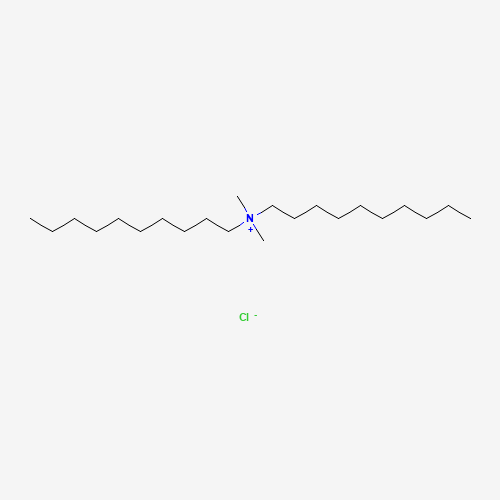
Didecyldimethylammonium chloride is an organic molecular entity.
科学粮草官-词典编辑部,修订于:2026-07-06
Toxicity
ToxicityEPA Ecotoxicity
Pesticide Ecotoxicity Data from EPA: 40
Fate Summary
ATMOSPHERIC FATE: According to a model of gas/particle partitioning of semivolatile organic compounds in the atmosphere(1), didecyl dimethyl ammonium chloride, which has a vapor pressure of <4.3X10⁻⁵ mm Hg at 25 °C(2), will exist in both the vapor and particulate phases in the ambient atmosphere. Vapor-phase didecyl dimethyl ammonium chloride is degraded in the atmosphere by reaction with photochemically-produced hydroxyl radicals(SRC); the half-life for this reaction in air is estimated to be 8 hours(SRC), calculated from its rate constant of 4.6X10⁻¹¹ cu cm/molecule-sec at 25 °C(SRC) that was derived using a structure estimation method(3). Particulate-phase didecyl dimethyl ammonium chloride may be removed from the air by wet or dry deposition(SRC). Didecyl dimethyl ammonium chloride...
Soil Adsorption / Mobility
The log Koc for didecyl dimethyl ammonium chloride has been reported as 5.64 (sand), 5.96 (sandy loam), 6.20 (silty clay loam), 6.17 (silt loam)(1), corresponding to Koc values of 4.4X10+5, 9.1X10+5, 1.6X10+6, and 1.5X10+6 respectively(SRC). In batch equilibrium studies using five different soil types and OECD Guideline 106 (Adsorption - Desorption Using a Batch Equilibrium Method), didecyl dimethyl ammonium chloride had Koc values of 667, 1140, 10456, 14072 and 24433(2). According to a classification scheme(2), these Koc values suggest that didecyl dimethyl ammonium chloride is expected to have low to no mobility in soil with most Koc values suggesting the compound is immobile in soil. Didecyl dimethyl ammounium chloride is a cationic surfactant(1) that may exist in cation form in the...
Environmental Biodegradation
AEROBIC: Quarternary ammonium compounds have been shown to biodegrade, exhibiting lag times of less than one to several days at a concentration of 5 mg/L(1). The half-life of analogous 12 carbon alkyl chain didodecyl dimethyl ammonium chloride has been reported at 21 days(1).
Environmental Bioconcentration
A BCF of 81 was reported in bluegill sunfish (Lepomis macrochirus) for didecyl dimethyl ammonium chloride(1). According to a classification scheme(2), this BCF suggests the potential for bioconcentration in aquatic organisms is moderate. Didecyl dimethyl ammonium chloride is reported to have low bioconcentration in tests using carp (Cyprinus carpio)(3); BCF values not reported(SRC).
Volatilization from Water / Soil
Volatilization from moist soil and water surfaces is not expected because didecyl dimethyl ammounium chloride exists as a cation(1) and cations do not volatilize. Didecyl dimethyl ammonium chloride is not expected to volatilize from dry soil surfaces(SRC) based upon a vapor pressure of <4.3X10⁻⁵ mm Hg at 25 °C(2).
Environmental Abiotic Degradation
The rate constant for the vapor-phase reaction of didecyl dimethyl ammonium chloride with photochemically-produced hydroxyl radicals has been estimated as 4.6X10⁻¹¹ cu cm/molecule-sec at 25 °C(SRC) using a structure estimation method(1). This corresponds to an atmospheric half-life of about 8 hours at an atmospheric concentration of 5X10+5 hydroxyl radicals per cu cm(1). Results of aqueous hydrolysis tests found didecyl dimethyl ammonium chloride to be hydrolytically stable with half-lives of >= 1 year at pH 4, pH 7 and pH 9 at 20 °C(2). Didecyl dimethyl ammonium chloride is reported to be photolytically stable(3), and therefore is not expected to be susceptible to direct photolysis by sunlight(SRC). Photodegradation half-lives of 132 and 169 days in exposed and non-exposed soils have b...
Environmental Water Concentrations
SEAWATER: Environmental concentrations measured at three different locations along the North East coast of England found concentrations of didecyl dimethyl ammonium chloride and dodecylbenzyldimethylammonium chloride in the range 120-270 ng/L(1).
Ecotoxicity Excerpts
/AQUATIC SPECIES/ The acute toxicity of the antisapstain wood preservative Bardac 2280 (principal active ingredient 80% didecyldimethylammonium chloride, DDAC) was tested with four fish and four aquatic invertebrate species. White sturgeon fry (Acipenser transmontanus) were the most sensitive fish species tested with a 24-hr 50% lethal concentration (LC50) value between 1 and 10 ppb Bardac 2280. The 96-hr LC50 values for the three other fish species ranged from 0.39 ppm for fathead minnows (Pimephales promelas) to 2.0 ppm for juvenile starry flounder (Platichthys stellatus). Developmental stage altered the sensitivity of Coho salmon to Bardac 2280, with alevins being approximately twice as sensitive as smolts. Altering salinity up to 30%o seawater had no significant effect on the toxici...
Effluent Concentrations
Levels of didecyl dimethyl ammonium chloride from treated packages of lumber following rainfall events were reported as 73.2 and 65.8 mg/L after 2 events, averaging 15.9 mg/L over 15 events(1). The discharge measured into the Fraser River (British Columbia, Canada)was 1.06 mg/L(1).
Artificial Pollution Sources
Didecyl dimethyl ammonium chloride's production and use as a disinfectant and microbiocide in various applications(1,2) may result in its release to the environment through various waste streams; its use as a general purpose disinfectant and pesticide, in water treatment of cooling towers and as a wood preservative(1,2) will result in its direct release to the environment(SRC).
Sediment/Soil Concentrations
SEDIMENT: Didecyl dimethyl ammonium chloride concentrations in sediment samples collected along the Fraser River, British Columbia, Canada ranged from 0.57 to 1.26 ug/g dry weight; collection times not specified(1).
Probable Routes of Human Exposure
NIOSH (NOES Survey 1981-1983) has statistically estimated that 111,703 workers (63,847 of these were female) were potentially exposed to didecyl dimethyl ammonium chloride in the US(1). The NOES Survey does not include farm workers. Occupational exposure to didecyl dimethyl ammonium chloride may occur through inhalation and dermal contact with this compound at workplaces where didecyl dimethyl ammonium chloride is produced or used(2). Use data indicate that the general population may be exposed to didecyl dimethyl ammonium chloride via dermal contact with consumer products containing this compound(SRC). The use of didecyl dimethyl ammonium chloride as an antimicrobial product on food contact surfaces, treatment of mushroom houses, and application to food-grade eggs may result in pestici...
Environmental Fate / Exposure Summary
Didecyl dimethyl ammonium chloride's production and use as a disinfectant and microbiocide in various applications may result in its release to the environment through various waste streams; its use as a general purpose disinfectant and pesticide, in water treatment of cooling towers and as a wood preservative will result in its direct release to the environment. If released to air, a vapor pressure of <4.3X10⁻⁵ mm Hg at 25 °C indicates didecyl dimethyl ammonium chloride will exist in both the vapor and particulate phases in the atmosphere. Vapor-phase didecyl dimethyl ammonium chloride will be degraded in the atmosphere by reaction with photochemically-produced hydroxyl radicals; the half-life for this reaction in air is estimated to be 8 hours. Particulate-phase didecyl dimethyl ammon...
Interactions
The bactericidal activity of a quaternary ammonium salt, didecyldimethylammonium chloride (DDAC), was depressed by the presence of soap, sodium laurate (NaLA): the minimum lethal concentration (MLC) of DDAC against Staphylococcus aureus was 63 and 250 ug/mL in the absence and presence of 0.01% NaLA, respectively. The neutralizing effect was studied in relation with the mode of action of DDAC. The apparent uptake of DDAC by the cell was not repressed by NaLA's presence when compared to that in its absence. The solution of NaLA showed alkaline pH, but the biocidal activity of DDAC was higher at pH 11 than at pH 7. Although the presence of NaLA had no significant effect on DDAC's action on increasing the turbidity of the cell suspension, the mixture of these reagents alone without cells ex...
Toxicity Data
LC50 (rat) = 70 mg/m3
Adverse Effects
Dermatotoxin - Skin burns.
Toxicity Summary
IDENTIFICATION AND USE: Didecyl dimethylammonium chloride is a clear yellow liquid with an ethanolic odor. It is used as an algaecide, bacteriocide, fungicide, fungistat, microbiocide, microbiostat disinfectant, viricide, tuberculocide, molluscide, sanitizer, wood preservative, deodorant, and insecticide. It has been tested for treatment of impetiginized eczema patients in combination with prednicarbate. HUMAN EXPOSURE AND TOXICITY: Nausea, headache, and sore throat are the primary systemic effects that have been reported. The primary dermal effects that have been reported are rash, burning sensation, numbness, and itching. A case report of dermatitis from detergent/disinfectant was described. A 24 year old woman, who had worked in a hospital for 2 years, presented with a 2 month histor...
RAIS Toxicity Values
Oral Chronic Reference Dose Reference: OPP
Human Toxicity Excerpts
/OTHER TOXICITY INFORMATION/ The relative toxicity of Aliquat 203 (didecyl-dimethyl-ammonium-chloride) was experimentally investigated in mice, rats, guinea-pigs, rabbits, and humans. These studies produced no evidence of an unusual degree or kind of toxicity. No data were found which indicated potential toxicologic hazard from wearing of uniforms impregnated with 0.5 percent Aliquat 203. An infrared spectrum of the technical-grade compound was evaluated also.
Antidote and Emergency Treatment
/SRP:/ Advanced treatment: Consider orotracheal or nasotracheal intubation for airway control in the patient who is unconscious, has severe pulmonary edema, or is in severe respiratory distress. Positive-pressure ventilation techniques with a bag valve mask device may be beneficial. Consider drug therapy for pulmonary edema ... . Consider administering a beta agonist such as albuterol for severe bronchospasm ... . Monitor cardiac rhythm and treat arrhythmias as necessary ... . Start IV administration of D5W TKO /SRP: "To keep open", minimal flow rate/. Use 0.9% saline (NS) or lactated Ringer's (LR) if signs of hypovolemia are present. For hypotension with signs of hypovolemia, administer fluid cautiously. Watch for signs of fluid overload ... . Treat seizures with diazepam or lorazepam...









