


 一键配货
一键配货
化合物详情
CAS7487-88-9
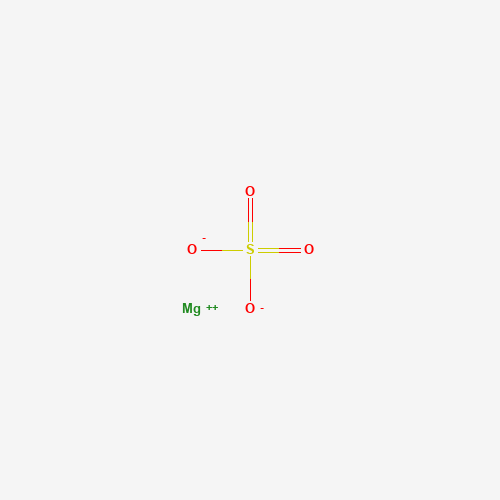
分子式MgO4S
分子量120.37 g/mol
非危品
Magnesium sulfate is a magnesium salt having sulfate as the counterion. It has a role as a fertilizer, an analgesic, a cardiovascular drug, an anticonvulsant, an anti-arrhythmia drug, a calcium channel blocker, an anaesthetic and a tocolytic agent. It is an organic magnesium salt, a magnesium salt and a metal sulfate.
科学粮草官-词典编辑部,修订于:2026-07-06
Toxicity
ToxicityFate Summary
AQUATIC FATE: Natural water systems acquire magnesium through weathering reactions, which involve the interaction of water and atmosphere with the earth's crust and subsequent leaching of magnesium compounds into water. The Mg2+ ion is the predominant form of dissolved magnesium. However, some magnesium complexes do form. The magnesium sulfate ion pair complex (MgSO4) is the most significant complex present, representing 2.6% and 11% of the total magnesium content in fresh and sea water, respectively. The concentrations of bicarbonate and carbonate complexes are significant but considerably less than sulfate complexes. Incorporation of magnesium compounds into sediment is an important removal process. For example, a small amount of magnesium is ion exchanged for calcium on clay minerals...
Natural Pollution Sources
MONOHYDRATE OCCURS IN NATURE AS MINERAL KIESERITE. /MONOHYDRATE/
Artificial Pollution Sources
The production and use of magnesium compounds as refractories, as chemical intermediates, and in construction materials(1,2) result in their release to the environment through various waste streams(SRC). The production and use of magnesium compounds in environmental applications and in agriculture(1,2) results in their direct release to the environment(SRC). About 69% of the magnesium compounds used in the United States were used for refractories (e.g., olivine)(1). The remaining 31% of magnesium compounds were used in agriculture as fertilizer or animal feed (e.g, magnesium oxide, magnesium sulfate), as chemical intermediates (e.g., magnesium chloride, magnesium hydroxide, magnesium carbonate, magnesium oxide), construction materials (e.g., magnesium oxide), environmental (e.g., magne...
Symptoms
Adverse reactions include hypotension, ECG changes, diarrhea, urinary retention, CNS depression and respiratory depression.
Treatment
EYES: irrigate opened eyes for several minutes under running water. INGESTION: do not induce vomiting. Rinse mouth with water (never give anything by mouth to an unconscious person). Seek immediate medical advice. SKIN: should be treated immediately by rinsing the affected parts in cold running water for at least 15 minutes, followed by thorough washing with soap and water. If necessary, the person should shower and change contaminated clothing and shoes, and then must seek medical attention. INHALATION: supply fresh air. If required provide artificial respiration.
Toxicity Data
LD50: 1200 mg/kg (rat, parenteral-subcutaneous). The first warning of impending toxicity is loss of the patellar reflex at plasma concentrations between 3.5 and 5 mmol/L. Respiratory paralysis occurs at 5 to 6.5 mmol/L. Cardiac conduction is altered at greater than 7.5 mmol/L, and cardiac arrest can be expected when concentrations of magnesium exceed 12.5 mmol/L.
Health Effects
May cause a potentially dangerous rash that may develop into Stevens Johnson syndrome, an extremely rare but potentially fatal skin disease. Respiratory paralysis occurs at 5 to 6.5 mmol/L. Cardiac conduction is altered at greater than 7.5 mmol/L, and cardiac arrest can be expected when concentrations of magnesium exceed 12.5 mmol/L.
Adverse Effects
When giving magnesium sulfate, there are minimal side effects with standard therapeutic doses, but magnesium sulfate has a broad therapeutic index. Patients most commonly complain of minor facial flushing and warmth with the administration; however, symptoms typically resolve spontaneously. In patients with neuromuscular disease, such as in myasthenia gravis, the neuromuscular function may worsen at lower concentrations of medication. If given rapidly or in high doses, patients may experience transient hypotension due to smooth muscle inhibition causing a vasodilatory effect that will resolve. If the patient is on a continuous magnesium sulfate infusion, serum levels must be accounted for as symptoms related to hypermagnesemia may become clinically evident. At supratherapeutic serum con...
Exposure Routes
Parenteral(intravenous, intramuscular) oral.
Toxicity Summary
Magnesium is the second most plentiful cation of the intracellular fluids. It is essential for the activity of many enzyme systems and plays an important role with regard to neurochemical transmission and muscular excitability. Magnesium sulfate reduces striated muscle contractions and blocks peripheral neuromuscular transmission by reducing acetylcholine release at the myoneural junction. Additionally, Magnesium inhibits Ca<sup>2+</sup> influx through dihydropyridine-sensitive, voltage-dependent channels. This accounts for much of its relaxant action on vascular smooth muscle.
Minimum Risk Level
3.5 mmol/L in blood.
Human Toxicity Excerpts
/HUMAN EXPOSURE STUDIES/ Human systemic effects: heart changes, cyanosis, flaccid paralysis with appropriate anesthesia.
Carcinogen Classification
No indication of carcinogenicity to humans (not listed by IARC).
Non-Human Toxicity Values
LD50 Rat subcutaneous 1200 mg/kg
Non-Human Toxicity Excerpts
/LABORATORY ANIMALS: Developmental or Reproductive Toxicity/ WEANLING RATS EXHIBITIED DIARRHEA, DEPRESSED GROWTH RATE, & INTESTINAL DISTENSION WHEN FED 1% MAGNESIUM SULFATE.
Effects During Pregnancy and Lactation
A retrospective chart review of mothers who delivered at the University of Chicago found that intravenous magnesium sulfate during delivery was associated with over 60% reduced odds of breastfeeding initiation compared to mothers who received no magnesium.









