


 一键配货
一键配货
化合物详情
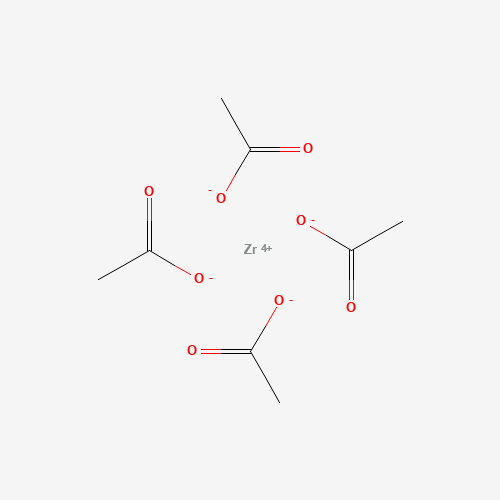
CAS7585-20-8
分子式C8H12O8Zr
分子量327.40 g/mol g/mol
危化品
Physical Description | Zirconium acetate appears as an clear amber aqueous solution. Weak vinegar odor. (USCG, 1999)
科学粮草官-词典编辑部,修订于:2026-07-06
Toxicity
ToxicityProbable Routes of Human Exposure
NIOSH (NOES Survey 1981-1983) has statistically estimated that 13,795 workers (5,829 of these were female) were potentially exposed to zirconium acetate in the US(1). Occupational exposure to zirconium acetate may occur through inhalation of dust and dermal contact with this compound at workplaces where zirconium acetate is produced or used(SRC).
Adverse Effects
Dermatotoxin - Skin burns.
Toxicity Summary
IDENTIFICATION AND USE: Zirconium acetate is used for preparation of water repellents, and other chemicals. HUMAN EXPOSURE AND TOXICITY: Contact with eyes or skin may cause irritation. In an in vitro reconstructed human epidermis model 20 uL of a solution containing 40.7% of anhydrous zirconium acetate was applied to tissues. The exposure time was 15 minutes, and the observation period was 42 hr. Based on the mean cell viability (109%) when compared to the negative control, the test item was considered not irritant. ANIMAL STUDIES: Zirconium acetate has no systemic toxic effect on the rat following dermal exposure over a 24 hour period at a level of 2000 mg/kg. The lack of mortality demonstrates the LD50 to be greater than 2000 mg/kg. Zirconium acetate solution does not elicit any sensi...
Human Toxicity Excerpts
/ALTERNATIVE and IN VITRO TESTS/ An in vitro reconstructed human epidermis model /was used/. The test system EPISKINTM is a reconstructed human epidermis (RhE) model, which in its overall design (the use of human derived epidermis keratinocytes as cell source and use of representative tissue and cytoarchitecture) closely mimics the biochemical and physiological properties of the upper parts of the human skin, i.e., the epidermis. 20 uL of test solution /(a solution containing 40.7% of anhydrous zirconium acetate)/ was applied to tissues. The exposure time was 15 minutes, and the observation period was 42 hr. Based on the mean cell viability (109%) when compared to the negative control, the test item was considered not irritant.
Antidote and Emergency Treatment
/SRP:/ Advanced treatment: Consider orotracheal or nasotracheal intubation for airway control in the patient who is unconscious, has severe pulmonary edema, or is in severe respiratory distress. Positive-pressure ventilation techniques with a bag valve mask device may be beneficial. Consider drug therapy for pulmonary edema ... . Consider administering a beta agonist such as albuterol for severe bronchospasm ... . Monitor cardiac rhythm and treat arrhythmias as necessary ... . Start IV administration of D5W TKO /SRP: "To keep open", minimal flow rate/. Use 0.9% saline (NS) or lactated Ringer's (LR) if signs of hypovolemia are present. For hypotension with signs of hypovolemia, administer fluid cautiously. Watch for signs of fluid overload ... . Treat seizures with diazepam (Valium) or l...









