


 一键配货
一键配货
化合物详情
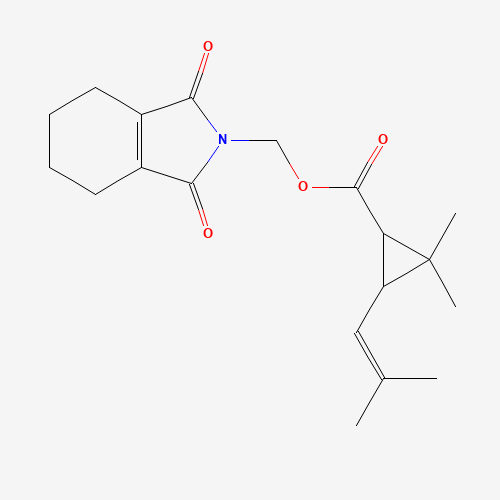
CAS7696-12-0
分子式C19H25NO4
分子量331.41 g/mol
非危品
Physical Description | Tetramethrin appears as colorless crystals with slight odor. Non corrosive. Used as an insecticide.
科学粮草官-词典编辑部,修订于:2026-07-06
Toxicity
ToxicityEPA Ecotoxicity
Pesticide Ecotoxicity Data from EPA: 22
Ecotoxicity Values
LC50; Species: Colinus virginianus (northern bobwhite, age 14 days) diet >5620 ppm for 8 days
Fate Summary
ATMOSPHERIC FATE: According to a model of gas/particle partitioning of semivolatile organic compounds in the atmosphere(1), tetramethrin, which has a vapor pressure of 7.08X10⁻⁶ mm Hg at 30 °C (2), is expected to exist in both the vapor and particulate phases in the ambient atmosphere. Vapor-phase tetramethrin is degraded in the atmosphere by reaction with photochemically-produced hydroxyl radicals(SRC); the half-life for this reaction in air is estimated to be 3 hours(SRC), calculated from its rate constant of 1.3X10⁻¹⁰ cu cm/molecule-sec at 25 °C(SRC) that was derived using a structure estimation method(3). Particulate-phase tetramethrin may be removed from the air by wet or dry deposition(SRC). Tetramethrin contains chromophores that absorb at wavelengths >290 nm(4) and therefore may...
Soil Adsorption / Mobility
The Koc of tetramethrin is estimated as 790(SRC), using a log Kow of 4.73(1) and a regression-derived equation(2). According to a classification scheme(3), this estimated Koc value suggests that tetramethrin is expected to have low mobility in soil.
Environmental Biodegradation
AEROBIC: Although environmental biodegradation data specific to tetramethrin are not available, the pyrethroid class of insecticides is degraded readily by environmental microorganisms(1,2).
Environmental Bioconcentration
An estimated BCF of 34 was calculated for tetramethrin(SRC), using a log Kow of 4.73(1) and a regression-derived equation(2). According to a classification scheme(3), this BCF suggests the potential for bioconcentration in aquatic organisms is moderate(SRC).
Volatilization from Water / Soil
The Henry's Law constant for tetramethrin is estimated as 1.7X10⁻⁶ atm-cu m/mole(SRC) derived from its vapor pressure, 7.08X10⁻⁶ mm Hg(1), and water solubility, 1.83 mg/L(1). This Henry's Law constant indicates that tetramethrin is expected to volatilize rapidly from water surfaces(2). Based on this Henry's Law constant, the volatilization half-life from a model river (1 m deep, flowing 1 m/sec, wind velocity of 3 m/sec)(2) is estimated as 951 hours(SRC). The volatilization half-life from a model lake (1 m deep, flowing 0.05 m/sec, wind velocity of 0.5 m/sec)(2) is estimated as 294 days(SRC). Tetramethrin's estimated Henry's Law constant indicates that volatilization from moist soil surfaces may occur(SRC). Tetramethrin is not expected to volatilize from dry soil surfaces(SRC) based upo...
Environmental Abiotic Degradation
The rate constant for the vapor-phase reaction of tetramethrin with photochemically-produced hydroxyl radicals has been estimated as 1.3X10⁻¹⁰ cu cm/molecule-sec at 25 °C(SRC) using a structure estimation method(1). This corresponds to an atmospheric half-life of about 3 hours at an atmospheric concentration of 5X10+5 hydroxyl radicals per cu cm(1). A base-catalyzed second-order hydrolysis rate constant of 8.8X10⁻² L/mole-sec(SRC) was estimated using a structure estimation method(2); this corresponds to half-lives of 2.5 years and 91 days at pH values of 7 and 8, respectively(2). Tetramethrin is susceptible to alkaline hydrolysis(4). Hydrolysis of tetramethrin yields 3.4.5.6-tetrahydrophthalic acid(4,5). Tetramethrin contains chromophores that absorb at wavelengths >290 nm(3) and theref...
Ecotoxicity Excerpts
/OTHER TOXICITY INFORMATION/ Synthetic pyrethroids have been shown to be toxic for fish, aquatic arthropods, and honeybees in laboratory tests. But, in practical usage, no serious adverse effects have been noticed because of the low rates of application and lack of persistence in the environment. The toxicity of synthetic pyrethroids in birds and domestic animals is low. /Synthetic pyrethroids/
ICSC Environmental Data
The substance is very toxic to aquatic organisms. Avoid release to the environment in circumstances different to normal use.
Atmospheric Concentrations
INDOOR: Tetramethrin was detected at a median concentration of 0.1 mg/kg in 13 dust samples from German houses and 0.1 mg/kg in another set of 4 German houses(1). Tetramethrin was detected at a mean concentration of 4.5 ug/sq m in one of six settled dust samples collected from Central New York farmers' non-air conditioned homes in 1999(2). A mean concentration of 3.5 ug/sq m was detected in four out of ten samples of carpet dust from the same farmers' homes; a mean concentration of 1.5 ug/sq m was detected in a second series of samples taken after participants vacuumed(2).
Artificial Pollution Sources
Tetramethrin's production may result in its release to the environment through various waste streams; its use as an insecticide(1) will result in its direct release to the environment(SRC).
Probable Routes of Human Exposure
NIOSH (NOES Survey 1981-1983) has statistically estimated that 9,244 workers (1,759 of these were female) were potentially exposed to tetramethrin in the US(1). The NOES Survey does not include farm workers. Occupational exposure to tetramethrin may occur through inhalation of dust particles and dermal contact with this compound at workplaces where tetramethrin is produced or used(SRC). Use data indicate that the general population may be exposed to tetramethrin via inhalation and dermal contact with consumer products containing tetramethrin(SRC).
Environmental Fate / Exposure Summary
Tetramethrin's production may result in its release to the environment through various waste streams; its use as an insecticide will result in its direct release to the environment. If released to air, a vapor pressure of 7.08X10⁻⁶ mm Hg at 30 °C indicates tetramethrin will exist in both the vapor and particulate phases in the atmosphere. Vapor-phase tetramethrin will be degraded in the atmosphere by reaction with photochemically-produced hydroxyl radicals; the half-life for this reaction in air is estimated to be 3 hours. The half-life for the reaction in air with ozone is estimated to be 30 minutes. Particulate-phase tetramethrin will be removed from the atmosphere by wet or dry deposition. Tetramethrin contains chromophores that absorb at wavelengths >290 nm and therefore may be susc...
Symptoms
Following oral exposure, severe fine tremor, marked reflex hyperexcitability, sympathetic activation can occur. Nausea, vomiting and abdominal pain commonly occur and develop following ingestion. Sudden bronchospasm, swelling of oral and laryngeal mucous membranes, and anaphylactoid reactions have been reported after inhalation. Hypersensitivity reactions characterized by pneumonitis, cough, dyspnea, wheezing, chest pain, irritability to sound and touch, and bronchospasm may occur too . Dermatitis is the main effect of a dermal exposure to tetramethrin. (T36)
Treatment
Following oral exposure, the treatment is symptomatic and supportive and includes monitoring for the development of hypersensitivity reactions with respiratory distress. Provide adequate airway management when needed. Gastric decontamination is usually not required unless the pyrethrin product is combined with a hydrocarbon. Following inhalation exposure, move patient to fresh air. monitor for respiratory distress. If cough or difficulty breathing develops, evaluate for respiratory tract irritation, bronchitis, or pneumonitis. Administer oxygen and assist ventilation as required. Treat bronchospasm with inhaled beta2 agonist and oral or parenteral corticosteroids. In case of eye exposure, irrigate exposed eyes with copious amounts of room temperature water for at least 15 minutes. If ir...
Effect Level
collection=toxvaldb&kind=^EL$
Interactions
Piperonyl butoxide potentiates /insecticidal activity/ of pyrethrins by inhibiting the hydrolytic enzymes responsible for pyrethrins' metabolism in arthropods. When piperonyl butoxide is combined with pyrethrins, the insecticidal activity of the latter drug is increased 2-12 times /Pyrethrins/
Lethal Dose
collection=toxvaldb&kind=^LD$
Toxicity Data
LD50: 5000 mg/kg (Oral, Rat) (L870) LD50 (racemate isomer): 2000 mg/kg (Oral, Mouse) (L870) LD50 (1R-isomer): 1060 mg/kg (Oral, Mouse) (L870)
Health Effects
Pyrethroid effects typically include rapid onset of aggressive behavior and increased sensitivity to external stimuli, followed by fine tremor, prostration with coarse whole body tremor, elevated body temperature, coma, and death. Paresthesia, severe corneal damage, hypotension and tachycardia, associated with anaphylaxis, can also occur following pyrethriod poisoning. (L857)
Adverse Effects
Asthma - Reversible bronchoconstriction (narrowing of bronchioles) initiated by the inhalation of irritating or allergenic agents.
Exposure Routes
Inhalation (L857); oral (L857); dermal (L857); eye contact (L857).
Toxicity Summary
Both type I and type II pyrethroids exert their effect by prolonging the open phase of the sodium channel gates when a nerve cell is excited. They appear to bind to the membrane lipid phase in the immediate vicinity of the sodium channel, thus modifying the channel kinetics. This blocks the closing of the sodium gates in the nerves, and thus prolongs the return of the membrane potential to its resting state. The repetitive (sensory, motor) neuronal discharge and a prolonged negative afterpotential produces effects quite similar to those produced by DDT, leading to hyperactivity of the nervous system which can result in paralysis and/or death. Other mechanisms of action of pyrethroids include antagonism of gamma-aminobutyric acid (GABA)-mediated inhibition, modulation of nicotinic cholin...
Lethal Concentration
collection=toxvaldb&kind=^LC$
Human Toxicity Excerpts
/SURVEILLANCE/ There are approximately 98 reported incidents in the OPP Incident Data System database over the last five years (2002 to /2007/) for products containing tetramethrin. Since there are no pesticide products for which tetramethrin is the sole active ingredient, reported incidents cannot be solely attributed to exposure to tetramethrin. The incidents are classified as mild to moderate human incidents (less than 1% involved major effects). The majority (approximately 85%) of incidents with documented health effects reported either no effects or mild effects resulting from tetramethrin related exposures. The majority of the symptoms included respiratory irritation, shortness of breath, blisters, welts, hives, dizziness, rashes, coughing, and eye irritation, which are similar to...
Carcinogen Classification
No indication of carcinogenicity to humans (not listed by IARC).
Non-Human Toxicity Values
LD50 Mouse (male) sc 2020 mg/kg /1R,cis/trans)-/
Non-Human Toxicity Excerpts
/LABORATORY ANIMALS: Acute Exposure/ In a skin-sensitization study of tetramethrin in guinea-pigs, Hartley male guinea pigs (seven per group) were /treated/ ten times at intervals of one or two days by intracutaneous injections (first injection: 0.05 mL, subsequent ones: 0.1 mL) of a 1% solution of the technical product (91.3% purity) in corn oil. The /treated/ animals were then challenged against the same concentration in the same manner (0.5 mL injection) 14 days later, but no skin sensitization reaction was noted.
Antidote and Emergency Treatment
Skin decontamination. Wash skin promptly with soap and water ... . If irritant or paresthetic effects occur, obtain treatment by a physician. Because volatilization of pyrethroids apparently accounts for paresthesia affecting the face, strenuous measures should be taken (ventilation, protective face mask and hood) to avoid vapor contact with the face and eyes. Vitamin E oil preparations (dL-alpha tocopheryl acetate) are uniquely effective in preventing and stopping the paresthetic reaction. They are safe for application to the skin under field conditions. Corn oil is somewhat effective, but possible side effects with continuing use make it less suitable. Vaseline is less effective than corn oil. Zinc oxide actually worsens the reaction. /Pyrethroids/









