

 一键配货
一键配货
化合物详情
CAS7719-09-7
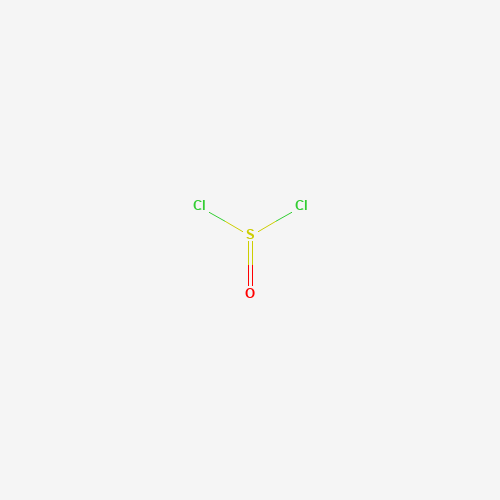
分子式Cl2OS
分子量118.97 g/mol
危化品
Physical Description | Thionyl chloride appears as a colorless to yellow fuming liquid with a suffocating pungent odor. Boiling point 79 °C. A lachrymator. Highly corrosive and toxic. Long-term inhalation of low concentrations or short-term inhalation of high concentrations has adverse health effects.
科学粮草官-词典编辑部,修订于:2026-07-06
Toxicity
ToxicityFate Summary
TERRESTRIAL FATE: Thionyl chloride reacts rapidly and violently with water, water vapor or moisture to form sulfur dioxide and hydrogen chloride(1). Therefore, reaction with hyrdroxyl radicals is not expected to be an environmental fate process(SRC).
Environmental Abiotic Degradation
Thionyl chloride reacts rapidly and violently with water, water vapor or moisture to form sulfur dioxide and hydrogen chloride(1).
Artificial Pollution Sources
Thionyl chloride's production and use in the manufacture of pesticides, engineering plastics, as a chlorinating agent, catalyst(1) and in the synthesis of various nerve agents(2) may result in its release to the environment through various waste streams(SRC).
Probable Routes of Human Exposure
NIOSH (NOES Survey 1981-1983) has statistically estimated that 7082 workers (1223 of these are female) were potentially exposed to thionyl chloride in the US(1).
Symptoms
irritation eyes, skin, mucous membrane; eye, skin burns
Target Organs
Eyes, skin, respiratory system
Toxicity Data
LC50 (rat) = 500 ppm/1h
Adverse Effects
Fibrogenic - Inducing tissue injury and fibrosis (scarring).
Exposure Routes
inhalation, ingestion, skin and/or eye contact
Toxicity Summary
IDENTIFICATION AND USE: Thionyl chloride is a colorless to pale yellow or reddish liquid. Thionyl chloride is an industrially produced liquid used to make acyl chlorides and to synthesize pharmaceuticals including drugs and vitamins. It is used to make dyes, to prepare organic chlorine compounds, as a solvent in the production of herbicides, and as an electrolyte in lithium batteries. Thionyl chloride is also used to prepare polyacrylate-type engineering thermoplastics made from iso- and tere-phthaloyl chlorides. It is required in the manufacture of methylphosphonic dichloride, a key precursor for the nerve gas Sarin. HUMAN STUDIES: Potential symptoms of overexposure are irritation of eyes, skin, mucous membranes, as well as eye and skin burns. Symptoms of exposure range from mild irrit...
Non-Human Toxicity Values
LC50 Rat inhalation 500 ppm/1 hr
Non-Human Toxicity Excerpts
/LABORATORY ANIMALS: Acute Exposure/ A 20-min exposure to 17.5 ppm is said to have proved fatal to cats.
Antidote and Emergency Treatment
If this chemical gets into the eyes, remove any contact lenses at once and irrigate immediately for at least 15 min, occasionally lifting upper and lower lids. Seek medical attention immediately. If this chemical contacts the skin, remove contaminated clothing and wash immediately with soap and water. Seek medical attention immediately. If this chemical has been inhaled, remove from exposure, begin rescue breathing (using universal precautions, including resuscitation mask) if breathing has stopped and CPR if heart action has stopped. Transfer promptly to a medical facility. When this chemical has been swallowed, get medical attention. If victim is conscious, administer water or milk. Do not induce vomiting. Medical observation is recommended for 24-48 hr after breathing overexposure, a...