


 一键配货
一键配货
化合物详情
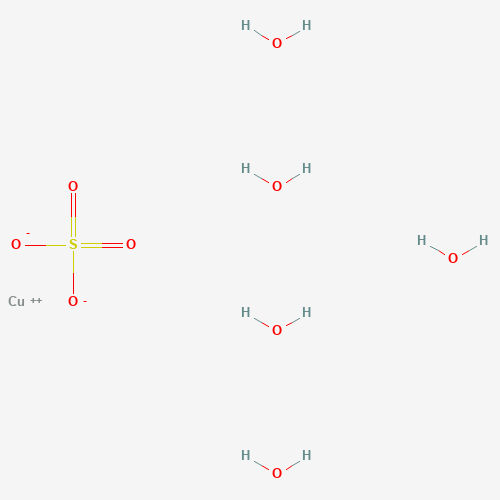
CAS7758-99-8
分子式CuH10O9S
分子量249.69 g/mol
非危品
Physical Description | Copper sulfate pentahydrate appears as blue crystalline granules or powder. Melting point 110 °C (with decomposition). Non-combustible. Nauseating metallic taste. Odorless. White when dehydrated. (NTP, 1992)
科学粮草官-词典编辑部,修订于:2026-07-06
Toxicity
ToxicityBody Burden
The milk of female vineyard workers, who were exposed to copper sulfate and a variety of other pesticides, contained 6.2 times as much copper as the milk of milkmaids who did equally hard work but not exposed to pesticides. Placentas from the vineyard workers contained 4.7 times more copper than those from milkmaids. ... Copper ... occurs in all tissues. ... The concn in blood, muscle, and most of the viscera range from 0.85 to 1.90 ppm. Values for plasma lie in the narrow range of 1.16 to 1.42 ppm. The concn in the brain (2.2 to 6.8 ppm), liver (7.1 ppm in adults and 24 ppm in infants), and bone (3.7 to 4.7 ppm in rib and 6.8 ppm in long bones) are higher.
EPA Ecotoxicity
Pesticide Ecotoxicity Data from EPA: 44
Fate Summary
Terrestrial Fate: In soil, copper sulfate is partly washed down to lower levels, partly bound by soil components, and partly oxidatively transformed.
Environmental Water Concentrations
SITE OF HERBICIDAL USE: IN FLOWING WATER CANALS OR IN RESERVOIRS. LIKELY CONCN IN IRRIGATION WATER REACHING CROP OR FIELD: @ TREATMENT RATE OF 0.5-3.0 MG/L (CONTINUOUS) 0.8-0.04 MG/L IN 10 MILES; @ 1/3 TO 1 LB/CFS (SLUG) 9.0 TO 0.08 MG/L IN 10-20 MILES. /FROM TABLE/
Milk Concentrations
The milk of female vineyard workers, who were exposed to copper sulfate and a variety of other pesticides, contained 6.2 times as much copper as the milk of milkmaids who did equally hard work but not exposed to pesticides.
Plant Concentrations
Absorbed by alga. Low foliar absorption on other vegetation. ... Both foliar & soil absorbed copper ions are translocated throughout the plant. Plant roots exclude the absorption of excess copper levels.
ICSC Environmental Data
The substance is very toxic to aquatic organisms. The substance may cause long-term effects in the aquatic environment. Bioaccumulation of this chemical may occur along the food chain, for example in fish. It is strongly advised not to let the chemical enter into the environment.
Natural Pollution Sources
Occurs in nature as mineral chalcanthite.
Symptoms
Ingestion Exposure: Abdominal pain. Burning sensation. Nausea. Vomiting. Diarrhoea. Shock or collapse.
Interactions
IP INJECTION OF 5-10 MG/KG COPPER SULFATE PENTAHYDRATE & 25-90 MG/KG ETHYLNITROSOUREA INTO RATS CAUSED LOCAL ASCITES SARCOMAS AFTER 190 DAYS. INJECTION OF THE LATTER ALONE OR METAL SALTS ALONE HAD NO CARCINOGENIC EFFECT. SC ADMIN OF 10 MG/KG/WK ETHYLNITROSOUREA WITH 1 MG/KG COPPER SULFATE PENTAHYDRATE INDUCED LOCAL SARCOMAS IN 4 OF 24 ANIMALS TESTED.
Exposure Routes
The substance can be absorbed into the body by inhalation of its aerosol and by ingestion.
Non-Human Toxicity Values
LD50 Rat oral 960 mg/kg body weight /from table/
Antidote and Emergency Treatment
Advanced treatment: Consider orotracheal or nasotracheal intubation for airway control in the patient who is unconscious. Start an IV with lactated Ringer's /SRP: "To keep open", minimal flow rate/. Watch for signs of fluid overload. For hypotension with signs of hypovolemia, administer fluid cautiously. Consider vasopressors if hypotensive with a normal fluid volume. Watch for signs of fluid overload ... . Use proparacaine, hydrochloride to assist eye irrigation ... . /Copper and related compounds/









