


 一键配货
一键配货
化合物详情
CAS7783-60-0
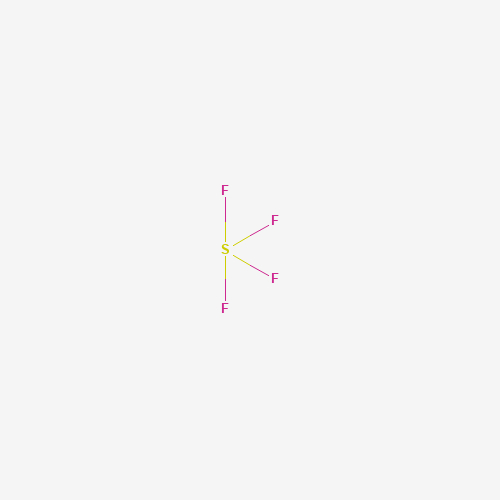
分子式F4S
分子量108.06 g/mol
危化品
Physical Description | Sulfur tetrafluoride is a colorless gas with a distinct sulfur odor. It is highly toxic by inhalation and a strong irritant to skin, eyes and mucous membranes. It reacts vigorously with water and acids to yield toxic fluoride and sulfur oxide fumes and an acidic solution. Sulfur tetrafluoride is heavier than air. Under prolonged exposure to fire or intense heat the containers may violently rupture or rocket. It is used as a fluoridizing agent and as an oil repellent.
科学粮草官-词典编辑部,修订于:2026-07-06
Toxicity
ToxicityFate Summary
ATMOSPHERIC FATE: According to a model of gas/particle partitioning of semivolatile organic compounds in the atmosphere(1), sulfur tetrafluoride, which has a vapor pressure of 1.52X10+4 mm Hg at 25 °C(2), is expected to exist solely as a gas in the ambient atmosphere. Sulfur tetrafluoride is a relatively heavy gas with a vapor density 3.78 times that of air(3). Therefore, if released in the atmosphere, it may tend to remain close to the ground and be transported to earth by wet deposition(SRC). Sulfur tetrafluoride reacts rapidly with water to yield hydrofluoric acid and thionyl fluoride(2). It also reacts and fumes in moist air(2). Therefore, hydrolysis is expected to be an important fate process in the ambient atmosphere(SRC).
Soil Adsorption / Mobility
Using a structure estimation method based on molecular connectivity indices(1), the Koc of sulfur tetrafluoride can be estimated to be 27(SRC). According to a classification scheme(2), this estimated Koc value suggests that sulfur tetrafluoride is expected to have very high mobility in soil. Sulfur tetrafluoride reacts rapidly with water(3), therefore, leaching in moist soils will be attenuated by hydrolysis(SRC).
Environmental Bioconcentration
Sulfur tetrafluoride reacts rapidly with water to yield hydrofluoric acid and thionyl fluoride(1). Therefore, bioconcentration in aquatic organisms weill not occur(SRC).
Volatilization from Water / Soil
Sulfur tetrafluoride reacts rapidly with water to yield hydrofluoric acid and thionyl fluoride(1). Therefore, volatilization from water is not expected to be an important fate process(SRC). Sulfur tetrafluoride is a gas with vapor pressure of 1.52X10+4 mm Hg at 25 °C(1). Therefore, volatilization from moist soil surfaces would be expected to occur; however, rapid hydrolysis will attenuate the importance of volatilization from moist soil(SRC). Sulfur tetrafluoride is expected to volatilize from dry soil surfaces based upon its vapor pressure(SRC).
Environmental Abiotic Degradation
Sulfur tetrafluoride reacts rapidly with water to yield hydrofluoric acid and thionyl fluoride(1). The hydrolysis reaction rate in water has been reported to be instantaneous(2). It has also been reported that sulfur tetrafluoride reacts and fumes in moist air(1).
Artificial Pollution Sources
Sulfur tetrafluoride's production and use as a selective fluorinating agent(1), as a treatment to increase the water repellency of polymeric materials, in the preparation of high-lubricity elastomers, and for treatment of carbon blacks to prepare improved rubber vulcanizates(2) may result in its release to the environment through various waste streams(SRC). Sulfur tetrafluoride can be formed as a degradation product of high temperature decomposition of sulfur hexafluoride(3).
Probable Routes of Human Exposure
Occupational exposure to sulfur tetrafluoride may occur through inhalation of this compound at workplaces where sulfur tetrafluoride is produced or used(SRC). Sulfur tetrafluoride was identified as a degradation product of sulfur hexafluoride during electrical repair work causing exposure to six electrical workers(1).
Environmental Fate / Exposure Summary
Sulfur tetrafluoride's production and use as a chemical agent, as an intermediate andin the treatment agent for rubbers and polymers may result in its release to the environment through various waste streams. Sulfur tetrafluoride can be formed as a degradation product of high temperature decomposition of sulfur hexafluoride. If released into the atmosphere, sulfur tetrafluoride will exist in the gas phase in the ambient atmosphere, based on a vapor pressure of 1.52X10+4 mm Hg at 25 °C. Sulfur tetrafluoride is a relatively heavy gas with a vapor density 3.78 times that of air. Therefore, if released in the atmosphere, it may tend to remain close to the ground and be transported to earth by wet deposition. Sulfur tetrafluoride reacts rapidly with water to yield hydrofluoric acid and thion...
Symptoms
irritation eyes, skin, mucous membrane; eye, skin burns (from SF4 releasing hydrofluoric acid on exposure to moisture); liquid: frostbite; In Animals: dyspnea (breathing difficulty), lassitude (weakness, exhaustion), rhinorrhea (discharge of thin nasal mucus)
Target Organs
Eyes, skin, respiratory system
Toxicity Data
LCLo (rat) = 19 ppm/4h
Adverse Effects
Toxic Pneumonitis - Inflammation of the lungs induced by inhalation of metal fumes or toxic gases and vapors.
Exposure Routes
inhalation, skin and/or eye contact
Toxicity Summary
IDENTIFICATION AND USE: Sulfur tetrafluoride (SF4) is a colorless gas. It is used as a selective fluorinating agent, capable of replacing oxygen in many organic, inorganic, and organometallic compounds with fluorine. It is also used in the production of water- and oil-repellant materials and lubricity improvers. HUMAN EXPOSURE AND TOXICITY: SF4 exerts severe local effects upon inhalation at rather low exposure levels, most probably due to respiratory tract irritation. Eye-irritating properties are suggested by a case study, in which workers were exposed to the breakdown products of sulphur hexafluoride. ANIMAL STUDIES: Local effects in the respiratory tract were found in a rat study at 4 ppm (18 mg/cu m).
Human Toxicity Excerpts
/OTHER TOXICITY INFORMATION/ In view of the violent reaction of sulphur tetrafluoride with water, systemic exposure to this compound itself may be deemed negligible. Systemic exposure to hydrogen fluoride, sulphur dioxide, and thionyl dioxide - hydrolysis products - will, however, occur.
Non-Human Toxicity Excerpts
/ALTERNATIVE and IN VITRO TESTS/ Using quadrupole mass spectrometric analysis of sparked sulfur hexafluoride over energy and pressure ranges of 4-94 kj and 40-233 kPa, respectively, the by-products include sulfur tetrafluoride. The cytotoxic activity of certain of the more abundant decomposition products (prepared as mixtures of the specified by- product SF6) toward the Chinese hamster lung cells using a colony formation assay were investigated. Sulfur fluoride exhibited no sigificant cytotoxic activity at 0.5% concentration, although concentrations of 1 and 2% showed definite cytotoxicity, particularly after 4 hr of exposure.









