


 一键配货
一键配货
化合物详情
CAS7790-94-5
分子式ClHO3S
分子量116.52 g/mol
危化品
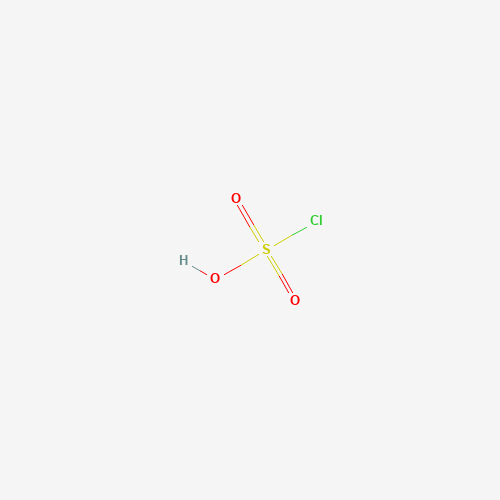
Physical Description | Chlorosulfonic acid appears as a colorless to yellow colored fuming liquid with a pungent odor. Density 14.7 lb / gal. Causes severe burns. Very toxic by inhalation. Corrosive to metals.
科学粮草官-词典编辑部,修订于:2026-07-06
Toxicity
ToxicityFate Summary
ATMOSPHERIC FATE: If chlorosulfonic acid is released to the atmosphere, it will be expected to exist almost entirely in the vapor phase(1) based upon a reported vapor pressure of 0.75 mm Hg at 20 °C(2). It may be susceptible to hydrolysis in moist air based upon its rapid hydrolysis in aqueous solution(4,SRC) and the report that the chemical fumes in air(5). It will be susceptible to photooxidation via vapor phase reaction with photochemically produced hydroxyl radicals. An atmospheric half-life of 1.2 years at an atmospheric concentration of 5X10+5 hydroxyl radicals per cu cm has been calculated for this process based upon an estimated rate constant(3,SRC).
Environmental Biodegradation
No data were located concerning the biodegradation of chlorosulfonic acid either in natural systems or in laboratory studies(SRC). Since chlorosulfonic acid is violently hydrolyzed in water(1), biodegradation is not expected to be a significant process(SRC).
Environmental Bioconcentration
Since chlorosulfonic acid is violently hydrolyzed in water(1), bioconcentration in aquatic organisms is not expected to be a significant process(SRC).
Volatilization from Water / Soil
Since chlorosulfonic acid is violently hydrolyzed in water(1), it is not possible to estimate the half-life for volatilization from these media(SRC). Volatilization from water and moist soil, however, is not expected to be significant relative to rapid hydrolysis(SRC). Based upon a measured vapor pressure of 0.75 mm Hg at 20 °C(2), volatilization of chlorosulfonic acid from surfaces and near-surface dry soil may be significant processes(SRC).
Environmental Abiotic Degradation
Chlorosulfonic acid reacts violently with water, hydrolyzing to hydrogen chloride and sulfuric acid(1) which indicates that the compound has a very short half-life in aqueous media(SRC). Chlorosulfonic acid fumes in air(3) suggesting that the compound may be susceptible to hydrolysis in the atmosphere(SRC). The rate constant for the vapor phase reaction of chlorosulfonic acid with photochemically produced hydroxyl radicals has been estimated to be 0.036X10⁻¹² cu cm/molecule-sec at 25 °C which corresponds to an atmospheric half-life of 1.2 years at an atmospheric concentration of 5X10+5 hydroxyl radicals per cu cm(2,SRC).
Artificial Pollution Sources
Chlorosulfonic acid may be released to the environment as a result of its manufacture and use as an intermediate in the synthesis of detergents, pharmaceuticals, sulfonating agents for dyes, pesticides, ion-exchange resins, anhydrous hydrogen chloride, and smoke-producing chemicals(1).
Probable Routes of Human Exposure
NIOSH (NOES Survey 1981-1983) has statistically estimated that 3,260 workers are potentially exposed to chlorosulfonic acid in the USA(1). NIOSH (NOHS Survey 1972-1974) has statistically estimated that 1,690 workers are potentially exposed to chlorosulfonic acid in the USA(2).
Environmental Fate / Exposure Summary
Chlorosulfonic acid may be released to the environment as a result of its manufacture and use as an intermediate in the synthesis of a variety of chemicals including detergents, pharmaceuticals, and pesticides. If chlorosulfonic acid is released to soil, it will be expected to rapidly hydrolyze if the soil is moist, based upon the reported violent hydrolysis by water giving hydrochloric and sulfuric acids. Since it rapidly hydrolyzes, biodegradation, adsorption to and volatilization from moist soil are not expected to be significant processes, although no data specifically regarding the fate of chlorosulfonic acid in soil were located. Based upon a measured vapor pressure of 0.75 mm Hg at 20 °C, volatilization from dry near-surface soil or other surfaces may be significant processes. If...
Symptoms
Ingestion Exposure: Burning sensation. Abdominal pain. Nausea. Shock or collapse.
Toxicity Data
LC50 (rat) = 38.5 mg/m3/4hr
Adverse Effects
Toxic Pneumonitis - Inflammation of the lungs induced by inhalation of metal fumes or toxic gases and vapors.
Exposure Routes
The substance can be absorbed into the body by inhalation of its vapour and by ingestion.
Human Toxicity Excerpts
... EXTREMELY CAUSTIC LIQUID WHICH GIVES OFF FUMES VERY IRRITATING TO EYES & RESP PASSAGES.
Non-Human Toxicity Values
LC50 RAT INHALATION 38.5 MG/CU M/4 HR
Non-Human Toxicity Excerpts
... RESP TRACT & OCULAR IRRITATION, HISTOPATHOLOGICAL CHANGES IN INTERNAL ORGANS WERE OBSERVED IN ACUTELY POISONED ANIMALS.









