


 一键配货
一键配货
化合物详情
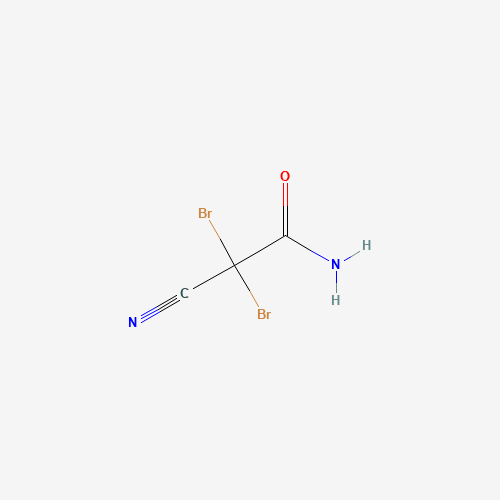
CAS10222-01-2
分子式C3H2Br2N2O
分子量241.87 g/mol
非危品
Physical Description | 2,2-dibromo-3-nitrilopropionamide is a colorless to yellow liquid with a moldy pungent odor.
科学粮草官-词典编辑部,修订于:2026-07-06
Toxicity
ToxicityEPA Ecotoxicity
Pesticide Ecotoxicity Data from EPA: 33
Fate Summary
ATMOSPHERIC FATE: According to a model of gas/particle partitioning of semivolatile organic compounds in the atmosphere(1), 2,2-dibromo-3-nitrilopropionamide, which has a vapor pressure of 9X10⁻⁴ mm Hg at 25 °C(2), will exist solely as a vapor in the ambient atmosphere. Vapor-phase 2,2-dibromo-3-nitrilopropionamide is degraded in the atmosphere by reaction with photochemically-produced hydroxyl radicals(SRC); the half-life for this reaction in air is estimated to be 8 days(SRC), calculated from its rate constant of 2.0X10⁻¹² cu cm/molecule-sec at 25 °C(SRC) determined using a structure estimation method(3). Based on photolysis studies showing degradation in aqueous solution exposed to sunlight (99% loss in 28 days)(4), 2,2-dibromo-3-nitrilopropionamide is expected to be susceptible to d...
Soil Adsorption / Mobility
The Koc of 2,2-dibromo-3-nitrilopropionamide is estimated as 58(SRC), using a log Kow of 0.80(1) and a regression-derived equation(2). According to a classification scheme(3), this estimated Koc value suggests that 2,2-dibromo-3-nitrilopropionamide is expected to have high mobility in soil.
Environmental Biodegradation
ANAEROBIC: 2,2-Dibromo-3-nitilopropionamide has a half-life of less than 4 hours in an anaerobic aquatic metabolism study; residues were mainly found in the aqueous layer. Concentrations of the two main degradates 2-cyanoacetamide (reached 56% of applied within 7 days) and dibromoacetic acid (reached 27% of applied at 0 hr, 17% by day 48) were measured. Other minor degradates include oxalic acid, bromoacetamide and dibromoactonitrile. 2-Cyanoacetamide, dibromoacetonitrile and bromoacetamide were found in the sediment layer. The anaerobic metabolism study includes degradation due to both biotic and abiotic mechanisms(1).
Environmental Bioconcentration
An estimated BCF of 3 was calculated in fish for 2,2-dibromo-3-nitrilopropionamide(SRC), using a log Kow of 0.80(1) and a regression-derived equation(2). According to a classification scheme(3), this BCF suggests the potential for bioconcentration in aquatic organisms is low(SRC). Using carp (Cyprinus carpio) which were exposed over an 8-week period, 2,2-dibromo-3-nitrilopropionamide was reported to have low bioconcentration (BCF value not available)(4).
Volatilization from Water / Soil
The Henry's Law constant for 2,2-dibromo-3-nitrilopropionamide is estimated as 1.9X10⁻⁸ atm-cu m/mole(SRC) derived from its vapor pressure, 9.0X10⁻⁴ mm Hg(1), and water solubility, 1.5X10+4 mg/L(1). This Henry's Law constant indicates that 2,2-dibromo-3-nitrilopropionamide is expected to be essentially nonvolatile from water surfaces(2). 2,2-Dibromo-3-nitrilopropionamide's estimated Henry's Law constant indicates that volatilization from moist soil surfaces is not expected to occur(SRC). 2,2-Dibromo-3-nitrilopropionamide is not expected to volatilize from dry soil surfaces(SRC) based upon its vapor pressure(1).
Environmental Abiotic Degradation
The rate constant for the vapor-phase reaction of 2,2-dibromo-3-nitrilopropionamide with photochemically-produced hydroxyl radicals has been estimated as 2.0X10⁻¹² cu cm/molecule-sec at 25 °C(SRC) using a structure estimation method(1). This corresponds to an atmospheric half-life of about 8 days at an atmospheric concentration of 5X10+5 hydroxyl radicals per cu cm(1). Less than 1% of a 4000 ppm aqueous solution of 2,2-dibromo-3-nitrilopropionamide remained after 28 days exposure to sunlight(2); 91% of the added 2,2-dibromo-3-nitrilopropionamide was still present in the dark control after the same period of time(2). Dibromoacetic acid (63.7%) is the major degradate at pH 5 (half-life of 14.8 hours; dark control forms dibromoacetic acid at 38.6%) and at pH 7 (half-life of 6.9 hours; dark...
Artificial Pollution Sources
2,2-Dibromo-3-nitrilopropionamide's production and use as a bactericide and algicide in commercial water cooling and treatment systems and paper-pulp mill water systems(1) may result in its release to the environment through various waste streams(SRC).
Probable Routes of Human Exposure
NIOSH (NOES Survey 1981-1983) has statistically estimated that 9,829 workers (108 of these were female) were potentially exposed to 2,2-dibromo-3-nitrilopropionamide in the US(1). Occupational exposure to 2,2-dibromo-3-nitrilopropionamide may occur through inhalation and dermal contact with this compound at workplaces where 2,2-dibromo-3-nitrilopropionamide is produced or used(SRC). The general population may be exposed to 2,2-dibromo-3-nitrilopropionamide via dermal contact with consumer products such as latex paint containing 2,2-dibromo-3-nitrilopropionamide(SRC).
Environmental Fate / Exposure Summary
2,2-Dibromo-3-nitrilopropionamide's production and use as a bactericide and algicide in commercial water cooling and treatment systems and paper-pulp mill water systems may result in its release to the environment through various waste streams. If released to air, a vapor pressure of 9X10⁻⁴ mm Hg at 25 °C indicates 2,2-dibromo-3-nitrilopropionamide will exist solely as a vapor in the ambient atmosphere. Vapor-phase 2,2-dibromo-3-nitrilopropionamide will be degraded in the atmosphere by reaction with photochemically-produced hydroxyl radicals; the half-life for this reaction in air is estimated to be 8 days. Based on photolysis studies showing degradation in aqueous solution exposed to sunlight (99% loss in 28 days), 2,2-dibromo-3-nitrilopropionamide is expected to be susceptible to dire...
Toxicity Data
LC50 (rat) = 320 mg/m3/4h
Adverse Effects
Toxic Pneumonitis - Inflammation of the lungs induced by inhalation of metal fumes or toxic gases and vapors.
Toxicity Summary
IDENTIFICATION AND USE: 2,2-Dibromo-3-nitrilopropionamide (DBNPA) is white to "off white" crystalline solid. It is used as a pesticide(Trade Names: DBNPA, Slimicide 508, XD-7287L Antimicrobial, XD-1603.) Main uses include the following: algicide, bactericide and fungicide; preservative used mainly in pulp, paper and paperboard mill water systems and in industrial water cooling systems. It is also used as a preservative in animal glues, metalworking cutting fluids, oil recovery drilling muds, latex paints, resin/latex/polymer emulsions, latex/oil/varnish paints, and paper and paper products. HUMAN EXPOSURE AND TOXICITY: Several human incident reports concerning DBNPA are on file with the EPA. These include eye, throat, & respiratory irritation, runny nose, & headache. Generally the effec...
Human Toxicity Excerpts
/GENOTOXICITY/ Samples of proliferating cultured human lymphocytes were exposed to C-103 (2,2-Dibromo-3- Nitrilopropionamide, DBNPG, lot 23/1817, 98% stated purity) with and without metabolic activation (S-9 fraction of Aroclor-1254 induced rat liver homogenates) for 2 hours, incubated for 22 or 46 hours, arrested in metaphase with colchicine, fixed, stained and microscopically examined for chromosome aberrations. 100 cells were evaluated per sample with two samples per treatment. Treatment levels without S-9 were 0, 25, 37.5 and 50 ug/mL (22 hour incubation) and 0 and 37.5 ug/mL (46 hour incubation) and with S-9 were 0, 5, 25, and 50 ug/mL (22 hour incubation) and 0 and 37.5 ug/mL (46 hour incubation). Positive controls were adequate. No treatment related effects on chromosome aberrati...
Antidote and Emergency Treatment
/SRP:/ Advanced treatment: Consider orotracheal or nasotracheal intubation for airway control in the patient who is unconscious, has severe pulmonary edema, or is in severe respiratory distress. Positive-pressure ventilation techniques with a bag valve mask device may be beneficial. Consider drug therapy for pulmonary edema ... . Consider administering a beta agonist such as albuterol for severe bronchospasm ... . Monitor cardiac rhythm and treat arrhythmias as necessary ... . Start IV administration of D5W TKO /SRP: "To keep open", minimal flow rate/. Use 0.9% saline (NS) or lactated Ringer's (LR) if signs of hypovolemia are present. For hypotension with signs of hypovolemia, administer fluid cautiously. Watch for signs of fluid overload ... . Treat seizures with diazepam or lorazepam...









