


 一键配货
一键配货
化合物详情
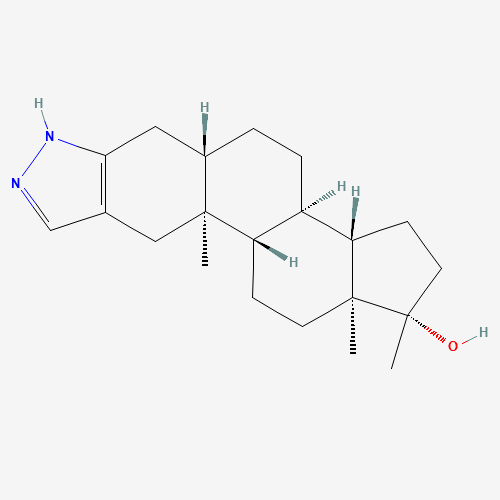
CAS10418-03-8
分子式C21H32N2O
分子量328.49 g/mol
非危品
Stanozolol can cause cancer according to state or federal government labeling requirements.
科学粮草官-词典编辑部,修订于:2026-07-06
Toxicity
ToxicityFate Summary
ATMOSPHERIC FATE: According to a model of gas/particle partitioning of semivolatile organic compounds in the atmosphere(1), stanozolol, which has an estimated vapor pressure of 3.3X10⁻⁹ mm Hg at 25 °C(SRC), determined from a fragment constant method(2), is expected to exist solely in the particulate phase in the ambient atmosphere. Particulate-phase stanozolol may be removed from the air by wet and dry deposition(SRC). Stanozolol does not absorb light at wavelengths >290 nm(3), and therefore should not be susceptible to direct photolysis.
Soil Adsorption / Mobility
Using a structure estimation method based on molecular connectivity indices(1), the Koc for stanozolol can be estimated to be 15,000(SRC). According to a classification scheme(2), this estimated Koc value suggests that stanozolol is expected to be immobile in soil.
Environmental Bioconcentration
An estimated BCF of 500 was calculated for stanozolol(SRC), using an estimated log Kow of 4.4(1) and a regression-derived equation(2). According to a classification scheme(3), this BCF suggests the potential for bioconcentration in aquatic organisms is high(SRC), provided the compound is not metabolized by the organism(SRC).
Volatilization from Water / Soil
The Henry's Law constant for stanozolol is estimated as 1.1X10⁻⁸ atm-cu m/mole(SRC) using a fragment constant estimation method(1). This Henry's Law constant indicates that stanozolol is expected to be essentially nonvolatile from moist soil(SRC) and water surfaces(2). Stanozolol is not expected to volatilize from dry soil surfaces(SRC) based upon an estimated vapor pressure of 3.3X10⁻⁹ mm Hg(SRC), determined from a fragment constant method(3).
Environmental Abiotic Degradation
Stanozolol is not expected to undergo hydrolysis in the environment due to the lack of hydrolyzable functional groups(1). Stanozolol does not absorb light at wavelengths >290 nm(2), and therefore should not be susceptible to direct photolysis.
Artificial Pollution Sources
Stanozolol's former production and use as an androgen(1) and possible use as a performance enhancement drug in athletes(2) may have resulted in its release to the environment through various waste streams(SRC).
Probable Routes of Human Exposure
Occupational exposure to stanozolol may have occured through dermal contact with this compound at workplaces where stanozolol was produced or used. Exposure to the drug among the general population may have been limited to those administered stanozolol, an androgen. Intentional human exposure may have occurred from possible stanozolol use as a performance enhancement drug in athletes. (SRC)
Environmental Fate / Exposure Summary
Stanozolol's former production and use as androgen may have resulted in its release to the environment through various waste streams. If released to air, an estimated vapor pressure of 3.3X10⁻⁹ mm Hg at 25 °C indicates stanozolol will exist solely in the particulate phase in the atmosphere. Particulate-phase stanozolol will be removed from the atmosphere by wet and dry deposition. Stanozolol does not absorb light at wavelengths >290 and therefore should not be susceptible to direct photolysis. If released to soil, stanozolol is expected to have no mobility based upon an estimated Koc of 15,000. Volatilization from water and moist soil surfaces is not expected to be an important fate process based upon an estimated Henry's Law constant of 1.1X10⁻⁸ atm-cu m/mole. Stanozolol will not volat...
Interactions
Concurrent use /of other hepatotoxic medications/ with anabolic steroids may result in an increased incidence of hepatotoxicity; patients, especially those on prolonged administration or those with a history of liver disease, should be carefully monitored. /Anabolic steroids/
Toxicity Summary
IDENTIFICATION: Stanozolol is an anabolic steroid used for systemic use. Origin of the substance: Naturally occurring anabolic steroids are synthesised in the testis, ovary and adrenal gland from cholesterol via pregnenolone. Synthetic anabolic steroids are based on the principal male hormone testosterone, modified in one of three ways: alkylation of the 17-carbon; esterification of the 17-OH group and modification of the steroid nucleus Stanozolol is a white or almost white solid crystals and it is odorless. It is practically insoluble in water; soluble alcohol, chloroform and ether. It is soluble in dimethylformamide; slightly soluble in acetone and ethyl acetate. Description: The only legitimate therapeutic indications for anabolic steroids are: (A) replacement of male sex steroids i...
Human Toxicity Excerpts
/CASE REPORTS/ A 28-year-old body builder was admitted because of jaundice. For 80 days, until 3 weeks before hospitalization, he had been taking moderately high doses of anabolic steroids: metandienone (methandienone), 10-50 mg daily by mouth, and stanozolol, 50 mg intramuscularly every other day. Physical examination was unremarkable except for yellow discoloration of the skin and sclerae. Bilirubin concentration was raised to 4.5 mg/dl, cholestasis enzymes were normal, while transaminase activities were raised. Liver biopsy was compatible with cholestasis induced by anabolic steroids. Although the steroids had been discontinued, the patient's general condition deteriorated over 7 weeks. Serum bilirubin rose up to a maximum of 77.9 mg/dl. In addition renal failure developed with a cre...
Drug Induced Liver Injury
References: DOI:10.1016/j.drudis.2019.09.022
Populations at Special Risk
Anabolic steroids may decrease blood glucose concentrations; diabetic patients should be closely monitored for signs of hypoglycemia and dosage of hypoglycemic agent adjusted as necessary. /Anabolic steroids/
Antidote and Emergency Treatment
Advanced treatment: Consider orotracheal or nasotracheal intubation for airway control in the patient who is unconscious, has severe pulmonary edema, or is in respiratory arrest. Positive pressure ventilation techniques with a bag valve mask device may be beneficial. Monitor cardiac rhythm and treat arrhythmias as necessary ... . Start an IV with D5W /SRP: "To keep open", minimal flow rate/. Use lactated Ringer's if signs of hypovolemia are present. Watch for signs of fluid overload. Consider drug therapy for pulmonary edema ... . For hypotension with signs of hypovolemia, administer fluid cautiously. Watch for signs of fluid overload ... . Treat seizures with diazepam (Valium) ... . Use proparacaine hydrochloride to assist eye irrigation ... . /Poison A and B/









