

 一键配货
一键配货
化合物详情
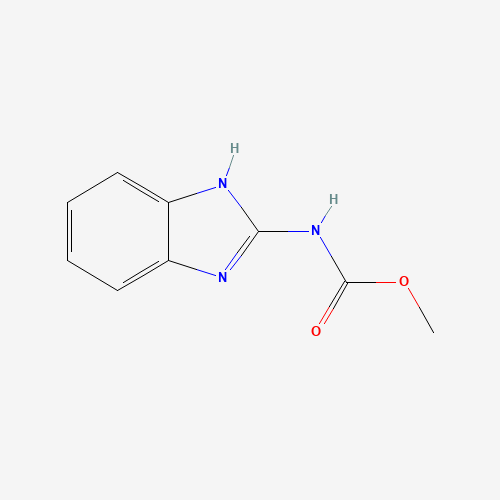
CAS10605-21-7
分子式C9H9N3O2
分子量191.19 g/mol g/mol
危化品
Physical Description | Carbendazim appears as light gray or beige powder. (NTP, 1992)
科学粮草官-词典编辑部,修订于:2026-07-06
Toxicity
ToxicityEPA Ecotoxicity
Pesticide Ecotoxicity Data from EPA: 46
Fate Summary
ATMOSPHERIC FATE: According to a model of gas/particle partitioning of semivolatile organic compounds in the atmosphere(1), carbendazim, which has a vapor pressure of 7.5X10⁻¹⁰ mm Hg at 25 °C(2), is expected to exist solely in the particulate phase in the ambient atmosphere. Particulate-phase carbendazim may be removed from the air by wet and dry deposition(SRC).
Environmental Biodegradation
AEROBIC: Carbendazim, present at 100 mg/L, reached 0% of its Theoretical BOD in 4 weeks using an activated sludge inoculum at 30 mg/L and the Japanese MITI test(1). Carbendazim, present at 10.0 ug/mL, was degraded 100% in 5 days in soil previously treated with the fungicide and degraded only 45% in 21 days in uncontaminated soil; mixed bacterial cultures were used(2). Carbendazim was degraded 5% in sterile sand after 14 days, 45% in non-history soil after 14 days, 97% in 2% pretreated soil after 9 days, and 100% in 100% pretreated soil after 7 days(2). Approximately two-thirds of the various fungal isolates capable of degrading carbendazim were identified as Alternaria alternata(3). Based on these data, carbendazim is expected to biodegrade slowly in soil under normal environmental cond...
Environmental Bioconcentration
BCFs of <1.5-3.5 and 0.6-1.1 were measured using carp (Cyprinus carpio) exposed to 2 and 20 ug/L, respectively, carbendazim over a 6-week period(1). Carbendazim was not bioconcentrated in perch (Perca fluviatilis) and carp exposed to food pellets containing a mixture of 13 pesticides(2). According to a classification scheme(3), these BCF values suggest bioconcentration in aquatic organisms is low(SRC).
Volatilization from Water / Soil
The Henry's Law constant for carbendazim is estimated as 1.5X10⁻¹² atm-cu m/mole(SRC) using a fragment constant estimation method(1). This Henry's Law constant indicates that carbendazim is expected to be essentially nonvolatile from moist soil and water surfaces(2). Carbendazim is not expected to volatilize from dry soil surfaces(SRC) based upon a vapor pressure of 7.5X10⁻¹⁰ mm Hg(3).
Environmental Abiotic Degradation
Measured hydrolysis half-lives for carbendazim at 22 °C were >350 days at pH 5-7 and 124 days at pH 9(1). Hydrolysis half-lives for carbendazim were 111.4, 85.6, 66.9 and 49.20 days, at salinity levels of 0, 20, 40, and 60 meq/L electrolyte, respectively(2). Aqueous photodegradation life-time of carbendazim in natural waters in Europe in the summer was reported as 12.5 days, with a degradation product of 2-aminobenzimidazole(3).
Milk Concentrations
Carbendazim was not detected (detection limit not reported) in 2739 and 180 plain and vitamin D milk samples, respectively; samples collected Oct 1, 1984 to Sept 30, 1991 in the US(1).
Plant Concentrations
Carbendazim was detected at 0.40 and 0.55 ppm in cauliflower leaves 15 days after 250 and 500 g/ha application, respectively, in December 1984(1). Carbendazim was detected at 0.71 and 1.85 ppm in cauliflower curd 15 days after 250 and 500 g/ha application, respectively, in February 1985. Carbendazim was detected at 0.85 ppm in cauliflower leaves 15 days after 500 g/ha application in February 1985(1). Carbendazim was detected in rice grown in integrated pest managed fields in Dehradun, India at 0.0009-0.002 ug/kg; samples were collected 2005-2006(2).
Animal Concentrations
There is considerable and ongoing debate as to the harm inflicted on bees by exposure to agricultural pesticides. In part, the lack of consensus reflects a shortage of information on field-realistic levels of exposure. Here, we quantify concentrations of neonicotinoid insecticides and fungicides in the pollen of oilseed rape, and in pollen of wildflowers growing near arable fields. We then compare this to concentrations of these pesticides found in pollen collected by honey bees and in pollen and adult bees sampled from bumble bee colonies placed on arable farms. We also compared this with levels found in bumble bee colonies placed in urban areas. Pollen of oilseed rape was heavily contaminated with a broad range of pesticides, as was the pollen of wildflowers growing nearby. Consequent...
Effluent Concentrations
Carbendazim was detected in grab samples from the River Leam catchment located in central England with a maximum concentration of 170 ng/L in 1992(1). Carbendazim was detected at 1.7-21.3 and 1.6-20.1 ug/kg dry weight in sludge samples from 12 different waste water treatment plants in Switzerland sampled Jan and May 2001, respectively(2). Leachate of carbendazim used in facade coatings under laboratory conditions resulted in emission rates of 5-30, 73-178 and 0.6-1.3 mg/sq m day from short term immersion, permanent immersion and irrigation tests, respectively(3).
ICSC Environmental Data
The substance is very toxic to aquatic organisms. This substance does enter the environment under normal use. Great care, however, should be taken to avoid any additional release, for example through inappropriate disposal.
Artificial Pollution Sources
Carbendazim's production may result in its release to the environment through various waste streams; its use as a fungicide(1) will result in its direct release to the environment(SRC). Benomyl, a pesticide, released to the environment will form carbendazim when it is degraded(2). Carbendazim's production and use as an antimicrobial in caulks, concrete, grouts, inks, paints, sealants, stains and textiles(3) will result in its release to the environment through various waste streams(SRC).
Probable Routes of Human Exposure
Occupational exposure to carbendazim may occur through inhalation of dust and dermal contact with this compound at workplaces where carbendazim is produced or used. Monitoring data indicate that the general population may be exposed to carbendazim via ingestion of food containing residual fungicide. (SRC)
Environmental Fate / Exposure Summary
Carbendazim's production may result in its release to the environment through various waste streams; it's use as a fungicide will result in its direct release to the environment. If released to air, a vapor pressure of 7.5X10⁻¹⁰ mm Hg at 25 °C indicates carbendazim will exist solely in the particulate phase in the atmosphere. Particulate-phase carbendazim will be removed from the atmosphere by wet and dry deposition. If released to soil, carbendazim is expected to have high mobility in some soils with decreasing mobility as the amount of clay and organic carbon content increases, based upon Koc values of 122.3-2805, pH will have a lesser effect on mobility. Volatilization from moist soil surfaces is not expected to be an important fate process based upon an estimated Henry's Law constan...
Symptoms
Skin redness and skin irritation. Fetuses exposed to high levels may exhibit microphthalmia (small eyes) or anaphthalmia (no eyes).
Treatment
For acute exposures and first aid: EYES: irrigate opened eyes for several minutes under running water. INGESTION: do not induce vomiting. Rinse mouth with water (never give anything by mouth to an unconscious person). Seek immediate medical advice. SKIN: should be treated immediately by rinsing the affected parts in cold running water for at least 15 minutes, followed by thorough washing with soap and water. If necessary, the person should shower and change contaminated clothing and shoes, and then must seek medical attention. INHALATION: supply fresh air. If required provide artificial respiration.
Toxicity Data
Acute oral LD50 for rats is >15000 mg/kg and >2500 mg/kg for dogs
Health Effects
Carbendazim is a suspected endocrine disruptor. It is also a developmental toxin. Animals exposed to carbendazim in the womb to have serious deformities such as lack of eyes and hydrocephalus (water on the brain). Carbendazim can disrupt the development of sperm and damage testicular development in adult rats.
Adverse Effects
Reproductive Toxin - A chemical that is toxic to the reproductive system, including defects in the progeny and injury to male or female reproductive function. Reproductive toxicity includes developmental effects. See Guidelines for Reproductive Toxicity Risk Assessment.
Exposure Routes
Inhalation (L793); oral (L793); dermal (L793)
Toxicity Summary
Carbendazim targets beta tubulin in actively dividing cells. It binds to microtubules, interfering with cell functions, such as meiosis and intracellular transportation (A15332).
Minimum Risk Level
The MRLs for fresh produce in the European Union are now between 0.1 and 0.7 mg/kg
Average Daily Intake
The estimated dermal and inhalation exposure to workers applying pesticides to flower crops in greenhouses in Colombia were 20 and 0.03 mg/day, respectively; 10% of the dermal exposure was expected to be adsorbed through the skin resulting in 2 mg/day absorbed(1).
RAIS Toxicity Values
Oral Slope Factor Reference: OPP
Carcinogen Classification
No indication of carcinogenicity to humans (not listed by IARC).
Evidence for Carcinogenicity
Cancer Classification: Group C Possible Human Carcinogen
Antidote and Emergency Treatment
Advanced treatment: Consider orotracheal or nasotracheal intubation for airway control in the patient who is unconscious, has severe pulmonary edema, or is in severe respiratory distress. Positive-pressure ventilation techniques with a bag-valve-mask device may be beneficial. Monitor cardiac rhythm and treat arrhythmias if necessary ... . Start IV administration of D5W TKO /SRP: "To keep open", minimal flow rate/. Use 0.9% saline (NS) or lactated Ringer's (LR) if signs of hypovolemia are present. For hypotension with signs of hypovolemia, administer fluid cautiously. Watch for signs of fluid overload ... . Administer atropine. Correct hypoxia before administration ... . In severely poisoned patients, administer pralidoxime chloride (2-PAM). DIRECT PHYSICIAN ORDERS ONLY ... . Treat seizu...
USGS Health-Based Screening Levels for Evaluating Water-Quality
Reference: Smith, C.D. and Nowell, L.H., 2024. Health-Based Screening Levels for evaluating water-quality data (3rd ed.). DOI:10.5066/F71C1TWP