

 一键配货
一键配货
化合物详情
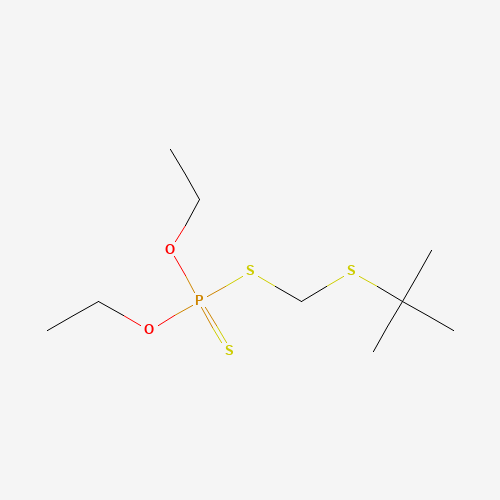
CAS13071-79-9
分子式C9H21O2PS3
分子量288.43 g/mol
危化品
Physical Description | Technical product is a clear, colorless to pale yellow liquid. Used as a soil insecticide. (EPA, 1998)
科学粮草官-词典编辑部,修订于:2026-07-06
Toxicity
ToxicityEPA Ecotoxicity
Pesticide Ecotoxicity Data from EPA: 72
Ecotoxicity Values
USDA APHIS Chemical Effects: collection=usda_chemeffect&query_type=synonym&query='^13071-79-9$'
Fate Summary
ATMOSPHERIC FATE: According to a model of gas/particle partitioning of semivolatile organic compounds in the atmosphere(1), terbufos, which has a vapor pressure of 0.00032 mm Hg at 20-25 °C(2), is expected to exist solely as a vapor in the ambient atmosphere. Vapor-phase terbufos is degraded in the atmosphere by reaction with photochemically-produced hydroxyl radicals(SRC); the half-life for this reaction in air is estimated to be 1.6 hours(SRC), calculated from its rate constant of 2.4X10⁻¹⁰ cu cm/molecule-sec at 25 °C(SRC), that was derived using a structure estimation method(3). While terbufos was found to degrade in solution upon exposure to sunlight(4), no data were found regarding direct photolysis in air by sunlight.
Soil Adsorption / Mobility
Koc values ranging from 500 to 5000 have been reported for terbufos(1-4). According to a classification scheme(5), these Koc values suggest that terbufos is expected to have low to slight mobility in soil.
Environmental Biodegradation
In soil, terbufos exhibited a half-life of 4 to 5 days. The sulfoxide formed by oxidation reached a maximum at about 14 days. The sulfone appeared one week after the start of incubation of soil with terbufos. Some other compounds observed in less than 1% amounts were the thiolophosphate, thiolophosphate sulfoxide and the thiolophosphate sulfone.
Environmental Bioconcentration
An estimated BCF of 560 was calculated for terbufos(SRC), using a log Kow of 4.48(1) and a regression-derived equation(2). According to a classification scheme(3), this BCF suggests the potential for bioconcentration in aquatic organisms is high(SRC).
Volatilization from Water / Soil
The Henry's Law constant for terbufos is 0.000024 atm-cu m/mole(SRC), derived from its vapor pressure, 0.00032 mm Hg(1), and water solubility, 5.07 mg/l(2). This Henry's Law constant indicates that terbufos is expected to volatilize from water surfaces(3). Based on this Henry's Law constant, the volatilization half-life from a model river (1 m deep, flowing 1 m/sec, wind velocity of 3 m/sec)(3) is estimated as 2.8 days (SRC). The volatilization half-life from a model lake (1 m deep, flowing 0.05 m/sec, wind velocity of 0.5 m/sec)(3) is estimated as 26 days(SRC). However, volatilization from water surfaces is expected to be attenuated by adsorption to suspended solids and sediment in the water column(SRC). The estimated volatilization half-life from a model pond is 43 days if adsorption...
Environmental Abiotic Degradation
The rate constant for the vapor-phase reaction of terbufos with photochemically-produced hydroxyl radicals has been estimated as 2.4X10⁻¹⁰ cu cm/molecule-sec at 25 °C(SRC) using a structure estimation method(1). This corresponds to an atmospheric half-life of about 1.6 hours at an atmospheric concn of 5X10+5 hydroxyl radicals per cu cm(1). Terbufos does not contain functional groups that are expected to absorb light at wavelengths >290 nm, and would not be expected to be susceptible to direct photolysis by sunlight in air (SRC). Terbufos was incubated in natural, sterilized and distilled water, with an initial pH of 8.8 at 20 °C; it disappeared rapidly (half-life=3 days) in all systems(2). The half-lives of terbufos in distilled, deionized unbuffered water, and in buffered solution at p...
Environmental Water Concentrations
RAIN/SNOW/FOG: Terbufos was detected in arctic marine fog samples in Aug-Sept 1993 from the Bering and Chukchi Seas at a maximum concn of 12 ng/l(1). Terbufos was not detected in urban and agricultural rain sampled in Mississippi from Apr-Sept 1995(2).
Food Survey Values
Terbufos was qualitatively found as residue in samples tested during the Food and Drug Administration pesticide residue monitoring of various food samples for the test period of 1978-1982(1) and 1983-1986(2). Terbufos was detected in the ethyl acetate and dichloromethane extracts of brown rice, potato, cabbage, lettuce, carrot, cucumber, shiitake mushroom, apple, strawberry, and banana obtained from a local retail store in Japan(3). Of the 16,198 imported commodities sampled from Jan 1992-Mar 1994 in the US, terbufos was found in one sample of imported fresh pears (n=775), at a concn in the range of 0.05-0.1 ppm(4). Terbufos was not detected as residues during the 1992(5) and 1994(6) US regulatory monitoring studies.
Milk Concentrations
Many of the organophosphorus insecticides are excreted in the milk ... /Organophosphorus insecticides/
Effluent Concentrations
Sediment from nine sampling sites located in the Suerte River basin in Costa Rica were analyzed for pesticides(1). Terbufos was detected in one of the nine samples from an open canal flowing from a banana packing facility at a concn of 154 ug/kg dry weight, and was not detected at the other sampling sites(1). Terbufos was detected in 2 of 32 samples in effluent from two banana packing plants in the Suerte River basin, Costa Rica(1).
ICSC Environmental Data
The substance is very toxic to aquatic organisms. The substance may cause long-term effects in the aquatic environment. Bioaccumulation of this chemical may occur in aquatic organisms. This substance does enter the environment under normal use. Great care, however, should be taken to avoid any additional release, for example through inappropriate disposal.
Atmospheric Concentrations
RURAL/REMOTE: Terbufos was not detected in agricultural air sampled in Mississipppi from Apr-Sept 1995(1).
Artificial Pollution Sources
Terbufos' production may result in its release to the environment through various waste streams; its use as an insecticide(1) will result in its direct release to the environment(SRC).
Sediment/Soil Concentrations
SEDIMENT: Sediment from nine sampling sites located in the Suerte River basin in Costa Rica were analyzed for pesticides(1). Terbufos was detected in one of the nine samples from an open canal flowing from a banana packing facility at a concn of 154 ug/kg dry weight, and was not detected at the other sampling sites(1).
Probable Routes of Human Exposure
Secondary exposure of children through contact with their parents' contaminated clothing can also occur. /Organophosphorus pesticides/
Environmental Fate / Exposure Summary
Terbufos' production may result in its release to the environment through various waste streams; its use as an insecticide will result in its direct release to the environment. If released to air, a vapor pressure of 0.00032 mm Hg at 20-25 °C indicates terbufos will exist solely as a vapor in the ambient atmosphere. Vapor-phase terbufos will be degraded in the atmosphere by reaction with photochemically-produced hydroxyl radicals; the half-life for this reaction in air is estimated to be 1.6 hours. Terbufos does not contain functional groups that are expected to absorb light at wavelengths >290 nm, and would not be expected to be susceptible to direct photolysis by sunlight in air. If released to soil, terbufos is expected to have low to slight mobility based upon Koc ranging from 500-5...
Symptoms
Ingestion Exposure: Blurred vision. Headache. Dizziness. Muscle spasms. Weakness. Vomiting. Diarrhoea. Abdominal pain.
Interactions
Because different classes of enzymes may be inhibited, the effects of organophosphorus pesticide poisoning may be complex and potentially at least could involve interactions with drugs as well as with other pesticides or chemicals. Potentiation may also involve solvents or other components of formulated pesticides. Certain drugs such a phenothiazines, antihistamines, CNS depressants, barbiturates, xanthines (theophylline), aminoglycosides and parasympathomimetic agents are to be avoided because of increased toxicity. /Organophosphorus pesticides/
Adverse Effects
ACGIH Carcinogen - Not Classifiable.
Exposure Routes
The substance can be absorbed into the body in hazardous amounts by ingestion, by inhalation and through the skin.
RAIS Toxicity Values
Oral Subchronic Chronic Reference Dose Reference: HEAST Current
Human Toxicity Excerpts
/SIGNS AND SYMPTOMS/ Principal effects /of anticholinesterases as toxic components of insecticides/ on eye, whether from local contact or systemic poisoning, are miosis and spasm of accommodation for near vision. /Anticholinesterases/
Acceptable Daily Intakes
FAO/WHO ADI: 0.0002 mg/kg
1 or Cancer Risk Level 1E-06
Soil Saturation Concentration (mg/kg): 3.09e+01
Hazard Quotient Level 3 or Cancer Risk Level 1E-04
Soil Saturation Concentration (mg/kg): 3.09e+01
USGS Health-Based Screening Levels for Evaluating Water-Quality
Reference: Smith, C.D. and Nowell, L.H., 2024. Health-Based Screening Levels for evaluating water-quality data (3rd ed.). DOI:10.5066/F71C1TWP