

 一键配货
一键配货
化合物详情
CAS13171-00-1
分子式C17H24O
分子量244.38 g/mol g/mol
非危品
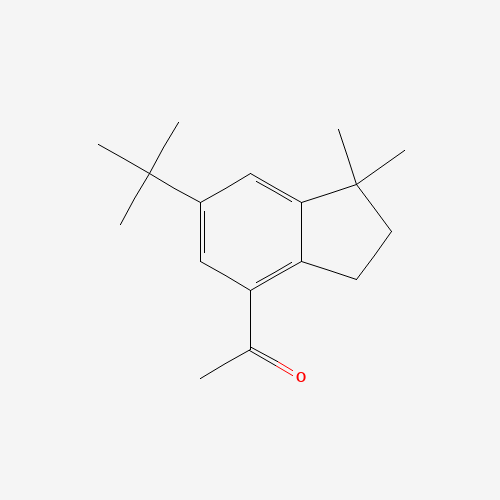
4-Acetyl-6-tert-butyl-1,1-dimethylindane is a member of indanes.
科学粮草官-词典编辑部,修订于:2026-07-06
Toxicity
ToxicityBody Burden
Blood concentrations of acetyl tert-butyl dimethylindan in 114 healthy young adults, Vienna, Austria, were below the detection limit of 25 ng/L(1). Levels in blood samples from 50 hairdressers and 10 non-hairdresser adults in Tianjin, China, collected during April and July, 2012 were below the detection limit of 0.23 ng/L(2). Occurrence of acetyl tert-butyl dimethylindan in 15 human adipose tissue samples from Switzerland taken 1983/84 and in 1994 ranged from 0.12 (1994) to 3.4 (1983) ng/g lipids(3). Acetyl tert-butyl dimethylindan concentration range of 1-18 ug/kg fat was reported in 5 breast milk samples from Schleswig-Holstein, Germany, sampled in 1995. A concentration range of not detected to 3 ug/kg fat was reported in 15 adipose tissue samples from the same area, sampled in 1993;...
Ecotoxicity Values
LC50; Species: Nitocra spinipes (Harpacticoid Copepod) Adult; Conditions: saltwater, static, 22 °C, pH 7.9-8.2, dissolved oxygen 8.0-8.7 mg/L; Concentration: > or =2000 ug/L for 96 hr /98% purity/
Fate Summary
ATMOSPHERIC FATE: According to a model of gas/particle partitioning of semivolatile organic compounds in the atmosphere(1), acetyl tert-butyl dimethylindan, which has a vapor pressure of 1.50X10⁻⁴ mm Hg(2), will exist in both the vapor and particulate phases in the ambient atmosphere. Vapor-phase acetyl tert-butyl dimethylindan is degraded in the atmosphere by reaction with photochemically-produced hydroxyl radicals(SRC); the half-life for this reaction in air is estimated to be 2 days(SRC), calculated from its rate constant of 7.4X10⁻¹² cu cm/molecule-sec at 25 °C(SRC) that was derived using a structure estimation method(3). Particulate-phase acetyl tert-butyl dimethylindan may be removed from the air by wet and dry deposition(SRC). Acetyl tert-butyl dimethylindan contains chromophores...
Soil Adsorption / Mobility
Using a structure estimation method based on molecular connectivity indices(1), the Koc of acetyl tert-butyl dimethylindan can be estimated to be 5000(SRC). According to a classification scheme(2), this estimated Koc value suggests that acetyl tert-butyl dimethylindan is expected to have slight mobility in soil(SRC).
Environmental Biodegradation
AEROBIC: Acetyl tert-butyl dimethylindan, present at 102 mg/L, was 0% biodegraded in 28 days using an activated sludge inoculum in the OECD 301 Modified MITI test(1).
Environmental Bioconcentration
An estimated BCF of 700 was calculated in fish for acetyl tert-butyl dimethylindan(SRC), using a log Kow of 5.7(1) and a regression-derived equation(2). According to a classification scheme(2), this BCF suggests the potential for bioconcentration in aquatic organisms is high(SRC).
Volatilization from Water / Soil
The Henry's Law constant for acetyl tert-butyl dimethylindan is 1.78X10⁻² atm-cu m/mole(1). This Henry's Law constant indicates that acetyl tert-butyl dimethylindan is expected to volatilize from water surfaces(2). Based on this Henry's Law constant, the volatilization half-life from a model river (1 m deep, flowing 1 m/sec, wind velocity of 3 m/sec)(2) is estimated as 5 hours(SRC). The volatilization half-life from a model lake (1 m deep, flowing 0.05 m/sec, wind velocity of 0.5 m/sec)(2) is estimated as 6 days(SRC). However, volatilization from water surfaces is expected to be attenuated by adsorption to suspended solids and sediment in the water column. The volatilization half-life from a model pond is about 52 months when adsorption is considered. Acetyl tert-butyl dimethylindan's H...
Environmental Abiotic Degradation
The rate constant for the vapor-phase reaction of acetyl tert-butyl dimethylindan with photochemically-produced hydroxyl radicals has been estimated as 7.4X10⁻¹² cu cm/molecule-sec at 25 °C(SRC) using a structure estimation method(1). This corresponds to an atmospheric half-life of about 2 days at an atmospheric concentration of 5X10+5 hydroxyl radicals per cu cm(1). Acetyl tert-butyl dimethylindan is not expected to undergo hydrolysis in the environment due to the lack of functional groups that hydrolyze under environmental conditions(2). Acetyl tert-butyl dimethylindan contains chromophores that absorb at wavelengths >290 nm(2) and, therefore, may be susceptible to direct photolysis by sunlight(SRC).
Environmental Water Concentrations
SURFACE WATER: Acetyl tert-butyl dimethylindan was present in the dissolved phase at a concentration of 0.029 ng/L in Lake Michigan water, sampled during June 1999 and May 2000(1). Acetyl tert-butyl dimethylindan was tested for but not detected in water samples from the Haihe River in North China collected from Dec 29-30, 2008(2). Mean concentrations in surface water have been reported as follows (ng/L, location): <11, France; <10-20, Germany; <0.20-96, Spain; 0.029, USA(3). A median concentration of 2.45 ng/L has been reported in surface water from the Molgora River (Lombardia Region, Northern Italy), sampled in 2010/2011. Concentrations in other European rivers are as follows (river, country, year, ng/L): Elbe, Germany, 1997, 5; Mulde Saale, Germany, 1996-1997, 50; Ruhr, Germany, 1995...
Milk Concentrations
Acetyl tert-butyl dimethylindan concentration range of 1-18 ug/kg fat was reported in 6 breast milk samples from Schleswig-Holstein, Germany, sampled in 1995(1). Acetyl tert-butyl dimethylindan median concentration was <2.0 ng/g lipid (max 11.0 ng/g lipid) mother's milk from 101 women living in Uppsala County, Sweden; 74 samples were <2.0 ng/g lipid. Samples were collected from 1996-2003(2).
Ecotoxicity Excerpts
/AQUATIC SPECIES/ A full life-cycle (</=26 days exposure) toxicity test with the harpacticoid copepod Nitocra spinipes was used to study the effects of one nitro musk (musk ketone) as well as three polycyclic musks (Tonalide, Celestolide and Galaxolide). A subchronic individual life-table endpoint, the larval development rate, was recorded after 7-8 days exposure of juveniles and was significantly decreased in copepods exposed to sublethal concentrations of musk ketone, Celestolide and Galaxolide. However, none of the Tonalide concentrations had any effect on larval development. The lowest Galaxolide concentration (0.02 mg/L), which affected juvenile development, was about 100 times below the adult 96-hr-LC(50)-value of 1.9 mg/L (95% confidence interval: 1.4-2.7 mg/L). However, none of...
Effluent Concentrations
The typical reported effluent concentration for acetyl tert-butyl dimethylindan into Lake Michigan was 110 ng/L in the dissolved phase. Sampling was conducted during June 1999 and May 2000(1). Average influent/effluent concentrations where 6.54/0.62 ug/L for a cosmetic plant located in HuangPu industrial park in GuangZhou, China, sampled from Nov 15-22, 2004. The average concentrations in primary and secondary sludge from the plant were 2.03 and 3.07 mg/kg dry weight, respectively(2). Acetyl tert-butyl dimethylindan concentrations ranged from 4-19 ng/L and 2-8 ng/L in sewage treatment plant effluents from Canada (Nova Scotia, New Brunswick) and Sweden (Uppsala, Vastra, Gavleborg), sampled in Jan 2002 and Jun-Dec, 2002, respectively(3). Acetyl tert-butyl dimethylindan was present in infl...
Atmospheric Concentrations
RURAL/REMOTE: Acetyl tert-butyl dimethylindan was present in the gas-phase over Lake Michigan at a concentration of 0.042 ng/cu m, sampled during June 1999 and May 2000(1).
Fish/Seafood Concentrations
Six polycyclic musk compounds [Cashmeran (DPMI), Celestolide (ADBI), Phantolide (AHMI), Traseolide (ATII), Tonalide (AHTN), and Galaxolide (HHCB)] were analysed in marine green-lipped mussels (Perna viridis) from Hong Kong. ADBI, HHCB and AHTN were detected in almost all samples, while AHMI, ATII and DPMI were not detected. Concentrations of ADBI, HHCB and AHTN in mussels ranged from below detection limit-0.0743 (mean: 0.0246), 0.247-6.08 (mean: 1.15) and 0.0591-0.738 (mean: 0.190)mg/kg lipid weight, respectively. Mussels from two sampling sites in central Victoria Harbour contained the highest total polycyclic musk levels, suggesting that these waters are heavily influenced by domestic sewage. Concentrations of HHCB and AHTN detected in the mussel samples were the second highest and th...
Artificial Pollution Sources
Acetyl tert-butyl dimethylindan's production and use as a musk fragrance for perfuming soap and cosmetics(1) may result in its release to the environment through various waste streams(SRC).
Sediment/Soil Concentrations
SEDIMENT: Synthetic musks, including acetyl tert-butyl dimethylindan, were detected in sediment cores from Lake Oberaar, Switzerland, a glacier-fed Alpine lake, sampled in 2006. Core analysis revealed peak musk deposition occurring in 1960s-1970s, low levels in 1980s-1990s, and a second peak beginning in the late 1990s. Presence in glacial melt water is thought to be the result of atmospheric deposition(1). /Musks/
Probable Routes of Human Exposure
Average gas-phase air concentrations of acetyl tert-butyl dimethylindan where 34.45, 0.50. 0.31 and 0.24 ng/cu m in workshop, out of workshop, 200m downwind, and 25m downwind, respectively, from a cosmetic plant located in HuangPu industrial park in GuangZhou, China. Sampling was conducted Nov 15-22, 2004(1). Occupational exposure of acetyl tert-butyl dimethylindan to barbers in Tianjin, China from barbershop dust was studied; samples were collected during April and July, 2012. Acetyl tert-butyl dimethylindan exhibited a 65.5% detection frequency with an average concentration of 127 ng/g; detection limit = 0.30 ng/g(2).
Other Environmental Concentrations
[Table#8464]: IkxvY2F0aW9uIiwiTm8uIHNhbXBsZXMiLCJBdmVyYWdlIGNvbmNuIChuZy9nKSIKImJhcmJlcnNob3AiLCI1NSIsIjEyNyIKImJhdGhob3VzZXMiLCIyIiwibm90IGRldGVjdGVkIgoiZG9ybWl0b3J5IiwiNTEiLCIxLjc3IgoiaG91c2UiLCIzNiIsIjEuMDUiCg==
Environmental Fate / Exposure Summary
Acetyl tert-butyl dimethylindan's production and use as a musk fragrance for perfuming soap and cosmetics may result in its release to the environment through various waste streams. If released to air, a vapor pressure of 1.50X10⁻⁴ mm Hg indicates acetyl tert-butyl dimethylindan will exist in both the vapor and particulate phases in the atmosphere. Vapor-phase acetyl tert-butyl dimethylindan will be degraded in the atmosphere by reaction with photochemically-produced hydroxyl radicals; the half-life for this reaction in air is estimated to be 2 days. Particulate-phase acetyl tert-butyl dimethylindan will be removed from the atmosphere by wet and dry deposition. Acetyl tert-butyl dimethylindan contains chromophores that absorb at wavelengths >290 nm and, therefore, may be susceptible to...
Toxicity Summary
IDENTIFICATION AND USE: Acetyl tert-butyl dimethylindan (Celestolide) is a synthetic polycyclic musk fragrance. It is used for perfuming soap and cosmetics. HUMAN STUDIES: Celestolide revealed no genotoxicity in the micronucleus test with human lymphocytes and with the human hepatoma cell line Hep G2. Celestolide did not activate estrogenic responses in concentrations up to 10(-5) M when tested in three reporter cell lines: HELN, HELN ERalpha, and HELN ERbeta. ANIMAL STUDIES: Celestolide tested negative for mutagenicity using the Salmonella/mammalian-microsome assay with Salmonella typhimurium strains TA97, TA98, TA100 and TA102 in the presence and absence of metabolic activation. ECOTOXICITY STUDIES: Celestolide strongly inhibited larval development in Acartia tonsa.
Average Daily Intake
The estimated median daily exposure doses of synthetic musks by adults and toddlers in households, and hairdressers is 9.81 and 33.1, and 107 ng/day, respectively. The estimated median daily exposure doses of synthetic musks by adults in dormitories is 5.61 ng/day(1). /Synthetic musks/
Human Toxicity Excerpts
/ALTERNATIVE and IN VITRO TESTS/ In this work, the estrogenic effects of three classes of substances included in cosmetic formulations-parabens, ultraviolet (UV) screens, and musk fragrances-were studied. Their estrogenic activity was measured with the use of three reporter cell lines: HELN, HELN ERalpha, and HELN ERbeta. These three cell lines allowed for the measurement of estrogenic activity toward estrogen receptors alpha and beta (ERalpha and ERbeta0, while taking nonspecific interactions into account. Eight of the 15 substances tested showed specific estrogenic activity with the following degree of potency on ERalpha: butylparaben > propylparaben > homosalate = octyl-dimethyl-PABA = 4-methyl-benzylidenecamphor = octyl-methoxycinnamate > ethylparaben = galaxolide. Among these activ...
Carcinogen Classification
No indication of carcinogenicity to humans (not listed by IARC).
Non-Human Toxicity Excerpts
/GENOTOXICITY/ Synthetic musks are widely used as fragrances and therefore found in various environmental samples. Residues were identified in river and waste water, animal and human tissues and breast milk. In the present study, six artificial polycyclic musk fragrances-Galaxolide, Tonalide, Celestolide, Phantolide, Cashmeran and Traseolide-were tested for mutagenicity using the Salmonella/mammalian-microsome assay with Salmonella typhimurium strains TA97, TA98, TA100 and TA102 in the presence (+S-9) and absence (-S-9) of an exogenous metabolizing system. All compounds tested exhibited no mutagenicity in the Salmonella assay. These results could be rated as one indicator of the biological inactivity of this group of chemicals with respect to genotoxicity.
Antidote and Emergency Treatment
/SRP:/ Advanced treatment: Consider orotracheal or nasotracheal intubation for airway control in the patient who is unconscious, has severe pulmonary edema, or is in severe respiratory distress. Positive-pressure ventilation techniques with a bag valve mask device may be beneficial. Consider drug therapy for pulmonary edema ... . Consider administering a beta agonist such as albuterol for severe bronchospasm ... . Monitor cardiac rhythm and treat arrhythmias as necessary ... . Start IV administration of D5W TKO /SRP: "To keep open", minimal flow rate/. Use 0.9% saline (NS) or lactated Ringer's (LR) if signs of hypovolemia are present. For hypotension with signs of hypovolemia, administer fluid cautiously. Watch for signs of fluid overload ... . Treat seizures with diazepam (Valium) or l...