


 一键配货
一键配货
化合物详情
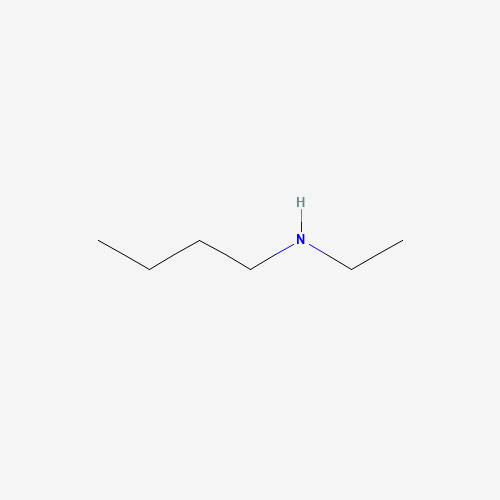
CAS13360-63-9
分子式C6H15N
分子量101.19 g/mol
非危品
Physical Description | Ethyl-n-butylamine appears as a colorless liquid with an ammonia-like odor. Insoluble in water and less dense than water. Flash point 65 °F. Vapors much heavier than air. Liquid and vapors strongly irritate skin, eyes and mucous membranes. Contact with liquid may cause burns.
科学粮草官-词典编辑部,修订于:2026-07-06
Toxicity
ToxicityFate Summary
ATMOSPHERIC FATE: According to a model of gas/particle partitioning of semivolatile organic compounds in the atmosphere(1), butylethylamine, which has an estimated vapor pressure of 27 mm Hg at 25 °C(SRC), determined from a fragment constant method(2), is expected to exist solely as a vapor in the ambient atmosphere. Vapor-phase butylethylamine is degraded in the atmosphere by reaction with photochemically-produced hydroxyl radicals(SRC); the half-life for this reaction in air is estimated to be 5 hours(SRC), calculated from its rate constant of 8.5X10⁻¹¹ cu cm/molecule-sec at 25 °C(SRC) that was derived using a structure estimation method(3). Butylethylamine does not contain chromophores that absorb at wavelengths >290 nm(4) and therefore is not expected to be susceptible to direct pho...
Soil Adsorption / Mobility
The Koc of butylethylamine is estimated as 14(SRC), using a water solubility of 3.56X10+4 mg/L(1) and a regression-derived equation(2). According to a classification scheme(3), this estimated Koc value suggests that butylethylamine is expected to have very high mobility in soil. The estimated pKa of butylethylamine is 10.69(4) indicating that this compound will exist almost entirely in the cation form in the environment and cations generally adsorb more strongly to soils containing organic carbon and clay than their neutral counterparts(5).
Environmental Biodegradation
AEROBIC: Butylethylamine is confirmed to be biodegradable according to the standard test of the Japanese Ministry of Industry and Trade (MITI) that employs a mixed inoculum obtained from freshwater, soil, and sludge(1).
Environmental Bioconcentration
An estimated BCF of 2 was calculated in fish for butylethylamine(SRC), using a water solubility of 3.56X10+4 mg/L(1) and a regression-derived equation(2). According to a classification scheme(3), this BCF suggests the potential for bioconcentration in aquatic organisms is low(SRC).
Volatilization from Water / Soil
An estimated pKa of 10.69(1) indicates butylethylamine will exist almost entirely in the cation form at pH values of 5 to 9 and therefore volatilization from water surfaces is not expected to be an important fate process(2). Butylethylamine is expected to volatilize from dry soil surfaces(SRC) based upon an estimated vapor pressure of 27 mm Hg(SRC), determined from a fragment constant method(3).
Environmental Abiotic Degradation
The rate constant for the vapor-phase reaction of butylethylamine with photochemically-produced hydroxyl radicals has been estimated as 8.5X10⁻¹¹ cu cm/molecule-sec at 25 °C(SRC) using a structure estimation method(1). This corresponds to an atmospheric half-life of about 5 hours at an atmospheric concentration of 5X10+5 hydroxyl radicals per cu cm(1). Butylethylamine is not expected to undergo hydrolysis in the environment due to the lack of functional groups that hydrolyze under environmental conditions(2). Butylethylamine does not contain chromophores that absorb at wavelengths >290 nm(2) and therefore is not expected to be susceptible to direct photolysis by sunlight(SRC).
Natural Pollution Sources
... amines from decomposing fish ... /Amines/
Artificial Pollution Sources
Butylethylamine's production may result in its release to the environment through various wast streams(SRC). Specific methods or uses were not identified in the literature(1).
Probable Routes of Human Exposure
Occupational exposure to butylethylamine may occur through inhalation and dermal contact with this compound at workplaces where butylethylamine is produced or used.(SRC)
Environmental Fate / Exposure Summary
Butylethylamine's production may result in its release to the environment through various waste streams. Specific methods or uses were not identified in the literature for butylethylamine. If released to air, an estimated vapor pressure of 27 mm Hg at 25 °C indicates butylethylamine will exist solely as a vapor in the atmosphere. Vapor-phase butylethylamine will be degraded in the atmosphere by reaction with photochemically-produced hydroxyl radicals; the half-life for this reaction in air is estimated to be 5 hours. Butylethylamine does not contain chromophores that absorb at wavelengths >290 nm and therefore is not expected to be susceptible to direct photolysis by sunlight. If released to soil, butylethylamine is expected to have very high mobility based upon an estimated Koc of 14....
Toxicity Data
LC50 (rat) = 500 ppm/4h
Adverse Effects
Toxic Pneumonitis - Inflammation of the lungs induced by inhalation of metal fumes or toxic gases and vapors.
Human Toxicity Excerpts
/OTHER TOXICITY INFORMATION/ Since the amines are bases and may form strongly alkaline solutions, they can be damaging if splashed in the eye or if allowed to contaminate the skin. Otherwise they have no specific toxic properties, and the lower aliphatic amines are normal constituents of body tissues, so that they occur in a large number of foods, particularly fish, to which they impart a characteristic odor. One area of concern at present is the possibility that some aliphatic amines may react with nitrate or nitrite in vivo to form nitroso compounds, many of which are known to be potent carcinogens in animals ... . /Aliphatic amines/
Non-Human Toxicity Values
LD50 Rat oral 390 mg/kg
Non-Human Toxicity Excerpts
/GENOTOXICITY/ Salmonella: negative









