


 一键配货
一键配货
化合物详情
CAS13410-01-0
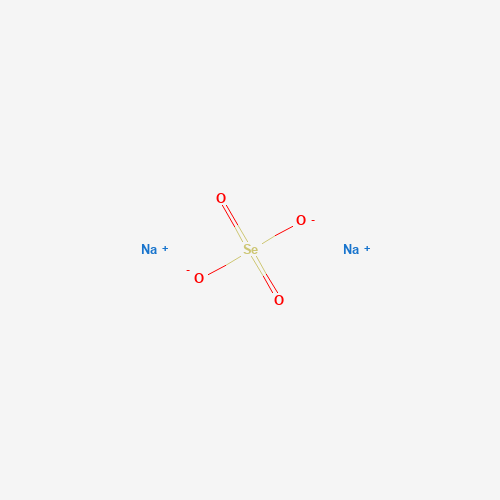
分子式Na2O4Se
分子量188.94 g/mol
危化品
Physical Description | Sodium selenate appears as colorless rhombic crystals. Used as an insecticide in some horticultural applications. (EPA, 1998)
科学粮草官-词典编辑部,修订于:2026-07-06
Toxicity
ToxicityFate Summary
AQUATIC FATE: In aqueous solution, selenates are stable under alkaline oxidizing conditions(1).
Soil Adsorption / Mobility
No sorption of sodium selenate was observed in 10 of 11 soils; a log Kd value of 0.958 was determined in Kula soil (pH 5.9, 6.62% TOC, 73.7% sand, 25.4% silt, 0.9% clay)(1).
Ecotoxicity Excerpts
/PLANT/ ... Pre-rooted plants of weeping willows (Salix babylonica L.) were grown hydroponically ... and treated with Na2SeO4 or Na2SeO3 at ...concentrations ... ranging from 0.44 to 8.72 mg Se/L for the treatments exposed to SeO4(2-) and from 0.50 to 10.0 mg Se/L for the treatments exposed to SeO3(2-), respectively. ... Both chemical forms of Se at low concentrations showed growth-promoting effects on plants. A significant decrease of transpiration rates and of soluble protein contents of plants was observed at higher Se concentrations after 168 hr of exposure. Measurable change of superoxide dismutases (SOD) activity in leaves was only detected under high Se treatments. Catalase (CAT) activity was significantly affected by the Se application. Slight change of peroxidase (POD) activity...
Natural Pollution Sources
Selenium is found in the +6 (selenate) oxidation state(1,2).
Probable Routes of Human Exposure
Sodium selenate can affect the body if it is inhaled, if it comes in contact with the eyes or skin, or if it is swallowed.
Symptoms
Short-term oral exposure to high concentrations of selenium may cause nausea, vomiting, and diarrhea. Brief exposures to high levels of elemental selenium or selenium dioxide in air can result in respiratory tract irritation, bronchitis, difficulty breathing, and stomach pains. Longer-term exposure to either of these air-borne forms can cause respiratory irritation, bronchial spasms, and coughing. (L619)
Treatment
EYES: irrigate opened eyes for several minutes under running water. INGESTION: do not induce vomiting. Rinse mouth with water (never give anything by mouth to an unconscious person). Seek immediate medical advice. SKIN: should be treated immediately by rinsing the affected parts in cold running water for at least 15 minutes, followed by thorough washing with soap and water. If necessary, the person should shower and change contaminated clothing and shoes, and then must seek medical attention. INHALATION: supply fresh air. If required provide artificial respiration.
Interactions
The study was conducted to determine the effect of four forms of selenium on inhibition of DMBA-induced mammary tumors. BALB/c virgin female mice were fed the AIN-76 diet containing 0.2 or 2.0 ppm Se as selenite, selenate, selenomethionine, or selenocystine prior to and for 6 months post DMBA-treatment. At necropsy, mammary glands were histologically treated for confirmation of adenocarcinomas and the livers were removed for analysis of glutathione-peroxidase (GSHPx) activity and selenium concentrations. Dietary levels or forms of selenium had no effect on body weights. Inorganic selenium fed at 2.0 ppm Se (selenite and selenate) decreased mammary tumor incidence, but organic selenium (selenomethionine and selenocystine) had no effect on mammary tumor incidence. Hepatic GSHPx activity w...
Health Effects
Chronic oral exposure to high concentrations of selenium compounds can produce a disease called selenosis. The major signs of selenosis are hair loss, nail brittleness, and neurological abnormalities (such as numbness and other odd sensations in the extremities). Animal studies have shown that selenium may also affect sperm production and the female reproductive cycle. (L619)
Adverse Effects
Occupational hepatotoxin - Secondary hepatotoxins: the potential for toxic effect in the occupational setting is based on cases of poisoning by human ingestion or animal experimentation.
Exposure Routes
Oral (L619); inhalation (L619); dermal (L619)
Toxicity Summary
Selenium readily substitutes for sulfur in biomolecules and in many biochemical reactions, especially when the concentration of selenium is high and the concentration of sulfur is low. Inactivation of the sulfhydryl enzymes necessary for oxidative reactions in cellular respiration, through effects on mitochondrial and microsomal electron transport, might contribute to acute selenium toxicity. Selenomethionine (a common organic selenium compound) also appears to randomly substitute for methionine in protein synthesis. This substitution may affect the structure and functionability of the protein, for example, by altering disulfide bridges. Inorganic forms of selenium appear to react with tissue thiols by redox catalysis, resulting in formation of reactive oxygen species and causing damage...
Minimum Risk Level
Chronic Oral: 0.005 mg/kg/day (L134)
Human Toxicity Excerpts
/CASE REPORTS/ A 15 year old female survived a suicidal ingestion of approximately 22 mg/kg selenium as sodium selenate possibly because of near-immediate induction of emesis. She presented with strong garlic odor, diarrhea, and diffuse T-wave flattening on ECG, which progressed to T-wave inversions and a prolonged QTc interval that resolved over 2 weeks. Her serum selenium concentration was 3.1 mg/L on admission (normal: 0.04-0.6 mg/L), with a 24 hour urine concentration of 0.8 mg/L (normal: <0.03 mg/L). She underwent treatment with vitamin C and British anti-Lewisite (BAL) and recovered.
Carcinogen Classification
3, not classifiable as to its carcinogenicity to humans. (L135)
Non-Human Toxicity Values
LD50 Rabbit oral 2250 ug/kg /SRP: 2.25 mg/kg/
Antidote and Emergency Treatment
Decontamination: Inhalation. Immediately remove the victim from exposure and give supplemental oxygen if available. Skin and eyes. Remove contaminated clothing and wash exposed skin with soap and copious water. Irrigate exposed eyes with copious tepid water or saline. Ingestion. Ingestion of elemental selenium or selenium salts does not usually benefit from GI decontamination. In light of the risk of severe corrosive GI injury, gastric lavage plus activated charcoal may be of value for ingestion s of selenious acid seen within 1 hour. Invitro experiments indicate that vitamin C can reduce selenium salts to elemental selenium, which poorly absorbed. Its use has not been studied in vivo, but oral or nasogastric administration of several grams of ascorbic acid has been recommended. /Selenium/









