


 一键配货
一键配货
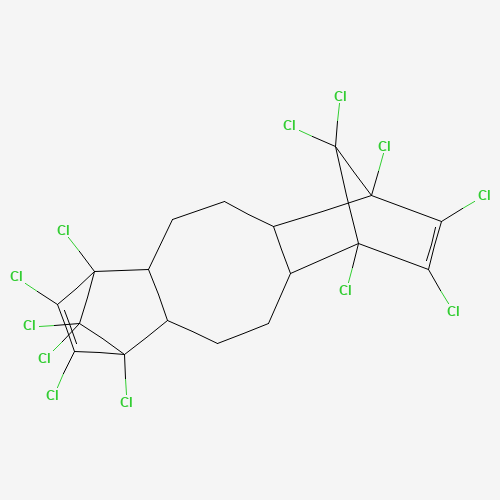
化合物详情
CAS13560-89-9
分子式C18H12Cl12
分子量653.72 g/mol
非危品
a flame retardant; structure in first source
科学粮草官-词典编辑部,修订于:2026-07-06
Toxicity
ToxicityFate Summary
ATMOSPHERIC FATE: According to a model of gas/particle partitioning of semivolatile organic compounds in the atmosphere(1), dechlorane plus, which has an estimated vapor pressure of 2.4X10⁻¹¹ mm Hg at 25 °C(SRC), determined from a fragment constant method(2), is expected to exist solely in the particulate phase in the ambient atmosphere. Particulate-phase dechlorane plus may be removed from the air by wet or dry deposition(SRC). Dechlorane plus does not contain chromophores that absorb at wavelengths >290 nm(3) and, therefore, is not expected to be susceptible to direct photolysis by sunlight(SRC).
Soil Adsorption / Mobility
Using a structure estimation method based on molecular connectivity indices(1), the Koc of dechlorane plus can be estimated to be 4.8X10+7(SRC). According to a classification scheme(2), this estimated Koc value suggests that dechlorane plus is expected to be immobile in soil.
Environmental Biodegradation
ANAEROBIC: No degradation of C-14 labeled dechlorane plus was noted in a 14 and 42 day anaerobic biodegradation test using a sewage sludge inoculum(1).
Environmental Bioconcentration
BCF ranges of 14-96 and 23-121 were measured in fish using carp (Cyprinus carpio), which were exposed over an 8-week period to 0.27 and 2.65 ppb of dechlorane plus, respectively(1). According to a classification scheme(2), BCF values of zero to 30 are low and from 100 to 1000 are high. The average biomagnification factor for anti- and syn-dechlorane plus measured in juvenile rainbow trout (Onchorynchus mykiss) exposed for 49 days was 1.9 and 5.2 respectively(3). The trophic magnification factors of 2.5 and <1 were calculated for anti- and syn-isomers of dechlorane plus in the food web of Lake Winnipeg, Canada from biota sampled Jun-Sep 2002(4). Log bioaccumulation factors (BAF) for dechlorane plus were reported as 2.13-4.40 in aquatic organisms sampled in a reservoir near the e-waste re...
Volatilization from Water / Soil
The Henry's Law constant for dechlorane plus is estimated as 7.4X10⁻⁶ atm-cu m/mole(SRC) using a fragment constant estimation method(1). This Henry's Law constant indicates that dechlorane plus may volatilize from water surfaces(2). Based on this Henry's Law constant, the volatilization half-life from a model river (1 m deep, flowing 1 m/sec, wind velocity of 3 m/sec)(2) is estimated as 13 days(SRC). The volatilization half-life from a model lake (1 m deep, flowing 0.05 m/sec, wind velocity of 0.5 m/sec)(2) is estimated as 100 days(SRC). However, volatilization from water surfaces is expected to be attenuated by adsorption to suspended solids and sediment in the water column. The estimated volatilization half-life from a model pond is 9.5X10+7 years if adsorption is considered(3). Dechl...
Environmental Abiotic Degradation
Dechlorane plus is not expected to undergo hydrolysis in the environment due to the lack of functional groups that hydrolyze under environmental conditions(1). Dechlorane plus does not contain chromophores that absorb at wavelengths >290 nm and, therefore, is not expected to be susceptible to direct photolysis by sunlight(1).
Environmental Water Concentrations
RAIN/SNOW/FOG: Dechlorane plus was detected in precipitation samples collected 2005-2009 from Eagle Harbor, Chicago, Sleeping Bear Dunes, Cleveland and Sturgeon Point in the Great Lakes region at 0.05, 0.76, 0.05, 0.49 and 0.89 ng/L, respectively(1).
Milk Concentrations
In a market basket study conducted in 2012 in Osaka, Japan, dechlorane plus was not detected (detection limit 0.4 pg/g wet weight) in milk or dairy products(1).
Effluent Concentrations
Dechlorane plus was detected at 2.45-93.8 ng/g dry weight in sewage sludge samples collected Apr-Jun 2006 from 31 urban Spanish wastewater treatment plants with 0.903-19.2 and 1.55- 75.1 ng/g dry weight for the syn- and anti-isomer, respectively(1).
Atmospheric Concentrations
SOURCE DOMINATED: The annual deposition flux of dechlorane plus is 27,900 ng/sq m/year, calculate from data collected Oct 2007 to Sep 2008 at an e-waste recycling site in China(1).
Artificial Pollution Sources
Dechlorane plus' production and use as a flame retardant for plastics(1) may result in its release to the environment through various waste streams(SRC).
Sediment/Soil Concentrations
SOIL: In soil samples collected Oct 2009 from 21 locations in Huai'an, China, dechlorane plus was detected at 0.83-1200 ng/g(1). Dechlorane plus concentrations in soil were reported as 5.11-13,400 ng/g dry weight in samples collected Oct 2009 in the city of Huai'an, China(2). Dechlorane plus was detected at 0.1-15 ng/g in 50 surface soil samples collected in 2011 from 10 sampling sites located along the River Ravi, Pakistan with a mean of 0.8 ng/g(3).
Probable Routes of Human Exposure
NIOSH (NOES Survey 1981-1983) has statistically estimated that 10,762 workers (6911 of these are female) were potentially exposed to dechlorane plus in the US(1). Occupational exposure to dechlorane plus may occur through dermal contact with this compound at workplaces where dechlorane plus is produced or used. Monitoring data indicate that the general population may be exposed to dechlorane plus via inhalation of contaminated ambient air and ingestion of some foods(SRC).
Other Environmental Concentrations
Dechlorane plus concentrations in indoor dust collected Nov 2002-Mar 2003 from 69 homes in Ottawa, Canada were 2.3-182 ng/g dust except one sample that contained 5683 ng/g dust; seven samples collected the spring of 2007 in Ottawa contained 14-61 ng/g dust(1). Dust samples collected from residence in occupationally exposed and non-occupationally exposed e-waste recycling site, a rural and an urban area of China contained dechlorane plus levels of 343-4197, 45.2-1798, 32.6-118 and 2.78-70.4 ng/g dry weight, respectively(2). Dog food samples collected from dog owners in Bloomington, IN, contained dechlorane plus at 0.005-0.089 ng/g wet weight; the average concentration of dechlorane plus in dry cat food was reported as 0.086 ng/g wet weight(3).
Environmental Fate / Exposure Summary
Although Dechlorane Plus (DP) has been used as a polychlorinated flame retardant for almost half a century, its detection in the environment was not reported until 2006. The subsequent intensive research has confirmed its global ubiquity. A few reviews have presented the properties, analytical methods and environmental occurrence of DP and related compounds in the past several years. The present review emphasizes on the environmental behavior of DP isomers which is assessed by the variation of the isomer ratio of DP in various matrices. Other aspects including the analytical methods, emission sources, general environmental occurrence and bioaccumulation of DP are also summarized. In this review, three typical emission sources in the environment are categorized after introducing the meas...
Toxicity Data
LC50 (rat) = 2,250 mg/m3
Adverse Effects
Occupational hepatotoxin - Secondary hepatotoxins: the potential for toxic effect in the occupational setting is based on cases of poisoning by human ingestion or animal experimentation.
Exposure Routes
Dechlorane Plus is a polychlorinated compound manufactured for close to 60 years as a flame retardant and for other applications. Dechlorane Plus and other Dechlorane-related compounds (DRCs) are currently marketed as a replacement for Dechlorane, also known as Mirex. These compounds share comparable properties to persistent organic pollutants (POPs), such as persistence in the environment, high lipophilicity, bioaccumulation through the food web and adverse effects on the environment and human health. Despite their long production history, they have been only recently reported in various environmental compartments, such as air, soil, and foodstuff.
Toxicity Summary
IDENTIFICATION AND USE: Dechlorane plus (DP) is a solid. It is used as fire retardant for plastics. Flame retardants such as DP were introduced as replacements and produced in high volumes. HUMAN STUDIES: DP is detected human milk, and human serum. Although human exposure to DP is evident, little is known about its potential effects on human health. The effects of DP on adipogenesis was investigated using human primary subcutaneous and omental preadipocytes. The results of the study showed that DP can induce adipogenesis and while DP can directly activate PPARgamma, its adipogenic effects may be mediated via other pathways. ANIMAL STUDIES: In rabbits DP produced no corneal, iridal, or conjunctival effects. In male mice, DP exposure increased the level of superoxide dismutase (SOD) and 8...
Average Daily Intake
The average daily intake of dechlorane plus from indoor dust exposure is 0.08 and 1.0 ng/day in adults and children, respectively, based on dust sample data collected Nov 2002-Mar 2003 from 69 homes in Ottawa, Canada(1). Based on a market basket and atmospheric study conducted in 2012 in Osaka, Japan, the average daily intake of dechlorane plus is 576 and 174 pg/day via diet and inhalation, respectively, in adults(2).
Human Toxicity Excerpts
/ALTERNATIVE and IN VITRO TESTS/ Polybrominated diphenyl ethers (PBDEs) are chemicals that were added to consumer products to reduce flammability but were deemed toxic and bioaccumulative and were phased out of commerce. Flame retardants (FRs) such as Dechlorane Plus (DP) were introduced as replacements. DP is being produced in high volumes and is detected in the environment, human milk, and human serum. Although human exposure to DP is evident, little is known about its potential effects on human health. We and others have shown that some FRs are potential obesogens, i.e., promote adipogenesis. However, the effects of DP on adipogenesis are not known. METHODS: Murine 3T3-L1 and human primary subcutaneous (Sc) and omental (Om) preadipocytes were differentiated in the presence of DP (0.0...
Non-Human Toxicity Values
LD50 Rabbit dermal >8000 mg/kg bw
Antidote and Emergency Treatment
/SRP:/ Advanced treatment: Consider orotracheal or nasotracheal intubation for air way control in the patient who is unconscious or is in severe respiratory distress. Monitor cardiac rhythm and treat arrhythmias if necessary ... . Start IV administration of D5W /SRP: "To keep open", minimal flow rate/. Use 0.9% saline (NS) or lactated Ringer's (LR) if signs of hypovolemia are present. For hypotension with signs of hypovolemia, administer fluid cautiously. Watch for signs of fluid overload ... Treat seizures with diazepam or lorazepam ... . Proparacaine hydrochloride should be used to assist eye irrigation ... . /Chlordane and related compounds/









