


 一键配货
一键配货
化合物详情
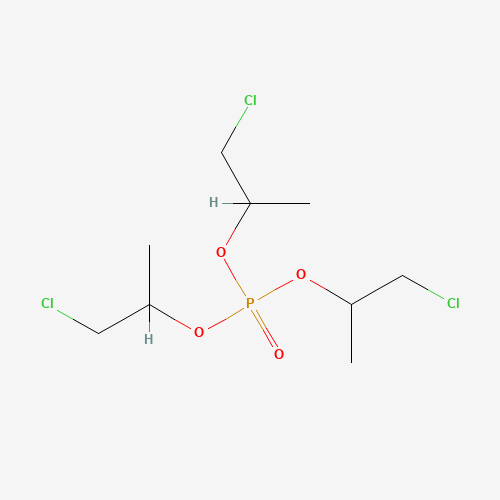
CAS13674-84-5
分子式C9H18Cl3O4P
分子量327.57 g/mol
非危品
Physical Description | Tris(1-chloro-2-propyl) phosphate is a clear colorless viscous liquid. (NTP, 1992)
科学粮草官-词典编辑部,修订于:2026-07-06
Toxicity
ToxicityBody Burden
Tri-(2-chloroisopropyl)phosphate concentrations in hand wash samples from workers at a circuit board factory and furniture workshop, Kuopio, Finland, were <4 ng/hand(1).
Fate Summary
ATMOSPHERIC FATE: According to a model of gas/particle partitioning of semivolatile organic compounds in the atmosphere(1), tri-(2-chloroisopropyl)phosphate, which has an estimated vapor pressure of 9.2X10⁻³ mm Hg at 25 °C(SRC), determined from a fragment constant method(2), will exist solely in the vapor phase in the ambient atmosphere. Vapor-phase tri-(2-chloroisopropyl)phosphate is degraded in the atmosphere by reaction with photochemically-produced hydroxyl radicals(SRC); the half-life for this reaction in air is estimated to be 0.2 days(SRC), calculated from its rate constant of 4.5X10⁻¹¹ cu cm/molecule-sec at 25 °C(SRC) that was derived using a structure estimation method(3). Tri-(2-chloroisopropyl)phosphate does not contain chromophores that absorb at wavelengths >290 nm(4) and,...
Soil Adsorption / Mobility
The Koc of tri-(2-chloroisopropyl)phosphate is estimated as 290(SRC), using a log Kow of 2.59(1) and a regression-derived equation(2). According to a classification scheme(3), this estimated Koc value suggests that tri-(2-chloroisopropyl)phosphate is expected to have moderate mobility in soil.
Environmental Biodegradation
AEROBIC: Tri-(2-chloroisopropyl)phosphate, present at 100 mg/L, reached 0% of its theoretical BOD in 4 weeks using an activated sludge inoculum at 30 mg/L in the Japanese MITI test(1). A low removal efficiency of 19% was noted for the Kalby Sewage Treatment plant in Lund, Sweden which releases treated effluent into the Hoje River(2).
Environmental Bioconcentration
A BCF range of <1.9 to 4.6 and a range of 0.8 to approximately 2.8 at concentrations of 0.02 and 0.2 mg/L were measured, respectively, in fish for tri-(2-chloroisopropyl)phosphate using carp (Cyprinus carpio) which were exposed over an 8-week period(1). According to a classification scheme(2), these BCF values suggest the potential for bioconcentration in aquatic organisms is low(SRC).
Volatilization from Water / Soil
The Henry's Law constant for tri-(2-chloroisopropyl)phosphate is estimated as 6.0X10⁻⁸ atm-cu m/mole(SRC) using a fragment constant estimation method(1). This Henry's Law constant indicates that tri-(2-chloroisopropyl)phosphate is expected to be essentially nonvolatile from water and moist soil surfaces(2). Tri-(2-chloroisopropyl)phosphate is not expected to volatilize from dry soil surfaces(SRC) based upon an estimated vapor pressure of 9.2X10⁻³ mm Hg(SRC), determined from a fragment constant method(3).
Environmental Abiotic Degradation
The rate constant for the vapor-phase reaction of tri-(2-chloroisopropyl)phosphate with photochemically-produced hydroxyl radicals has been estimated as 4.5X10⁻¹¹ cu cm/molecule-sec at 25 °C(SRC) using a structure estimation method(1). This corresponds to an atmospheric half-life of about 0.2 days at an atmospheric concentration of 5X10+5 hydroxyl radicals per cu cm(1). Tri-(2-chloroisopropyl)phosphate hydrolyzes slowly in both alkaline and acidic environments(2). Tri-(2-chloroisopropyl)phosphate does not contain chromophores that absorb at wavelengths >290 nm(3) and, therefore, is not expected to be susceptible to direct photolysis by sunlight(SRC).
Environmental Water Concentrations
SEAWATER: Tri-(2-chloroisopropyl)phosphate was reported in samples from the German Bight (North Sea) at a concentration range of 40-250 ng/L; sampling was conducted in March, April, August, and October of 2012(1).
Milk Concentrations
ENVIRONMENTAL: In human pooled milk collected from Swedish women after delivery of their first babies in 1997-2006, levels of tris(1-chloro-2-propyl) phosphate were 22-82 ng/g lipid.
Effluent Concentrations
Tri-(2-chloroisopropyl)phosphate influent and effluent concentrations were 2.79 and 2.26 ug/L, respectively, at the Kalby Sewage Treatment Plant in Lund, Sweden; sampling was conducted on October 21, 2002. Samples were collected upstream and downstream of the plant located on the Hoje River(1).
Atmospheric Concentrations
INDOOR: Tri-(2-chloroisopropyl)phosphate was detected at concentrations of 63, 46, 57, and 130 ng/cu m in a theater, furniture store 1 and 2, and an office, respectively, collected from locations in Zurich, Switzerland. The compound was not detected in three electronic stores nor 2 other offices, detection limit = 0.12 ng/cu m(1).
Artificial Pollution Sources
Tri-(2-chloroisopropyl)phosphate's production and use as a flame retardant(1) may result in its release to the environment through various waste streams(SRC).
Other Environmental Concentrations
Tri-(2-chloroisopropyl)phosphate was detected at concentrations of 23, not detected, 260 and 190 ng/cu m in a new car, 1 yr old car, 9 yr old car, and an occupied 9 yr old car, respectively, collected in Zurich, Switzerland. The detection limit was 0.12 ng/cu m(1). The compound was detected in polyurethane foam used in furniture as follows (foam source; year purchased; %wt flame retardant): footstool, 2006, 2.2; chair, 2008, 0.5; chair, 2007, 1.5; ottoman, 2005, 0.7. The compound was detected in 24% of house dust samples analyzed, <140 ng/g minimum, 5490 ng/g maximum, with a median of 572 ng/g. Foam samples were obtained from numerous cites around the US (excluding Boston, MA) and dust samples were from vacuum cleaner bags from homes in Boston, MA; all samples were collected from 2002 t...
Environmental Fate / Exposure Summary
Tri-(2-chloroisopropyl)phosphate's production and use as a flame retardant may result in its release to the environment through various waste streams. If released to air, an estimated vapor pressure of 9.2X10⁻³ mm Hg at 25 °C indicates tri-(2-chloroisopropyl)phosphate will exist soley in the vapor phase in the atmosphere. Vapor-phase tri-(2-chloroisopropyl)phosphate will be degraded in the atmosphere by reaction with photochemically-produced hydroxyl radicals; the half-life for this reaction in air is estimated to be 9.2 days. Tri-(2-chloroisopropyl)phosphate does not contain chromophores that absorb at wavelengths >290 nm and, therefore, is not expected to be susceptible to direct photolysis by sunlight. If released to soil, tri-(2-chloroisopropyl)phosphate is expected to have moderate...
Toxicity Data
LC50 (rat) > 4,600 mg/m3/4hr
Average Daily Intake
The estimated daily dust ingestion of tri-(2-chloroisopropyl)phosphate was approximately 1200 and 300 ng/day for a child and an adult, respectively, assuming ingestion of 100 mg dust/day (child) and 20 mg dust/day (adult)(1).
RAIS Toxicity Values
Oral Subchronic Chronic Reference Dose Reference: PPRTV Current
Human Toxicity Excerpts
/GENOTOXICITY/ In an initial unscheduled DNA synthesis (UDS) assay, human WI-38 cells blocked in G1 phase were grown in a medium containing Fyrol PCF in DMSO at concentrations of 0.1, 0.5, 1 or 5 uL/mL. In one series, S9 from Arochlor-pretreated rat livers provided the activation system. N-methyl nitroguanidine was used as the positive control in the activation system, while benzo(a)pyrene was used as the positive control in the nonactivated system. A second assay was conducted because Fyrol PCF concentrations above 0.1 uL/mL were too toxic. The second assay employed Fyrol in DMSO at concentrations of 5, 10, 50 and 100 nL/mL...Fyrol PCF was perhaps weakly active at 0.01 uL/mL in activated and nonactivated systems without an associated dose response at higher concentrations.
Carcinogen Classification
Summary: Back to TopAnimal SourceTime-mated (F0) female Sprague Dawley (Hsd:Sprague Dawley SD) rats were obtained from Envigo (formerly Harlan Laboratories, Inc., Indianapolis, IN). Male and female B6C3F1/N mice were obtained from the
1 or Cancer Risk Level 1E-06
Fraction of Contaminant Absorbed Dermally from Soil: 0.1
Antidote and Emergency Treatment
/SRP:/ Advanced treatment: Consider orotracheal or nasotracheal intubation for airway control in the patient who is unconscious, has severe pulmonary edema, or is in severe respiratory distress. Positive-pressure ventilation techniques with a bag valve mask device may be beneficial. Consider drug therapy for pulmonary edema ... . Consider administering a beta agonist such as albuterol for severe bronchospasm ... . Monitor cardiac rhythm and treat arrhythmias as necessary ... . Start IV administration of D5W /SRP: "To keep open", minimal flow rate/. Use 0.9% saline (NS) or lactated Ringer's if signs of hypovolemia are present. For hypotension with signs of hypovolemia, administer fluid cautiously. Watch for signs of fluid overload ... . Treat seizures with diazepam or lorazepam ... . Use...
Hazard Quotient Level 3 or Cancer Risk Level 1E-04
Fraction of Contaminant Absorbed Dermally from Soil: 0.1









