


 一键配货
一键配货
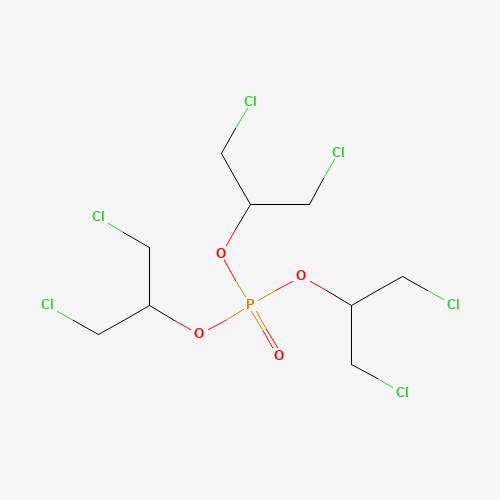
化合物详情
CAS13674-87-8
分子式C9H15Cl6O4P
分子量430.89 g/mol g/mol
危化品
Tris(1,3-dichloro-2-propyl) Phosphate (TDCPP) can cause cancer according to an independent committee of scientific and health experts.
科学粮草官-词典编辑部,修订于:2026-07-06
Toxicity
ToxicityBody Burden
Tris(1,3-dichloro-2-propyl) phosphate was detected in 34 of 123 extracts of human seminal plasma obtained from student donors(1). Tris(1,3-dichloro-2-propyl) phosphate was detected in 5 of 16 human adipose tissue samples obtained from cadavers at autopsy in the range of 0.5-110 ng/g(2).
Ecotoxicity Values
LC50; Species: Oryzias latipes (Japanese Medaka) weight 0.1-0.2 g; Conditions: freshwater, static, 25 °C; Concentration: 3600 ug/L for 96 hr /technical product/
Fate Summary
ATMOSPHERIC FATE: According to a model of gas/particle partitioning of semivolatile organic compounds in the atmosphere(1), tris(1,3-dichloro-2-propyl) phosphate, which has an estimated vapor pressure of 2.9X10⁻⁷ mm Hg at 25 °C(SRC), determined from a fragment constant method(2), will exist in both the vapor and particulate phases in the ambient atmosphere. Vapor-phase tris(1,3-dichloro-2-propyl) phosphate is degraded in the atmosphere by reaction with photochemically-produced hydroxyl radicals(SRC); the half-life for this reaction in air is estimated to be 21.3 hrs(SRC), calculated from its rate constant of 1.8X10⁻¹¹ cu cm/molecule-sec at 25 °C(SRC) that was derived using a structure estimation method(3). Particulate-phase tris(1,3-dichloro-2-propyl) phosphate may be removed from the a...
Soil Adsorption / Mobility
The Koc of tris(1,3-dichloro-2-propyl) phosphate is estimated as 1100(SRC), using a log Kow of 3.65(1) and a regression-derived equation(2). According to a classification scheme(3), this estimated Koc value suggests that tris(1,3-dichloro-2-propyl) phosphate is expected to have slight mobility in soil.
Environmental Biodegradation
AEROBIC: Tris(1,3-dichloro-2-propyl) phosphate, present at 100 mg/L, reached 0 to 4% of its Theoretical BOD (with an average of 1% Theoretical BOD) in 4 weeks using an activated sludge inoculum at 30 mg/L in the Japanese MITI test(1).
Environmental Bioconcentration
BCFs of 3-5 and 77-113 were measured for tris(1,3-dichloro-2-propyl) phosphate using goldfish (Carassius auratus) and Japanese medaka (Oryzias latipes), respectively, which were exposed over 24 and 96 hr periods(1). A BCF of 50-89 was measured for tris(1,3-dichloro-2-propyl) phosphate using Japanese medaka (Oryzias latipes) which were exposed over a 38 day period(2). A BCF of 0.30-3.3 was measured for tris(1,3-dichloro-2-propyl) phosphate using carp (Cyprinus carpio)(3). According to a classification scheme(4), BCF values of zero to 30 are low and from 100 to 1,000 are high.
Volatilization from Water / Soil
The Henry's Law constant for tris(1,3-dichloro-2-propyl) phosphate is estimated as 2.61X10⁻⁹ atm-cu m/mole(SRC) using a fragment constant estimation method(1). This Henry's Law constant indicates that tris(1,3-dichloro-2-propyl) phosphate is expected to be essentially nonvolatile from water and moist soil surfaces(2). Tris(1,3-dichloro-2-propyl) phosphate is not expected to volatilize from dry soil surfaces(SRC) based upon an estimated vapor pressure of 2.9X10⁻⁷ mm Hg(SRC), determined from a fragment constant method(3).
Environmental Abiotic Degradation
The rate constant for the vapor-phase reaction of tris(1,3-dichloro-2-propyl) phosphate with photochemically-produced hydroxyl radicals has been estimated as 18.1X10⁻¹² cu cm/molecule-sec at 25 °C(SRC) using a structure estimation method(1). Hydrolysis of phosphate esters is highly pH-dependent and they are generally resistant to hydrolysis in neutral or acidic water (pH 5.0-7.0), but readily degrade in more alkaline conditions (pH 9.0-9.5)(2). Product literature suggests that tris(1,3-dichloro-2-propyl) phosphate will be resistant to hydrolysis in most environmental waters (3). Tris(1,3-dichloro-2-propyl) phosphate does not contain chromophores that absorb at wavelengths >290 nm(4) and, therefore, is not expected to be susceptible to direct photolysis by sunlight(SRC).
Environmental Water Concentrations
RAIN/SNOW/FOG: Tris(1,3-dichloro-2-propyl) phosphate was detected in snow samples taken from a road intersection in northern Sweden in 2003 at 12, 230, and 8 ng/kg snow at distances of 2, 100, and 250 m from the intersection respectively. Tris(1,3-dichloro-2-propyl) phosphate was detected in 3 of 3 snow samples taken from a Swedish municipal airport at 4-15 ng/kg snow in the same study(1).
Food Survey Values
Tris(1,3-dichloro-2-propyl) phosphate was tested for but not detected in market basket samples collected in grocery stores from 30 different sectors of the US(1).
Ecotoxicity Excerpts
/AQUATIC SPECIES/ After 20 launderings, 37% of flame retardant was lost from polyester sleepwear. Fyrol fr-2 released from unlaundered sleepwear to water at 30 ppm caused death to goldfish within 3 hr. It remained stable in water for 24 hr.
Plant Concentrations
Tris(1,3-dichloro-2-propyl)phosphate was detected in the needles of Pinus ponderosa in the samples collected from the foothills of Sierra Nevada in 1993-94 at concentrations ranging from <2.5 to 1260 ng/g(1).
Effluent Concentrations
Phosphoric acids, including tris(1,3-dichloro-2-propyl) phosphate, were detected in leachate from the Osaka North Port Sea-Based Solid Waste Disposal Site and in the surrounding seawater at a concentration range of 0.1 to 17.0 ug/L(1). Tris(1,3-dichloro-2-propyl) phosphate was detected in the effluent of samples taken from 11 Swedish sewage treatment plants in 2002 to 2003 at 0.13-0.34 ug/L, average 0.23 ug/L. Tris(1,3-dichloro-2-propyl) phosphate was detected in the sewage sludge from these same STPs at 0.0033-0.260 ug/L(2). Tris(1,3-dichloro-2-propyl) phosphate was detected 77.5% of the time in upstream, downstream, and effluent samples from 10 wastewater treatment plants located throughout the United States at a median concentration of 0.2 ug/L, maximum concentration 0.48 ug/L(3). Tr...
Atmospheric Concentrations
INDOOR AIR: Tris(1,3-dichloro-2-propyl) phosphate was detected in 6 of 12 indoor air samples from locations in and around Zurich (Switzerland), including 3 offices, 2 furniture stores, 3 electronics stores, a theater, and 3 cars, at 23-260 ng/cu m(1). Tris(1,3-dichloro-2-propyl) phosphate was detected in 2 of 29 indoor air samples from various locations in Sweden at 5-7 ng/cu m(2). Tris(1,3-dichloro-2-propyl) phosphate was detected in indoor air environments in Tokyo, Japan: In 18 houses sampled, tris(1,3-dichloro-2-propyl) phosphate concentration ranged from 0-0.60 ng/cu m. In 14 office buildings sampled, tris(1,3-dichloro-2-propyl) phosphate concentration ranged from 0-8.7 ng/cu m. In a newly constructed home in Tokyo, Japan, the indoor air concentration of tris(1,3-dichloro-2-propyl)...
Artificial Pollution Sources
Tris(1,3-dichloro-2-propyl) phosphate's production and use as a flame retardant in plastics and as a secondary plasticizer(1) and former use as a flame retardant in children's sleepwear(2) may result in its release to the environment through various waste streams(SRC).
Probable Routes of Human Exposure
Occupational exposure to tris(1,3-dichloro-2-propyl) phosphate may occur through inhalation and dermal contact with this compound at workplaces where tris(1,3-dichloro-2-propyl) phosphate is produced or used. Monitoring and use data indicate that the general population may be exposed to tris(1,3-dichloro-2-propyl) phosphate via inhalation of ambient air, ingestion of drinking water and dermal contact with consumer products containing tris(1,3-dichloro-2-propyl) phosphate. (SRC)
Other Environmental Concentrations
Tris(1,3-dichloro-2-propyl) phosphate was detected in soft polyurethane foam samples at levels of 4.5-10.2 ug/g(1).
Environmental Fate / Exposure Summary
Tris(1,3-dichloro-2-propyl) phosphate's production and use as a flame retardant in plastics and as a secondary plasticizer may result in its release to the environment through various waste streams. It was formerly used as a flame retardant in children's sleepware. If released to air, an estimated vapor pressure of 2.9X10⁻⁷ mm Hg at 25 °C indicates tris(1,3-dichloro-2-propyl) phosphate will exist in both the vapor and particulate phases in the atmosphere. Vapor-phase tris(1,3-dichloro-2-propyl) phosphate will be degraded in the atmosphere by reaction with photochemically-produced hydroxyl radicals; the half-life for this reaction in air is estimated to be 21.3 hrs. Particulate-phase tris(1,3-dichloro-2-propyl) phosphate will be removed from the atmosphere by wet and dry deposition. Tris...
Toxicity Data
LC50 (rat) > 5,220 mg/m3/4h
RAIS Toxicity Values
Short-term Oral Reference Dose Reference: ATSDR Final
Human Toxicity Excerpts
/EPIDEMIOLOGY STUDIES/ During 1981 workers at a TDCPP manufacturing plant in the USA had their health assessed in physical exams. The health reports of 93 potentially exposed workers from the factory were compared with the health reports of 31 non-exposed workers who were matched for age, alcohol consumption and smoking habits. The 2 groups of workers were comparable with regard to chest X-ray results. Exposed workers had a 2-fold incr in the prevalence of "abnormal" EKG, but fewer exposed workers had a history of heart disease. There were no significant differences in any of the clinical chemistry parameters investigated. The prevalence of minor respiratory disease was slightly incr in exposed workers. The results of the study did not reveal any significantly incr morbidity in workers...
1 or Cancer Risk Level 1E-06
Fraction of Contaminant Absorbed Dermally from Soil: 0.1
Antidote and Emergency Treatment
/SRP:/ Advanced treatment: Consider orotracheal or nasotracheal intubation for airway control in the patient who is unconscious, has severe pulmonary edema, or is in severe respiratory distress. Positive-pressure ventilation techniques with a bag valve mask device may be beneficial. Consider drug therapy for pulmonary edema ... . Consider administering a beta agonist such as albuterol for severe bronchospasm ... . Monitor cardiac rhythm and treat arrhythmias as necessary ... . Start IV administration of D5W /SRP: "To keep open", minimal flow rate/. Use 0.9% saline (NS) or lactated Ringer's if signs of hypovolemia are present. For hypotension with signs of hypovolemia, administer fluid cautiously. Watch for signs of fluid overload ... . Treat seizures with diazepam or lorazepam ... . Use...
Hazard Quotient Level 3 or Cancer Risk Level 1E-04
Fraction of Contaminant Absorbed Dermally from Soil: 0.1
USGS Health-Based Screening Levels for Evaluating Water-Quality
Reference: Smith, C.D. and Nowell, L.H., 2024. Health-Based Screening Levels for evaluating water-quality data (3rd ed.). DOI:10.5066/F71C1TWP









