


 一键配货
一键配货
化合物详情
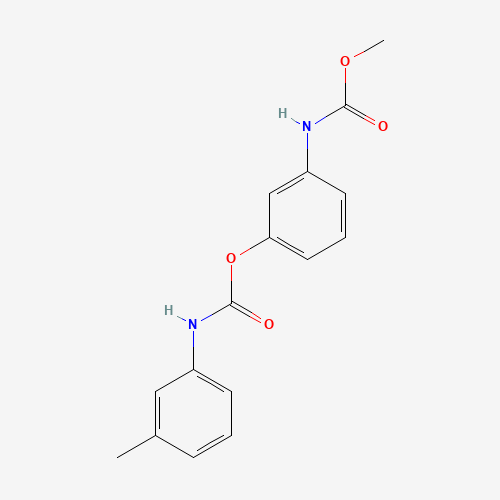
CAS13684-63-4
分子式C16H16N2O4
分子量300.31 g/mol
非危品
Physical Description | Phenmedipham appears as colorless crystals or white powder. (NTP, 1992)
科学粮草官-词典编辑部,修订于:2026-07-06
Toxicity
ToxicityEPA Ecotoxicity
Pesticide Ecotoxicity Data from EPA: 61
Ecotoxicity Values
LC50 Harlequin fish 16.5 mg/l/96 hr /Conditions of bioassay not specified/ /emulsifiable preparation/
Soil Adsorption / Mobility
Using several different soils, an Rf value of 0.17 was measured via soil thin-layer chromatography which is indicative of low soil mobility(1). Based upon a water solubility of 4.7 mg/L at 25 °C(2), the Koc of betanal can be estimated to be about 1860 from a regression derived equation(3,SRC). The US Dept Agric's Pesticide Properties Database lists a Koc value of 2400 for betanal(2). According to a suggested classification scheme(4), these Koc values suggest that betanal has low mobility in soil(SRC). Betanal is reported to remain in the top layers of soil (0 to 2 inches) after herbicidal application(5). In a field study in sugar beet soil, applications of betanal remained in the upper 10 cm of soil 2 months after application(6).
Environmental Biodegradation
Using an activated sludge inoculum, betanal had a 5-day theoretical BOD of 52.3%(1). Betanal was found to be very susceptible to microbial attack by a variety of microorganisms isolated from soil(2); in 28-day incubation studies, only 0.6% (or less) of initial betanal remained when the microbes were present while 29.8% remained in the control tests(2); methyl-N-(3-hydroxyphenyl) carbamate was the major degradation product(2).
Environmental Bioconcentration
Based upon a water solubility of 4.7 mg/L at 25 °C(1), the BCF of betanal can be estimated to be 260 from a regression derived equations(2,SRC). This BCF value suggests that bioconcentration in aquatic organisms may occur(SRC).
Volatilization from Water / Soil
Based upon a vapor pressure of 1.0X10⁻¹¹ mm Hg(1 and a water solubility of 4.7 mg/L at 25 °C(1), the Henry's Law constant for betanal can be estimated to be 8.41X10⁻¹³ atm-cu m/mole(SRC). This value of Henry's Law constant indicates that betanal is essentially nonvolatile from water(3).
Environmental Abiotic Degradation
The rate constant for the vapor phase reaction of betanal with photochemically produced hydroxyl radicals has been estimated to be 1.91X10⁻¹⁰ cu cm/molecule-sec at 25 °C which corresponds to an atmospheric half-life of about 2 hours at an atmospheric concn of 5X10+5 hydroxyl radicals per cu cm(1,SRC). The following aqueous hydrolysis half-lives have been reported for buffered betanal solutions at 22 °C(2); 70 days at pH 5, 24 hr at pH 7 and 10 min at pH 9(2). The second-order alkaline hydrolysis rate constant was experimentally determined to be 106 L/mol-sec at 25 °C(3) which corresponds to halves-life of 7.5 days at pH 6, 18 hr at pH 7 and 1.8 hr at pH 8(3,SRC); the hydrolysis products include methyl N-3(hydroxyphenyl) carbamate and m-toluidine via N-(m-tolyl)carbamic acid(3). Betanal...
Environmental Water Concentrations
GROUNDWATER: During various sampling periods in 1984, water samples were collected from 206 waterwork wells in Germany and analyzed from 35 different pesticides(1); betanal was not detected above a detection limit of 0.05 ug/L(1).
Artificial Pollution Sources
Betanal's use as a post-emergence herbicide(1-2) releases the compound directly to the environment through applications in sprays, concentrates and other routes of application(SRC).
Probable Routes of Human Exposure
Occupational exposure to betanal occurs through dermal contact and inhalation of sprays, especially to workers applying the compound as a herbicide(1).
Environmental Fate / Exposure Summary
Betanal's use as a post-emergence herbicide releases the compound directly to the environment through applications in sprays, concentrates and other routes of application. If released to the atmosphere, betanal will degrade rapidly in the vapor phase by reaction with photochemically produced hydroxyl radicals (half-life of about 2.6 hr). Particulate-phase betanal and aerosols released to air during applications of betanal herbicides will be removed from air physically by dry and wet deposition. If released to soil or water, betanal can degrade through biodegradation and aqueous hydrolysis. The hydrolysis rate increases with increasing pH; at 25 °C, the hydrolysis half-life is about 7.5 days, 18 hr, and 1.8 hr at respective pHs of 6, 7, and 8. Betanal is reported to remain in the top lay...
Symptoms
As with organophosphates, the signs and symptoms are based on excessive cholinergic stimulation. Unlike organophosphate poisoning, carbamate poisonings tend to be of shorter duration because the inhibition of nervous tissue acetylcholinesterase is reversible, and carbamates are more rapidly metabolized. Muscle weakness, dizziness, sweating and slight body discomfort are commonly reported early symptoms. Headache, salivation, nausea, vomiting, abdominal pain and diarrhea are often prominent at higher levels of exposure. Contraction of the pupils with blurred vision, incoordination, muscle twitching and slurred speech have been reported. (L795)
Treatment
If the compound has been ingested, rapid gastric lavage should be performed using 5% sodium bicarbonate. For skin contact, the skin should be washed with soap and water. If the compound has entered the eyes, they should be washed with large quantities of isotonic saline or water. In serious cases, atropine and/or pralidoxime should be administered. Anti-cholinergic drugs work to counteract the effects of excess acetylcholine and reactivate AChE. Atropine can be used as an antidote in conjunction with pralidoxime or other pyridinium oximes (such as trimedoxime or obidoxime), though the use of '-oximes' has been found to be of no benefit, or possibly harmful, in at least two meta-analyses. Atropine is a muscarinic antagonist, and thus blocks the action of acetylcholine peripherally.
Toxicity Data
LD50: >8000 mg/kg (Rat, oral)
Health Effects
Acute exposure to cholinesterase inhibitors can cause a cholinergic crisis characterized by severe nausea/vomiting, salivation, sweating, bradycardia, hypotension, collapse, and convulsions. Increasing muscle weakness is a possibility and may result in death if respiratory muscles are involved. Accumulation of ACh at motor nerves causes overstimulation of nicotinic expression at the neuromuscular junction. When this occurs symptoms such as muscle weakness, fatigue, muscle cramps, fasciculation, and paralysis can be seen. When there is an accumulation of ACh at autonomic ganglia this causes overstimulation of nicotinic expression in the sympathetic system. Symptoms associated with this are hypertension, and hypoglycemia. Overstimulation of nicotinic acetylcholine receptors in the central...
Adverse Effects
Skin Sensitizer - An agent that can induce an allergic reaction in the skin.
Exposure Routes
Inhalation (L793); oral (L793); dermal (L793)
Toxicity Summary
Phenmedipham is a cholinesterase or acetylcholinesterase (AChE) inhibitor. Carbamates form unstable complexes with chlolinesterases by carbamoylation of the active sites of the enzymes. This inhibition is reversible. A cholinesterase inhibitor suppresses the action of acetylcholine esterase. Because of its essential function, chemicals that interfere with the action of acetylcholine esterase are potent neurotoxins, causing excessive salivation and eye-watering in low doses. Headache, salivation, nausea, vomiting, abdominal pain and diarrhea are often prominent at higher levels of exposure. Acetylcholine esterase breaks down the neurotransmitter acetylcholine, which is released at nerve and muscle junctions, in order to allow the muscle or organ to relax. The result of acetylcholine este...
RAIS Toxicity Values
Oral Chronic Reference Dose Reference: OPP
Human Toxicity Excerpts
Two farmers came separately to the same department of dermatology for diagnosis. One had used phenmedipham for 8 or 9 yr without recognized difficulty in spite of a long history of photodermatitis. However, what was considered an exacerbation of photodermatitis began only a few days after he used phenmedipham in 1978, and a patch test required 14 days to subside. The second farmer presented with a severe, spreading, bullous dermatitis of both hands a few days after he used the compound. He too had used it for 8 or 9 yr without difficulty, but a patch test was positive.
Carcinogen Classification
No indication of carcinogenicity to humans (not listed by IARC).
Non-Human Toxicity Values
LD50 Rat oral >8000 mg/kg
Non-Human Toxicity Excerpts
Rats fed at rates of 125, 250, and 500 mg/kg/day for 120 days survived, but food intake was decreased in a dosage-dependent way.
1 or Cancer Risk Level 1E-06
Fraction of Contaminant Absorbed Dermally from Soil: 0.1
Antidote and Emergency Treatment
Treatment /of phenmedipham poisoning/ is symptomatic.
Hazard Quotient Level 3 or Cancer Risk Level 1E-04
Fraction of Contaminant Absorbed Dermally from Soil: 0.1









