


 一键配货
一键配货
化合物详情
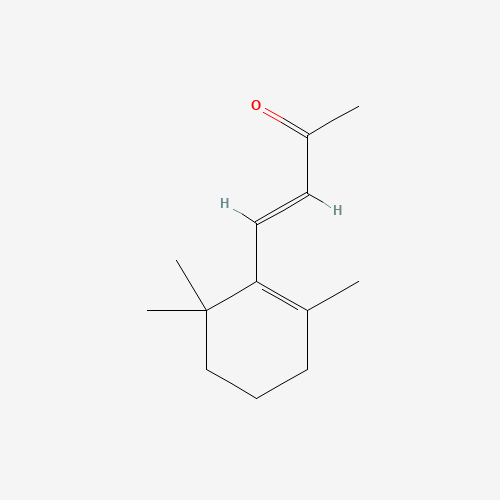
CAS14901-07-6
分子式C13H20O
分子量192.3 g/mol g/mol
危化品
Physical Description | Beta-ionone is a colorless to light yellow liquid with an odor of cedar wood. In very dilute alcoholic solution the odor resembles odor of violets. Used in perfumery.
科学粮草官-词典编辑部,修订于:2026-07-06
Toxicity
ToxicityEcotoxicity Values
USDA APHIS Chemical Effects: collection=usda_chemeffect&query_type=synonym&query='^14901-07-6$'
Fate Summary
ATMOSPHERIC FATE: According to a model of gas/particle partitioning of semivolatile organic compounds in the atmosphere(1), beta-ionone, which has a vapor pressure of 0.054 mm Hg at 25 °C(2), is expected to exist solely as a vapor in the ambient atmosphere. Vapor-phase beta-ionone is degraded in the atmosphere by reaction with photochemically-produced hydroxyl radicals(SRC); the half-life for this reaction in air is estimated to be 3.3 hours(SRC), calculated from its rate constant of 1.18X10⁻¹⁰ cu cm/molecule-sec at 24 deg(3). beta-Ionone is also degraded in the atmosphere by reaction with ozone and nitrate radicals. The half-life for the reaction with ozone is estimated to be 14 hours(SRC), calculated from its rate constant of 1.9X10⁻¹⁷ cu cm/molecule-sec at 24 °C(3). The half-life for...
Soil Adsorption / Mobility
Using a structure estimation method based on molecular connectivity indices(1), the Koc of beta-ionone can be estimated to be 670(SRC). According to a classification scheme(2), this estimated Koc value suggests that beta-ionone is expected to have low mobility in soil.
Environmental Biodegradation
AEROBIC: Using the OECD 301F method (manometric respirometry) with an activated sludge inoculum, beta-ionone, at 50 mg/L, reached 79% of its theoretical BOD in 28 days which classified the compound as readily biodegradable(1). beta-Ionone was also classified as readily biodegradable by the results of a CO2-evolution test where beta-ionone, at 10 mg/L, achieved 46% and 73% CO2 evolution after 7 and 28 days respectively(1). Another respirometry study reported 80% biodegradation of beta-ionone at 100 mg/L(2). In a spiked river water die-away test using water from the Murrumbidgee River, beta-ionone, at 6.28 ug/L, was degraded about 95% after 20 hours of incubation(1). Results of a modified MITI test (OECD 301C) reported 50% degradation after 28 days (consistent with inherent biodegradabili...
Environmental Bioconcentration
An estimated BCF of 202 was calculated in fish for beta-ionone(SRC), using a log Kow of 4.0(1) and a regression-derived equation(2). According to a classification scheme(3), this BCF suggests the potential for bioconcentration in aquatic organisms is high(SRC), provided the compound is not metabolized by the organism(SRC).
Volatilization from Water / Soil
The Henry's Law constant for beta-ionone is estimated as 8.1X10⁻⁵ atm-cu m/mole(SRC) derived from its vapor pressure, 0.054 mm Hg(1), and water solubility, 169 mg/L(1). This Henry's Law constant indicates that beta-ionone is expected to volatilize from water surfaces(2). Based on this Henry's Law constant, the volatilization half-life from a model river (1 m deep, flowing 1 m/sec, wind velocity of 3 m/sec)(2) is estimated as 19 hours(SRC). The volatilization half-life from a model lake (1 m deep, flowing 0.05 m/sec, wind velocity of 0.5 m/sec)(2) is estimated as 10 days(SRC). beta-Ionone's estimated Henry's Law constant indicates that volatilization from moist soil surfaces may occur(SRC). Even though the vapor pressure is low environmentally at standard temperature and pressure, there...
Environmental Abiotic Degradation
The rate constant for the vapor-phase reaction of beta-ionone with photochemically-produced hydroxyl radicals has been measured as 1.18X10⁻¹⁰ cu cm/molecule-sec at 25 °C(SRC) using a structure estimation method(1). This corresponds to an atmospheric half-life of about 3.3 hours at an atmospheric concentration of 5X10+5 hydroxyl radicals per cu cm(2). The rate constant for the vapor-phase reaction of beta-ionone with atmospheric ozone has been measured as 1.9X10⁻¹⁷ cu cm/molecule-sec at 25 °C(1) using a structure estimation method(1); this corresponds to an atmospheric half-life of about 14 hours at an atmospheric concentration of 7X10+11 ozone molecules per cu cm(2). Ethanedial and 2-oxopropanal were identified as reaction products with hydroxyl radicals and 2-oxopropanal was identified...
Environmental Water Concentrations
SURFACE WATER: beta-Ionone is found in concentrations ranging from 0.002 ug/L up to 1.2 ug/L in waters of lakes and rivers mainly as a result of biotransformation processes in phytoplankton species(1). beta-Ionone was detected in dissolved and particulate samples of water collected from 15 sites in the Gonghu Bay of Lake Taihu, China in 2008 at total concentrations of 0-50.44 ng/L(2). beta-Ionone has been detected in waters of the Great Lakes ecosystem(3). beta-Ionone was qualitatively detected in 8 small rivers and brooks in southwestern Germany(4). A maximum beta-ionone concentration of 35.6 ng/L was detected in the fifth largest lake in China(5). A maximum beta-ionone concentration of 27 ng/L was detected in waters sampled from three Swiss Lakes(6).
Food Survey Values
In addition to variety of fruits, beta-ionone has detected in milk powder, beef, cognac, whiskies, grape wines, tea, rice bran, buckwheat, and corn oil(1). beta-Ionone was detected in popcorn at a concentration of 2 ug/kg(2). beta-Ionone was detected in the volatile compounds from edible Korean Chamchwi (Aster scaber Thunb)(3).
Ecotoxicity Excerpts
/AQUATIC SPECIES/ In order to explore the potential targets of toxicity of beta-ionone on the photosynthetic system of Microcystis aeruginosa, the polyphasic rise in chlorophyll a (Chl a) fluorescence transient and transcript expression for key genes in photosystem II (PSII) of M. aeruginosa NIES-843 were studied. The EC50 value of beta-ionone on M. aeruginosa NIES-843 was found to be 21.23+/-1.87 mg/L. It was shown that beta-Ionone stress can lead to a decrease in pigment content of M. aeruginosa NIES-843 cells, and that carotenoids were more sensitive to beta-ionone stress than Chl a. The normalized Chl a fluorescence transients were slightly decreased at 6.67 and 10 mg/L beta-ionone, but significantly increased at 15, 22.5 and 33.75 mg/L. There was no significant variation on transcr...
Natural Pollution Sources
beta-Ionone is very widespread in nature being found in, among others, rose, osmanthus, raspberries, cherries, tobacco, carrots, and capsicums(1). beta-Ionone occurs in a wide variety of plants(2).
Fish/Seafood Concentrations
beta-Ionone was detected in salt-fermented big eyed herring (Harengula zunasi) and hair tail (Trichiurus japonica) viscera at respective concentrations of 463 and 923 ng/g; samples were obtained from fish market in Masan, Korea(1). beta-Ionone was detected in crabmeat (Charybdis feriatus) in the body (0.8 ug/kg) and carapace (32.2 ug/kg)(2). beta-Ionone was identified in the volatiles of clam corbicula(3).
Artificial Pollution Sources
beta-Ionone's production and use as an intermediate in the synthesis of Vitamins A, E, and K(1) and as a flavoring compound in foods(2) may result in its release to the environment through various waste streams(SRC). Its use as a fragrance ingredient in perfumery, in cosmetics and personal care products, in household cleaners and detergents(3) will result in its direct release to the environment(SRC). beta-Ionone has been identified as a component of tobacco smoke(4).
Sediment/Soil Concentrations
SEDIMENT: beta-Ionone was qualitatively detected in sediment collected in the German Bight, near the Elbe River, in 1998(1).
Probable Routes of Human Exposure
NIOSH (NOES Survey 1981-1983) has statistically estimated that 40,007 workers (11,154 of these were female) were potentially exposed to ionone (CAS 8013-90-9; mixed isomers) in the US(1). Occupational exposure to beta-ionone may occur through inhalation and dermal contact with this compound at workplaces where beta-ionone is produced or used. Monitoring and use data indicate that the general population may be exposed to beta-ionone via inhalation of ambient air, ingestion of food and drinking water, and dermal contact with this consumer products containing beta-ionone(SRC).
Other Environmental Concentrations
beta-Ionone has been identified as a component of tobacco smoke(1).
Environmental Fate / Exposure Summary
beta-Ionone's production and use as an intermediate in the synthesis of Vitamins A, E, and K and as a flavoring compound in foods may result in its release to the environment through various waste streams. Its use as a fragrance ingredient in perfumery, in cosmetics and personal care products, in household cleaners and detergents will result in its direct release to the environment. beta-Ionone has been identified as a component of tobacco smoke. beta-Ionone is very widespread in nature being found in many plants, including rose, osmanthus, raspberries, cherries, tobacco, carrots, and capsicums. If released to air, an estimated vapor pressure of 0.054 mm Hg at 25 °C indicates beta-ionone will exist solely as a vapor in the atmosphere. Vapor-phase beta-ionone will be degraded in the atmo...
Interactions
Beta-ionone (BI) is a degraded (C 13) sesquiterpene found in plant essential oils. It has been used in the synthesis of perfume chemicals and vitamin A. Recently, it was reported that BI is a rather potent in vitro inhibitor of CYP2B1-catalysed reactions in rat liver microsomes. The present study was performed to investigate whether inhibition of CYP2B1 reactions by BI could lead to an attenuation of cyclophosphamide (CP)-induced embryotoxicity in the rat. In a preliminary experiment, a dose-dependent prolongation of pentobarbital sleeping time in male and female Wistar rats suggested that BI inhibits CYP2B1 in vivo as well. In a second experiment, rats were treated by gavage with BI (0, 250, 500, 750 or 1000 mg/kg body wt) 45 min prior to a subcutaneous injection of either CP (7.5 mg/k...
Toxicity Summary
IDENTIFICATION AND USE: Beta-ionone (BI) is a colorless to pale, straw-colored liquid. BI is of use, not only in perfumery, but also as a key intermediate in the synthesis of Vitamins A, E, and K. HUMAN EXPOSURE AND TOXICITY: At 1% BI produced no irritation or sensitization in patients. At 5% concentration, 2 patients showed questionable positive irritation reactions, but there was no sensitization. ANIMAL STUDIES: No evidence of sensitization was observed in guinea pigs. In rabbits application of neat beta-ionone produced very slight to well-defined erythema on the abraded and intact skin at 24 hr and well defined erythema at 72 hr. Very slight conjunctival irritation was observed in all three rabbits at 0, 1, 2, and 4 hr with neat BI. In 90 day feeding study in rats BI did not produce...
Average Daily Intake
US per capita intake of beta-ionone was 110 ug/day in 1989(1). Individual: 0.001709 mg/kg/day(2).
Human Toxicity Excerpts
/HUMAN EXPOSURE STUDIES/ In a multicenter study, extending over a three-year period, dermatological patients were tested for their sensitivity to fragrance materials. Sensitization due to beta-ionone was tested in 205 consecutive patients. Patch tests were performed with 1% and 5% beta-ionone in petrolatum using Finn Chambers on Scanpor tape applied for two days on the back of each patient. Reactions were recorded according to ICDRG /(International Contact Dermatitis Research Group)/ on days 2 and 3 or on days 2 and 4. beta-Ionone at 1% produced no irritation or sensitization. At 5% concentration, 2 patients showed questionable positive irritation reactions, but there was no sensitization
Non-Human Toxicity Values
LD50 Mouse ipr 2277 mg/kg
Antidote and Emergency Treatment
/SRP:/ Advanced treatment: Consider orotracheal or nasotracheal intubation for airway control in the patient who is unconscious, has severe pulmonary edema, or is in severe respiratory distress. Positive-pressure ventilation techniques with a bag valve mask device may be beneficial. Consider drug therapy for pulmonary edema ... . Consider administering a beta agonist such as albuterol for severe bronchospasm ... . Monitor cardiac rhythm and treat arrhythmias as necessary ... . Start IV administration of D5W TKO /SRP: "To keep open", minimal flow rate/. Use 0.9% saline (NS) or lactated Ringer's (LR) if signs of hypovolemia are present. For hypotension with signs of hypovolemia, administer fluid cautiously. Watch for signs of fluid overload ... . Treat seizures with diazepam or lorazepam...









