


 一键配货
一键配货
化合物详情
CAS15299-99-7
分子式C17H21NO
分子量271.35 g/mol g/mol
危化品
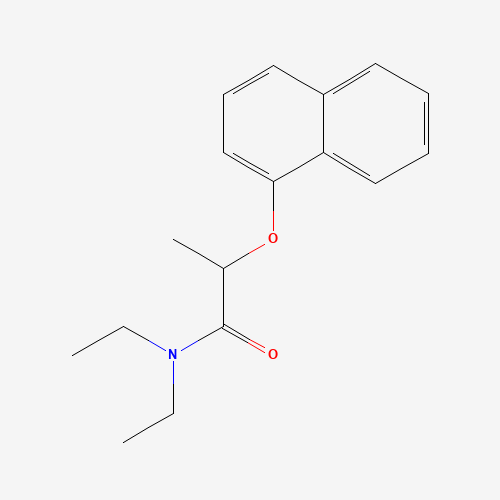
N,N-diethyl-2-(naphthalen-1-yloxy)propanamide is a monocarboxylic acid amide that is propanamide substituted by two ethyl groups at the nitrogen atom and a naphthalen-1-yloxy group at position 2. It is a member of naphthalenes, a monocarboxylic acid amide and an aromatic ether.
科学粮草官-词典编辑部,修订于:2026-07-06
Toxicity
ToxicityEPA Ecotoxicity
Pesticide Ecotoxicity Data from EPA: 56
Ecotoxicity Values
LC50 Bluegill sunfish 30 mg/l/96 hr, goldfish >10 mg/l/96 hr and rainbow trout 16.6 mg/l/96 hr
Fate Summary
ATMOSPHERIC FATE: According to a model of gas/particle partitioning of semivolatile organic compounds in the atmosphere(1), napropamide, which has a vapor pressure of 1.72X10⁻⁷ mm Hg at 25 °C(2), will exist in both the vapor and particulate phases in the ambient atmosphere. Vapor-phase napropamide is degraded in the atmosphere by reaction with photochemically-produced hydroxyl radicals(SRC); the half-life for this reaction in air is estimated to be 2 hrs(SRC), calculated from its rate constant of 2.3X10⁻¹⁰ cu cm/molecule-sec at 25 °C(SRC) determined using a structure estimation method(3). Particulate-phase napropamide may be removed from the air by wet and dry deposition(SRC).
Soil Adsorption / Mobility
Dissolved organic matter has been shown to form a stable complex with this compound(1-3). Napropamide in a 3.5 ml solution with dissolved organic matter at 25 °C for 48 hrs(1) showed a negative linear correlation between the log of the solubility and the log of the association coefficient with dissolved humic acid extracted from Texas peat, fulvic acid obtained from Greenfield sandy loam, Suwannee stream reference fulvic acid, Tujunga loamy sand, and Bermeo clay(1). Using a sludge-amended silt loam soil, it was observed that the water-soluble dissolved organic matter in the soil facilitated napropamide movement, exhibiting a strong positive relationship(4). In laboratory and soil column studies, napropamide was found to bind strongly to dissolved organic matter in sewage sludge and thus...
Environmental Biodegradation
AEROBIC: Napropamide degradation may be dependent on concentration(1). Following acclimation at 25 °C, napropamide half-lives in soil were observed to range from 34 to 217 days at 4 ug/g and from 156 to 436 days at 16 ug/g in Gilat soil; half-lives ranged from 108 to 507 days at 4 ug/g and 150-923 days at 16 ug/g in Neve Yaar soil, both samples from Israel(1). The rate generally decreased as soil moisture content decreased(1). Similar results were obtained using soil samples from Great Britain(2). These results indicate that this compound biodegrades slowly(1). These rates were positively correlated with the extent of napropamide adsorption and soil clay content and negatively correlated with soil pH(3). Napropamide applied at 1.12 and 2.24 kg/ha in the spring adversely affected fall gr...
Environmental Bioconcentration
An estimated BCF of 77 was calculated for napropamide(SRC), using a log Kow of 3.36(1) and a regression-derived equation(2). According to a classification scheme(3), this BCF suggests the potential for bioconcentration in aquatic organisms is moderate(SRC). However, due to rapid aqueous photolysis(4), bioconcentration is not likely to be an important environmental process(SRC).
Volatilization from Water / Soil
The Henry's Law constant for napropamide is estimated as 8.41X10⁻¹⁰ atm-cu m/mole(SRC) calculated from its vapor pressure, 1.72X10⁻⁷ mm Hg(1), and water solubility, 73 mg/l(2). This Henry's Law constant indicates that napropamide is expected to be essentially nonvolatile from water surfaces(3). Napropamide is not expected to volatilize from dry soil surfaces(SRC) based upon it's vapor pressure(1).
Environmental Abiotic Degradation
The rate constant for the vapor-phase reaction of napropamide with photochemically-produced hydroxyl radicals has been estimated as 2.3X10⁻¹⁰ cu cm/molecule-sec at 25 °C(SRC) using a structure estimation method(1). This corresponds to an atmospheric half-life of about 2 hours at an atmospheric concentration of 5X10+5 hydroxyl radicals per cu cm(1). Napropamide is resistant to hydrolysis in the environment; more than 97% of the initial 1 mg/kg was recovered after incubation at 20 °C in a sterilized water buffer at pH 7.0 for 3-5 months(3). Napropamide is subject to photodecomposition in soil(4). The first-order half-lives for photodegradation on nine soils incubated at 20 °C varied from 72 to 150 days(5). This rate can be affected by the rate of transport by evaporation of water-soluble...
Environmental Water Concentrations
SURFACE WATER: Napropamide was not detected in stormwater runoff within the Sacramento River Basin, California during a storm in January 1994(1). Napropamide was not detected in Arno River water samples entering the drinking water treatment plant in Florence, Italy, collected from 1992 through 1995(2). Pesticides adsorbed on soil particulates in runoff can enhance the movement of pesticides from a field(5). In a study conducted from April 1993 through April 1994, napropamide was detected in water samples from two tributary streams of the South Platte River, a small agricultural area in the Lonetree Creek Basin at a median concentration of <0.01 ug/l, but not detected in a small urban area in the Cherry Creek Basin in Colorado(3). Napropamide was not detected in ten water runoff samples...
Food Survey Values
In a 1993-94 US FDA monitoring program of domestic and imported apples and rice, napropamide was detected in 2 of 796 domestic apple samples at a concentration of 0.09 ppm and in 1 of 1062 imported apple samples at a concentration of 0.06 ppm(1).
Atmospheric Concentrations
RURAL/REMOTE: Air samples collected over the Mississippi River from New Orleans, LA to St. Paul, MN during the first 10 days in June, 1994 were not found to contain napropamide, detection limit equaling 0.15 ng/cu m, which is used on cropland within 40 km of the river(1).
Artificial Pollution Sources
Napropamide's production and use as a herbicide(1) will result in its direct release to the environment(SRC).
Probable Routes of Human Exposure
Occupational exposure to napropamide may occur through inhalation and dermal contact with this compound at workplaces where napropamide is produced or used(SRC). Napropamide was not detected in a year-long conifer nurseryworker pesticide exposure study conducted in March, 1986 using samples from nurseries in Brooklyn, MI, Coeur d'Alene, ID, Elkton, OR, Medford, OR, and Watersmeet, MI(1).
Environmental Fate / Exposure Summary
Napropamide's use as a herbicide will result in its direct release to the environment. If released to air, a vapor pressure of 1.72X10⁻⁷ mm Hg at 25 °C indicates napropamide will exist in both the vapor and particulate phases in the ambient atmosphere. Vapor-phase napropamide will be degraded in the atmosphere by reaction with photochemically-produced hydroxyl radicals; the half-life for this reaction in air is estimated to be 2 hrs. Particulate-phase napropamide will be removed from the atmosphere by wet and dry deposition. If released to soil, napropamide is expected to have moderate to low mobility based upon measured Kocs ranging from 218 to 700. Volatilization from moist soil surfaces is not expected to be an important fate process based upon an estimated Henry's Law constant of 8....
Target Organs
Reproductive
Toxicity Data
LC50 (rat) >4,800 mg/m3
RAIS Toxicity Values
Oral Chronic Reference Dose Reference: OPP
Carcinogen Classification
No indication of carcinogenicity to humans (not listed by IARC).
Non-Human Toxicity Values
LD50 Rat acute oral >5,000 mg/kg
1 or Cancer Risk Level 1E-06
Fraction of Contaminant Absorbed Dermally from Soil: 0.1
Hazard Quotient Level 3 or Cancer Risk Level 1E-04
Fraction of Contaminant Absorbed Dermally from Soil: 0.1
USGS Health-Based Screening Levels for Evaluating Water-Quality
Reference: Smith, C.D. and Nowell, L.H., 2024. Health-Based Screening Levels for evaluating water-quality data (3rd ed.). DOI:10.5066/F71C1TWP









