


 一键配货
一键配货
化合物详情
CAS15545-48-9
分子式C10H13ClN2O
分子量212.68 g/mol g/mol
危化品
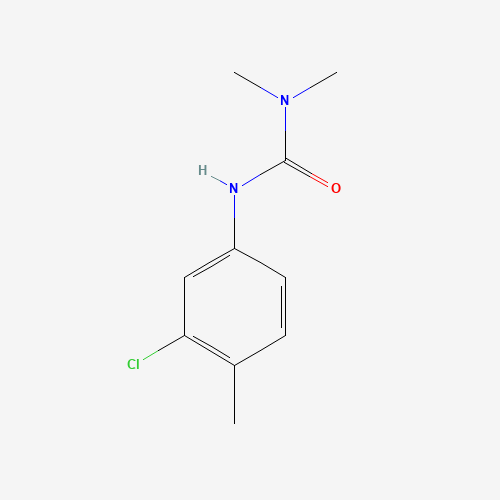
Chlorotoluron is a member of the class of phenylureas that is urea in which one of the nitrogens is substituted by two methyl groups while the other is substituted by a 3-chloro-4-methylphenyl group. A herbicide that is non-toxic to honeybees but moderately toxic to mammals, birds, earthworms and most aquatic organisms. It has a role as a herbicide, an agrochemical, a xenobiotic and an environmental contaminant. It is a member of phenylureas and a member of monochlorobenzenes.
科学粮草官-词典编辑部,修订于:2026-07-06
Toxicity
ToxicityEcotoxicity Values
LC50 trout more than 100 mg/l
Fate Summary
ATMOSPHERIC FATE: According to a suggested classification scheme(1), an experimental vapor pressure of 3.6X10⁻⁸ mm Hg at 25 °C(2,SRC) indicates that chlortoluron will exist solely in the particulate phase in the ambient atmosphere. Particulate-phase chlortoluron may be physically removed from the air by wet and dry deposition(SRC).
Soil Adsorption / Mobility
An average organic matter-water distribution of 60 was measured for seven soils (organic matter range 1.09-5.92%; pH range 5.9-7.5)(1). Seventeen soils from Australia had a range of organic matter-water distribution values for this compound from 25-85, giving Koc values ranging from 1-3467 (organic matter range 0.19-6.62; pH range 4.8-8.4)(2). Leaching was studied following field application of chlortoluron to a sandy soil; after 10 cm of rain had fallen, >2 mg/kg, 1 mg/kg, 0.5 mg/kg, and a trace remained in the 0-2.5, 2.5-5, 5-7.5, and 7.5-10 cm depth, respectively(2). Chlortoluron has measured Koc values ranging from 146-346 for eight Czechoslovakian soils (mean=228), with higher values corresponding to soils with a greater content of organic matter(3). Koc values of 271 and 419 were...
Environmental Biodegradation
Chlortoluron at 5 and 100 umol/kg soil was incubated at 25 °C in both a sandy loam and a mucky peat(1). Degradation was slow and there was no indication of a lag phase. The percentage of total applied 14C activity evolved as 14CO2 from the soil varied from 0.21 to 0.14% in peat and sand, respectively, at the 5 umol/kg soil herbicide concentration and from 0.25 to 0.38% in peat and sand, respectively, at the 100 umol/kg soil herbicide concentration(1). The higher rate for the sandy soil at 100 umol/kg soil concentration was believed due to the protective effect of sorption (in the peat soil) on the degradation process(1). A half-life of chlortoluron in soil was estimated at 25 °C as 2306 and 4730 days for peat and sand soils, respectively, at a herbicide concentration of 5 umol/kg soil(1...
Environmental Bioconcentration
An estimated BCF value of 40 was calculated for chlortoluron(SRC), using an experimental log Kow of 2.41(1,SRC) and a recommended regression-derived equation(2). According to a classification scheme, this BCF value suggests that bioconcentration in aquatic organisms is moderate, not high(3). Winter wheat grown in soil containing 4.7 mg chlortoluron/kg dry soil had bioconcentration factors of 21 and 22 for root material and for shoots, respectively (bioconcentration factor is the concentration of 14C from the chlortoluron in the plant versus the soil)(4).
Volatilization from Water / Soil
The Henry's Law constant for chlortoluron is estimated as 1.4X10⁻¹⁰ atm-cu m/mole(SRC) from its experimental values for vapor pressure, 3.6X10⁻⁸ mm Hg(1), and water solubility, 70 mg/L(2). This value indicates that chlortoluron will be essentially nonvolatile from water surfaces(3,SRC). Chlortoluron's vapor pressure(1) and Henry's Law constant(1,2,SRC) indicate that this compound should not volatilize from either dry or moist soil surfaces, respectively(SRC).
Environmental Abiotic Degradation
Water, spiked with chlortoluron at 1 ug/L, was used to measure transport of this compound in groundwater from a sand-gravel aquifer(2). Chlortoluron was not detected at a flow distance of 10 m and a depth of 6 m; at 14 m and 18 m depths chlortoluron had a relative residence time 7 times (retention capacity of 400 ng/kg) and 1.75 times (retention capacity of 50 ng/kg) that of the mean residence time for a conservative tracer(2). A semi-quantitative mass-balance over a 175 day period shows that 70% to 90% of this compound was transported either convectively or dispersively. From 7-10% was adsorbed by sediment and from 2-20%, depending on the depth from the surface, was degraded biologically or abiotically(2).
Environmental Water Concentrations
DRINKING WATER: Chlortoluron was detected in British drinking water at an unreported location and concentration(1).
Plant Concentrations
No residue can be detected in the seed of winter wheat 120 days after treatment in spring.
ICSC Environmental Data
The substance is very toxic to aquatic organisms. This substance does enter the environment under normal use. Great care, however, should be taken to avoid any additional release, for example through inappropriate disposal.
Artificial Pollution Sources
Chlortoluron's production and use (not marketed in U.S.)(1) as a herbicide(2) would result in its release directly to the environment(SRC).
Sediment/Soil Concentrations
IN TEMPERATE CLIMATES, AN INITIAL SOIL APPLICATION OF 6 KG AI/HA HAD T/2 OF 30 TO 40 DAYS.
Environmental Fate / Exposure Summary
Chlortoluron's production and use (not marketed in U.S.) as a herbicide may have resulted in its release directly to the environment. If released to the atmosphere, chlortoluron should exist solely in the particulate phase based on an experimental vapor pressure of 3.6X10⁻⁸ mm Hg at 25 °C. Particulate-phase chlortoluron may be physically removed from the air by wet and dry deposition. In soil, measured Koc values averaged from 150- 420 with adsorption dependent on the percentage of organic matter present in the soil. These values indicate that chlortoluron will generally have moderate mobility in soil. Biodegradation is expected to be a major fate process for chlortoluron in soil; degradation half-lives range from 4-16 weeks. Monomethyl chlortoluron and N-demethylated chlortoluron were...
Symptoms
Eye Exposure: Redness.
Interactions
Levels of cytochrome p450s and rates of monooxygenase activities were studied in microsomes prepared from wheat cell suspension cultures. Cytochrome contents and enzymatic activities, namely, the enzymatic systems responsible for chlorotoluron ring-methy1 hydroxy1ation and N-demethylation, were enhanced after pretreatment of cells with 2,4-D, procloraz, mecoprop, chlorotoluron, and oxime ether safeners. Effects of various agrochemicals were also determined on chlorotoluron ring-methyl hydroxylase and N-demethylase, following their direct addition to microsomal preparations. Plant growth regulators and fungicide, as well as piperonyl butoxide decreased both activities, tetcyclacis, and procloraz being marked1y inhibitory. Naphthalic anhydride, oxime ether safeners, dich1ormid, and tridip...
Exposure Routes
The substance can be absorbed into the body by inhalation of its aerosol and by ingestion.
Non-Human Toxicity Values
LD50 Rat subcutaneous greater than 2000 mg/kg
Non-Human Toxicity Excerpts
The effects of eight structurally related, substituted urea herbicides (including chlortoluron) on the hepatic cytochrome p450 dependent monooxygenase enzyme were investigated in rats. Male Wistar-rats were given one sixth the median lethal dose (LD50) of herbicides by gavage on 3 consecutive days. The dose administered was 166 mg/ml chlortoluron. Animals were sacrificed 24 hours after the last treatment with the herbicides. Cytochrome p450 and cytochrome b5 content of liver microsomes were determined by difference spectrophotometry. Chlortoluron was the only compound that increased the relative liver weight to body weight. Diuron, linuron, chlorbromuron, and chlortoluron were the most effective inducers of benzo(a)pyrene monooxygenase, causing a 3.5 to 8 fold induction. Diuron,chlorto...
Antidote and Emergency Treatment
5. INGESTIONS OCCURRING MORE THAN AN HR BEFORE TREATMENT ARE PROBABLY BEST TREATED ONLY BY ACTIVATED CHARCOAL /PRC: 30 G ACTIVATED CHARCOAL IN 3-4 OZ WATER (CHILDREN), 100 G IN 8-10 OZ WATER (ADULT)/...& SODIUM OR MAGNESIUM SULFATE, 0.25 G/KG... 6. THERE ARE NO SPECIFIC ANTIDOTES FOR THESE CHEMICALS. BECAUSE MANIFESTATIONS OF TOXICITY DO OCCASIONALLY OCCUR IN PECULIARLY PREDISPOSED INDIVIDUALS, MAINTAIN CONTACT WITH VICTIM FOR AT LEAST 72 HR SO THAT UNEXPECTED ADVERSE EFFECTS CAN BE TREATED PROMPTLY. /PESTICIDES OF LOW OR MODERATE TOXICITY/









