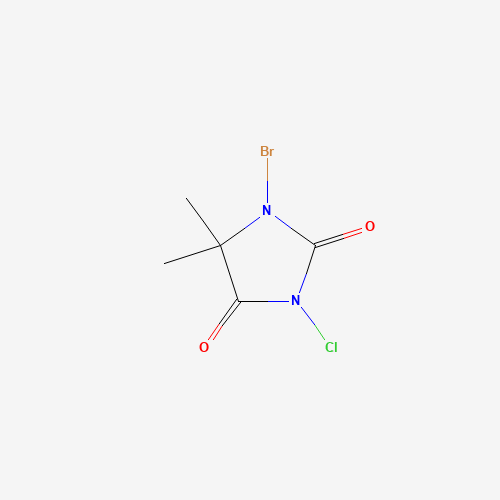
EPA Ecotoxicity
Pesticide Ecotoxicity Data from EPA: 44
Ecotoxicity Values
LD50; Species: Colinus virginianus (Northern bobwhite) age 27 weeks; oral >2150 mg/kg
Fate Summary
ATMOSPHERIC FATE: According to a model of gas/particle partitioning of semivolatile organic compounds in the atmosphere(1), 1-bromo-3-chloro-5,5-dimethylhydantoin, which has an estimated vapor pressure of 3.5X10⁻⁶ mm Hg at 25 °C(SRC), determined from a fragment constant method(2), will exist in both the vapor and particulate phases in the ambient atmosphere. Vapor-phase 1-bromo-3-chloro-5,5-dimethylhydantoin is degraded in the atmosphere by reaction with photochemically-produced hydroxyl radicals(SRC); the half-life for this reaction in air is estimated to be 5 days(SRC), calculated from its rate constant of 3.1X10⁻¹² cu cm/molecule-sec at 25 °C(SRC) that was derived using a structure estimation method(2). Particulate-phase 1-bromo-3-chloro-5,5-dimethylhydantoin may be removed from the...
Soil Adsorption / Mobility
Using a structure estimation method based on molecular connectivity indices(1), the Koc of 1-bromo-3-chloro-5,5-dimethylhydantoin can be estimated to be 10(SRC). According to a classification scheme(2), this estimated Koc value suggests that 1-bromo-3-chloro-5,5-dimethylhydantoin is expected to have very high mobility in soil(SRC).
Environmental Bioconcentration
An estimated BCF of 3 was calculated in fish for 1-bromo-3-chloro-5,5-dimethylhydantoin(SRC), using a log Kow of 0.35(1) and a regression-derived equation(2). According to a classification scheme(3), this BCF suggests the potential for bioconcentration in aquatic organisms is low(SRC).
Volatilization from Water / Soil
The Henry's Law constant for 1-bromo-3-chloro-5,5-dimethylhydantoin is estimated as 7.4X10⁻¹⁰ atm-cu m/mole(SRC) derived from its estimated vapor pressure, 3.5X10⁻⁶ mm Hg(1), and water solubility, 1500 mg/L(2). This Henry's Law constant indicates that 1-bromo-3-chloro-5,5-dimethylhydantoin is expected to be essentially nonvolatile from water surfaces(3). 1-Bromo-3-chloro-5,5-dimethylhydantoin's estimated Henry's Law constant indicates that volatilization from moist soil surfaces is not expected to occur(SRC). 1-Bromo-3-chloro-5,5-dimethylhydantoin is not expected to volatilize from dry soil surfaces(SRC) based upon its estimated vapor pressure(1).
Environmental Abiotic Degradation
The rate constant for the vapor-phase reaction of 1-bromo-3-chloro-5,5-dimethylhydantoin with photochemically-produced hydroxyl radicals has been estimated as 3.1X10⁻¹² cu cm/molecule-sec at 25 °C(SRC) using a structure estimation method(1). This corresponds to an atmospheric half-life of about 5 days at an atmospheric concentration of 5X10+5 hydroxyl radicals per cu cm(1).
Artificial Pollution Sources
1-Bromo-3-chloro-5,5-dimethylhydantoin's production and use as a disinfectant in industrial water treatment, in commercial and residential swimming pools, spas and hot tubs and as sanitizer for treatment of toilet bowl water in homes(1) may result in its release to the environment through various waste streams(SRC). 1-Bromo-3-chloro-5,5-dimethylhydantoin's use as a molluscicide(2) and as an ingredient in hydraulic fracturing(3) will result in its direct release to the environment(SRC).
Probable Routes of Human Exposure
Occupational exposure to 1-bromo-3-chloro-5,5-dimethylhydantoin may occur through inhalation and dermal contact with this compound at workplaces where 1-bromo-3-chloro-5,5-dimethylhydantoin is produced or used(1). Use data indicate that the general population may be exposed to 1-bromo-3-chloro-5,5-dimethylhydantoin via dermal contact with products containing this compound(SRC) or areas treated with 1-bromo-3-chloro-5,5-dimethylhydantoin biocides such as swimming pools, hot tubs and toilet bowl waters(1). Ingestion may be possible in treated swimming pools(1).
Environmental Fate / Exposure Summary
1-Bromo-3-chloro-5,5-dimethylhydantoin's production and use as a disinfectant in industrial water treatment, in commercial and residential swimming pools, spas and hot tubs and as sanitizer for treatment of toilet bowl water in homes may result in its release to the environment through various waste streams. 1-Bromo-3-chloro-5,5-dimethylhydantoin's use as a molluscicide and as an ingredient in hydraulic fracturing will result in its direct release to the environment. If released to air, an estimated vapor pressure of 3.5X10⁻⁶ mm Hg at 25 °C indicates 1-bromo-3-chloro-5,5-dimethylhydantoin will exist in both the vapor and particulate phases in the atmosphere. Vapor-phase 1-bromo-3-chloro-dimethylhydantoin will be degraded in the atmosphere by reaction with photochemically-produced hydrox...
Symptoms
Irritating to nose and throat. Can cause redness and itching of skin due to chronic skin exposure.
Treatment
EYES: irrigate opened eyes for several minutes under running water. INGESTION: do not induce vomiting. Rinse mouth with water (never give anything by mouth to an unconscious person). Seek immediate medical advice. SKIN: should be treated immediately by rinsing the affected parts in cold running water for at least 15 minutes, followed by thorough washing with soap and water. If necessary, the person should shower and change contaminated clothing and shoes, and then must seek medical attention. INHALATION: supply fresh air. If required provide artificial respiration.
Toxicity Data
LD50: 1390 mg/kg (Oral, Rat) (T14) LD50: >2000 mg/kg (Dermal, Rabbit) (T14)
Health Effects
Corrosive. Acute exposure causes irreversible eye damage and skin burns. Eye contact may cause loss of vision. Irritating to nose and throat and may be fatal if large quantities are inhaled. Harmful if absorbed through skin or swallowed. Can cause contact dermatitis through exposure in swimming pools. It is not carcinogenic or mutagenic.
Adverse Effects
Skin Sensitizer - An agent that can induce an allergic reaction in the skin.
Exposure Routes
Oral (L626); inhalation (L626); dermal (L626)
Toxicity Summary
BCDMH likely causes tissue irritation through its breakdown products (hypochlorous acid and hypobromous acid) which, on their own, can cause local irritation. 5,5-dimethylhydantoin is also produced spontaneously from BCDMH decomposition and hydantoins are also known to be allergens.
Human Toxicity Excerpts
/OTHER TOXICITY INFORMATION/ Cancer Classification: Not Likely to be Carcinogenic to Humans
Carcinogen Classification
No indication of carcinogenicity (not listed by IARC). (L135)
Non-Human Toxicity Values
LD50 Rabbit dermal >2000 mg/kg
Non-Human Toxicity Excerpts
/LABORATORY ANIMALS: Chronic Exposure or Carcinogenicity/ Dimethylhydantoin (purity = 98.9%) was fed in diet to Beagle dogs (4/sex/dose) at 0, 4000, 12000 and 40000 ppm for one-year. Chronic NOEL = 12000 ppm (adrenal cortical hypertrophy was increased and correlated with increased relative adrenal weight for males at 40000 ppm. Adrenal hypertrophy was diffuse/bilateral and involved zona fasciculata cells. Body weight values were not statistically significantly decreased, but were generally lower in both sexes at 40000 ppm relative to the controls.) ... /5,5-Dimethylhydantoin/[California Environmental Protection Agency Department of Pesticide Regulation; 1-bromo-3-chloro-5,5-dimethylhydantoin
Antidote and Emergency Treatment
/SRP:/ Advanced treatment: Consider orotracheal or nasotracheal intubation for airway control in the patient who is unconscious, has severe pulmonary edema, or is in severe respiratory distress. Positive-pressure ventilation techniques with a bag valve mask device may be beneficial. Consider drug therapy for pulmonary edema ... . Consider administering a beta agonist such as albuterol for severe bronchospasm ... . Monitor cardiac rhythm and treat arrhythmias as necessary ... . Start IV administration of D5W TKO /SRP: "To keep open", minimal flow rate/. Use 0.9% saline (NS) or lactated Ringer's (LR) if signs of hypovolemia are present. For hypotension with signs of hypovolemia, administer fluid cautiously. Watch for signs of fluid overload ... . Treat seizures with diazepam or lorazepam...



 一键配货
一键配货