


 一键配货
一键配货
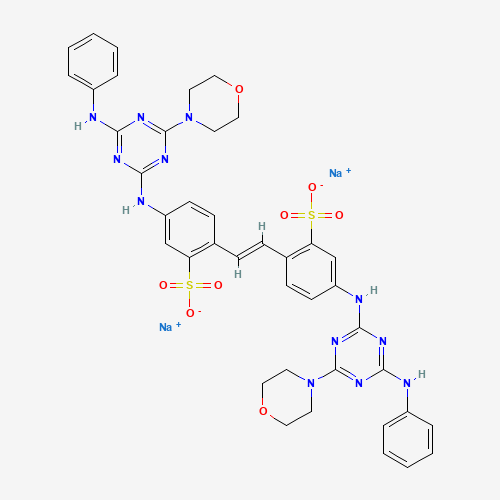
化合物详情
CAS16090-02-1
分子式C40H38N12Na2O8S2
分子量924.91 g/mol
非危品
科学粮草官-词典编辑部,修订于:2026-07-06
Toxicity
ToxicityFate Summary
ATMOSPHERIC FATE: The ionic state of C.I. Fluorescent Brightener 260 makes this compound essentially non-volatile(1,SRC), therefore this compound will only exist in the particulate phase in the ambient atmosphere. Particulate-phase C.I. Fluorescent Brightener 260 may be physically removed from the air by wet and dry deposition(SRC).
Soil Adsorption / Mobility
The Koc of C.I. Fluorescent Brightener 260 is estimated as approximately 1800(SRC), using a water solubility of 5 mg/l(1) and a regression-derived equation(2,SRC). According to a classification scheme(3), this estimated Koc value suggests that C.I. Fluorescent Brightener 260 is expected to have low mobility in soil(SRC). Due to the ionic nature of the brightener, the retention of C.I. Fluorescent Brightener 260 by ion-exchange processes(4,SRC), particularly on clay surfaces and adsorption at mineral surfaces such as geothite(5,SRC), may slow down or prevent leaching(SRC). In one experiment, clean water was percolated through sludge containing fluorescent whitening agents. After 68 days the total amount leached from the original 216 mg C.I. Fluorescent Brightener 260 in 20 kg sludge was...
Environmental Biodegradation
Laboratory experiments showed that fluorescent whitening agents used in detergents are not readily biodegradable. Tests which used the oxygen consumption over 5 days as a measure of the ability of fluorescent agents to serve a substrate for bacterial growth gave no evidence of biodegradation; C.I. Fluorescent Brightener 260 had a BOD5 of zero. In a river die-away test at which carbon dioxide production was measured in solutions of maximum 1000 ppb over a period of 35 days, no biodegradability was found(1).
Environmental Bioconcentration
A bioconcentration factor range of 1.4 to 28 in carp was determined for C.I. Fluorescent Brightener 260(1). According to a classification scheme(2), this BCF suggests the potential for bioconcentration in aquatic organisms is low(SRC).
Volatilization from Water / Soil
Since C.I. Fluorescent Brightener 260 is an ionic compound, volatilization from water and moist soil surfaces is not expected to be an important fate process(1,SRC).
Environmental Abiotic Degradation
C.I. Fluorescent Brightener 260 is not expected to undergo hydrolysis in the environment due to the lack of hydrolyzable functional groups(1). Fluorescent whitening agents, which includes C.I. Fluorescent Brightener 260, have an UV absorption maximum between 340 to 360 nm in water and transform UV energy almost quantitatively into blue fluorescent light(2).
Environmental Water Concentrations
ONLY TRACE QUANTITIES OF FLUORESCENT WHITENING AGENTS HAVE BEEN FOUND IN DRINKING WATER.
Effluent Concentrations
Samples of 35 US rivers in 1974 showed concentration of fluorescent whitening agents up to 0.6 ppb upstream of a sewage treatment plant. Downstream concentrations were never above 40 ppb for C.I. Fluorescent Brightener 260(1).
ICSC Environmental Data
The substance is harmful to aquatic organisms.
Artificial Pollution Sources
C.I. Fluorescent Brightener 260's production and use in laundry detergents(1) may result in its release to the environment through various waste streams(SRC).
Sediment/Soil Concentrations
Fluorescent whitening agents are strongly adsorbed to soil. In one experiment, clean water was percolated through sludge containing fluorescent whitening agents. After 68 days the total amount leached from the original 216 mg C.I. Fluorescent Brightener 260 in 20 kg sludge was only 0.02%. The sludge had been exposed to natural weather and non-agricultural conditions(1).
Probable Routes of Human Exposure
NIOSH (NOES Survey 1981-1983) has statistically estimated that 231 workers (76 of these are female) are potentially exposed to C.I. Fluorescent Brightener 260 in the US(1). Occupational exposure to C.I. Fluorescent Brightener 260 may occur through dermal contact with this compound at workplaces where C.I. Fluorescent Brightener 260 is produced or used(SRC). The general population may be exposed to C.I. Fluorescent Brightener 260 via dermal contact with consumer products (i.e. detergents) containing C.I. Fluorescent Brightener 260(SRC).
Environmental Fate / Exposure Summary
C.I. Fluorescent Brightener 260's production and use in laundry detergents may result in its release to the environment through various waste streams. As C.I. Fluorescent Brightener 260 is ionic in nature at environmental pHs, it is expected to exist in the particulate phase under these conditions. Particulate-phase C.I. Fluorescent Brightener 260 will be physically removed from the atmosphere by wet and dry deposition. If released to soil, C.I. Fluorescent Brightener 260 is expected to have low mobility based upon an estimated Koc of 1800. Due to the ionic nature of C.I. Fluorescent Brightener 260, volatilization of this compound will not be important from moist soil surfaces. Based on limited data, C.I. Fluorescent Brightener 260 is expected to be resistant to aerobic biodegradation....
Symptoms
Eye Exposure: Redness.









