


 一键配货
一键配货
化合物详情
CAS16672-87-0
分子式C2H6ClO3P
分子量144.49 g/mol
非危品
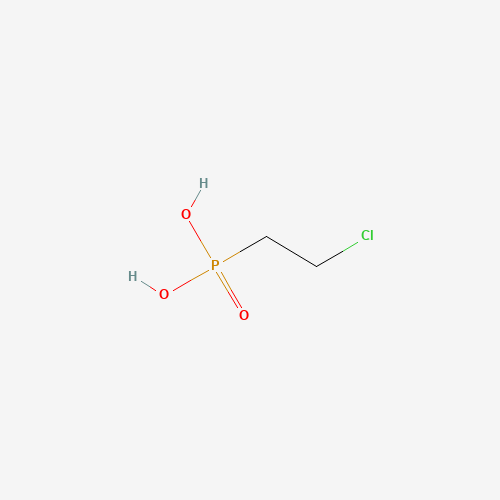
(2-chloroethyl)phosphonic acid is a phosphonic acid compound having a 2-chloroethyl substituent attached to the P-atom. It has a role as a plant growth regulator.
科学粮草官-词典编辑部,修订于:2026-07-06
Toxicity
ToxicityEPA Ecotoxicity
Pesticide Ecotoxicity Data from EPA: 94
Fate Summary
ATMOSPHERIC FATE: According to a model of gas/particle partitioning of semivolatile organic compounds in the atmosphere(1), ethephon, which has an estimated vapor pressure of 7.5X10⁻⁸ mm Hg at 20 deg(2), is expected to exist solely in the particulate phase in the ambient atmosphere. Particulate-phase ethephon may be removed from the air by wet or dry deposition(SRC). Ethephon does not contain chromophores that absorb at wavelengths >290 nm(4), and therefore is not expected to be susceptible to direct photolysis by sunlight(SRC).
Soil Adsorption / Mobility
The Koc of ethephon ranges from 608 to 8547 determined from adsorption/desorption experiments(1). 14C-Ethephon in solution at 0.4, 1.3, 5.1, and 10.1 ppm and applied to loamy sand, silt loam soil, sandy loam and clay soils as well as in sandy loam pond sediments was equilibrated in the dark for 24 hours at 25 °C. Freundlich adsorption values were 2.4 for the silt loam soil, 7.2 for the loamy sand soil, 29.8 for sandy loam soil, 53.1 for the clay soil, and 57.3 for the sandy loam pond sediment; respective K values were 608, 3117, 4078, 3220, and 1676. Freundlich desorption values were 3.9 for the silt loam soil, 17.5 for the loamy sand soil, 62.4 for sandy loam soil, 69.0 for the clay soil, and 87.9 for the sandy loam pond sediment; respective K values were 992, 7600, 8547, 4181, and 257...
Environmental Biodegradation
ANAEROBIC: Degradation of ethephon occurs with a half-life of 5.3 days in flooded silt loam sediment when incubated in the dark at 25 °C under a nitrogen atmosphere. The major degradates were ethylene gas and soil bound 2-hydroxy ethyl phosphonic acid. In a sediment/pond water system only 1.8 percent of 14C-radiolabeled ethephon added remained after 30 days incubation(1).
Environmental Bioconcentration
An estimated BCF of 3.2 was calculated for ethephon(SRC), using a measured log Kow of -0.22(1) and a regression-derived equation(2). According to a classification scheme(3), this BCF suggests the potential for bioconcentration in aquatic organisms is low(SRC).
Volatilization from Water / Soil
The Henry's Law constant for ethephon is estimated as 1.43X10⁻¹³ atm-cu m/mole(SRC)derived from its vapor pressure, 7.5X10⁻⁷ mm Hg(1), and water solubility, 1X10+6 mg/L(2). This Henry's Law constant indicates that ethephon is expected to be essentially nonvolatile from water surfaces(3). Ethephon's estimated Henry's Law constant indicates that volatilization from moist soil surfaces is not expected(SRC).
Environmental Abiotic Degradation
Ethephon is stable in aqueous solutions having pH <5; at higher pH, decomposition occurs with the liberation of ethylene; the half-life is 2.4 days (pH 7, 25 °C). The compound is sensitive to UV irradiation(1).
Milk Concentrations
WHEN...FED TO LACTATING COW IN DIET @ 5 PPM, SOME OF DOSE WAS EXCRETED UNCHANGED IN URINE (9.8%), BUT NONE WAS PRESENT IN MILK OR FECES.
Ecotoxicity Excerpts
/PLANTS/ Phytotoxic when used at extremely high rates.
Artificial Pollution Sources
Ethephon's production and use as a ripening aid(1), flow stimulant of rubber and pine gum(2), and defoliant(3) is expected to result in its direct release to the environment(SRC).
Probable Routes of Human Exposure
Occupational exposure via inhalation and dermal contact to ethephon may occur to mixer/loader/applicator (handlers) of this chemical. These exposure routes are possible at workplaces where ethephon is produced or used during activities that include open pouring, broadcast (aerial and ground) application, and application with hand-held equipment. Post application dermal and inhalation exposure to persons entering recently treated areas was also identified as a potential exposure pathway(1). The general population is not likely to be exposed to ethephon due to its rapid degradation under environmental conditions(SRC).
Environmental Fate / Exposure Summary
Ethephon's production may result in its release to the environment through various waste streams; its use as a fruit and vegetable ripening aid, flow stimulant of rubber and pine gum, and defoliant will result in its direct release to the environment. If released to air, a vapor pressure of 7.5X10⁻⁸ mm Hg at 20 °C indicates ethephon will exist solely in the particulate phase in the atmosphere. Particulate-phase ethephon will be removed from the atmosphere by wet or dry deposition. Ethephon does not contain chromophores that absorb at wavelengths >290 nm, and therefore is not expected to be susceptible to direct photolysis by sunlight. If released to soil, ethephon is expected to have low to slight mobility but could be immobile in certain soils based upon experimental Koc values ranging...
Symptoms
Symptoms of low dose exposure include excessive salivation and eye-watering. Acute dose symptoms include severe nausea/vomiting, salivation, sweating, bradycardia, hypotension, collapse, and convulsions. Increasing muscle weakness is a possibility and may result in death if respiratory muscles are involved. Hypertension, hypoglycemia, anxiety, headache, tremor and ataxia may also result.
Treatment
If the compound has been ingested, rapid gastric lavage should be performed using 5% sodium bicarbonate. For skin contact, the skin should be washed with soap and water. If the compound has entered the eyes, they should be washed with large quantities of isotonic saline or water. In serious cases, atropine and/or pralidoxime should be administered. Anti-cholinergic drugs work to counteract the effects of excess acetylcholine and reactivate AChE. Atropine can be used as an antidote in conjunction with pralidoxime or other pyridinium oximes (such as trimedoxime or obidoxime), though the use of '-oximes' has been found to be of no benefit, or possibly harmful, in at least two meta-analyses. Atropine is a muscarinic antagonist, and thus blocks the action of acetylcholine peripherally.
Interactions
Health effects of subacute treatment of combinations of gibberellic acid and ethephon (2-chloroethylphosphonic acid) were investigated. Mice was used as an experimental model. Ten groups of male ICR (CD-1) mice were treated with oral doses of 25, 50 and 100 mg of either gibberellic acid (GA3), ethephon (2-chloroethylphosphonic acid) alone or in combination / kg body weight for 11 weeks. A significant dose dependent reduction in weight gain and low dry matter intakes were recorded in animals treated with the combination of both chemicals. Treated groups showed statistically significant increases in mean liver, kidney and spleen weights. Hemoglobin (Hb) and total erythrocyte count (TEC) decreased while total leukocyte count (TLC) was raised in all treated groups. Gibberellic acid (alone)...
Target Organs
Nervous
Toxicity Data
LC50 (rat) = 4,520 mg/m3
Health Effects
Acute exposure to cholinesterase inhibitors can cause a cholinergic crisis characterized by severe nausea/vomiting, salivation, sweating, bradycardia, hypotension, collapse, and convulsions. Increasing muscle weakness is a possibility and may result in death if respiratory muscles are involved. Accumulation of ACh at motor nerves causes overstimulation of nicotinic expression at the neuromuscular junction. When this occurs symptoms such as muscle weakness, fatigue, muscle cramps, fasciculation, and paralysis can be seen. When there is an accumulation of ACh at autonomic ganglia this causes overstimulation of nicotinic expression in the sympathetic system. Symptoms associated with this are hypertension, and hypoglycemia. Overstimulation of nicotinic acetylcholine receptors in the central...
Hepatotoxicity
Ethephon is one of the most common plant growth regulators, and it used on fruits, vegetables, and cereals for promoting pre- and post-harvest ripening. Adult rats received ethephon at a dose of 200 mg/kg/day by gavage for 14 days. The orderly arrangement of hepatocytes was disrupted and was replaced by blood-filled sinusoids, and the hepatocytes appeared to be degenerated. The authors noted that the observations are probably indicative of degenerative changes associated with ethephon, and concluded that it has hepatotoxic potential.
Adverse Effects
Toxic Pneumonitis - Inflammation of the lungs induced by inhalation of metal fumes or toxic gases and vapors.
Toxicity Summary
Ethephon is a cholinesterase or acetylcholinesterase (AChE) inhibitor. A cholinesterase inhibitor (or 'anticholinesterase') suppresses the action of acetylcholinesterase. Because of its essential function, chemicals that interfere with the action of acetylcholinesterase are potent neurotoxins, causing excessive salivation and eye-watering in low doses, followed by muscle spasms and ultimately death. Nerve gases and many substances used in insecticides have been shown to act by binding a serine in the active site of acetylcholine esterase, inhibiting the enzyme completely. Acetylcholine esterase breaks down the neurotransmitter acetylcholine, which is released at nerve and muscle junctions, in order to allow the muscle or organ to relax. The result of acetylcholine esterase inhibition is...
RAIS Toxicity Values
Oral Chronic Reference Dose Reference: IRIS Current
Human Toxicity Excerpts
/HUMAN EXPOSURE STUDIES/ When volunteers were given ethephon orally at a dose of 0.17 or 0.33 mg/kg bw per day (in three divided doses), the only significant finding was inhibition of plasma cholinesterase activity. No gross symptoms or changes in haematological, clinical chemical or urine end-points were associated with treatment.
Carcinogen Classification
No indication of carcinogenicity to humans (not listed by IARC).
Non-Human Toxicity Values
LD50 Rabbit percutaneous 5730 mg/kg
1 or Cancer Risk Level 1E-06
Fraction of Contaminant Absorbed Dermally from Soil: 0.1
Evidence for Carcinogenicity
Cancer Classification: Group D Not Classifiable as to Human Carcinogenicity
Antidote and Emergency Treatment
/SRP:/ Advanced treatment: Consider orotracheal or nasotracheal intubation for airway control in the patient who is unconscious, has severe pulmonary edema, or is in severe respiratory distress. Positive-pressure ventilation techniques with a bag valve mask device may be beneficial. Monitor cardiac rhythm and treat arrhythmias if necessary ... . Start IV administration of D5W /SRP: "To keep open", minimal flow rate/. Use 0.9% saline (NS) or lactated Ringer's (LR) if signs of hypovolemia are present. For hypotension with signs of hypovolemia, administer fluid cautiously and consider vasopressors if patient is hypotensive with a normal fluid volume. Watch for signs of fluid overload ... . Administer atropine. Correct hypoxia before giving atropine ... . Administer pralidoxime chloride (2...
Hazard Quotient Level 3 or Cancer Risk Level 1E-04
Fraction of Contaminant Absorbed Dermally from Soil: 0.1









