


 一键配货
一键配货
化合物详情
CAS17109-49-8
分子式C14H15O2PS2
分子量310.37 g/mol g/mol
危化品
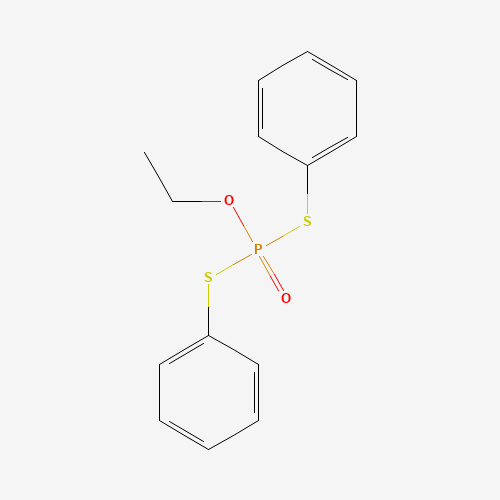
Edifenphos is an organic thiophosphate that is the O-ethyl-S,S-diphenyl ester of phosphorodithioic acid. Used to control a variety of fungal diseases on rice including blast, ear blight and stem rot. Edifenphos is moderately toxic to mammals and fish but poses more of a risk to aquatic invertebrates. It has a role as an EC 3.1.1.7 (acetylcholinesterase) inhibitor, a neurotoxin, a phospholipid biosynthesis inhibitor and an antifungal agrochemical.
科学粮草官-词典编辑部,修订于:2026-07-06
Toxicity
ToxicityEcotoxicity Values
USDA APHIS Chemical Effects: collection=usda_chemeffect&query_type=synonym&query='^17109-49-8$'
Fate Summary
ATMOSPHERIC FATE: According to a model of gas/particle partitioning of semivolatile organic compounds in the atmosphere(1), edifenphos, which has a vapor pressure of 2.7X10⁻⁷ mm Hg at 25 °C(2), will exist in both the vapor and particulate phases in the ambient atmosphere(SRC). Vapor-phase edifenphos is degraded in the atmosphere by reaction with photochemically-produced hydroxyl radicals(SRC); the half-life for this reaction in air is estimated to be 8.7 hrs(SRC), calculated from its rate constant of 4.4X10⁻¹¹ cu cm/molecule-sec at 25 °C(SRC) that was derived using a structure estimation method(3). Particulate-phase edifenphos may be removed from the air by wet and dry deposition(SRC).
Soil Adsorption / Mobility
The Koc of edifenphos is estimated as 1,900(SRC), using a log Kow of 3.48(1) and a regression-derived equation(2). According to a classification scheme(3), this estimated Koc value suggests that edifenphos is expected to have low mobility in soil(SRC).
Environmental Biodegradation
ANAEROBIC: Using adapted bacteria, edifenphos was found to degrade faster under flooded conditions compared to non-flooded conditions(1). Edifenphos was recovered at 42% from autoclaved soils compared to 10% recovery from non-autoclaved soils(1). During a field-study, edifenphos, applied at a rate of 5.0 mg on a paddy field soil in Japan, disappeared in 39 days with a half-life of 5-6 days(2).
Environmental Bioconcentration
Whole fish BCFs for female guppy, male guppy, killifish, gold fish, and white cloud mountain fish are measured as 40.6, 29.3, 28.8, 38.9, and 29.3, respectively(1). According to a classification scheme(2), BCF values ranging from 28.8 to 40.6 for fish(1) suggest bioconcentration in aquatic organisms is moderate(SRC).
Volatilization from Water / Soil
The Henry's Law constant for edifenphos is estimated as 7.6X10⁻¹⁰ atm-cu m/mole(SRC) derived from its vapor pressure, 2.7X10⁻⁷ mm Hg(1), and water solubility, 56 mg/l(2). This Henry's Law constant indicates that edifenphos is expected to be essentially nonvolatile from water and moist soil surfaces(3). The volatilization rate of edifenphos from the surface of aqueous solution was found to be 8.8X10⁻⁹ m/hr(4). Edifenphos is not expected to volatilize from dry soil surfaces(SRC) based upon its vapor pressure(1).
Environmental Abiotic Degradation
The rate constant for the vapor-phase reaction of edifenphos with photochemically-produced hydroxyl radicals has been estimated as 4.4X10⁻¹¹ cu cm/molecule-sec at 25 °C(SRC) using a structure estimation method(1). This corresponds to an atmospheric half-life of about 8.7 hours at an atmospheric concentration of 5X10+5 hydroxyl radicals per cu cm(1). Edifenphos is hydrolyzed by strong acids and alkalis(2). The fifty-percent disappearance times at pH 7 and 9 are 19 and 2 days, respectively(2). Edifenphos is not expected to directly photolyze due to the lack of absorption in the environmental portion of the UV spectrum (>290 nm)(SRC).
Environmental Water Concentrations
RAIN: Pesticide residues in rainwater were investigated for the estimation of pesticide flux into a lake in Ibaraki Prefecture (Japan) during the 1990 rainy season(1). The max concn of edifenphos in rainwater was estimated to be 0.36 ug/l(1).
Artificial Pollution Sources
Edifenphos's former production in the US may have resulted in its release to the environment through various waste streams; it's use as a fungicide(1) results in its direct release to the environment(SRC).
Sediment/Soil Concentrations
SOIL: Edifenphos was detected in a few soil samples from 108 districts (in Korea) in year 1982(1).
Probable Routes of Human Exposure
Secondary exposure of children through contact with their parents' contaminated clothing can also occur. /Organophosphorus pesticides/
Environmental Fate / Exposure Summary
Edifenphos's former production in the US may have resulted in its release to the environment through various waste streams; it's use as a fungicide results in its direct release to the environment. If released to air, a vapor pressure of 2.7X10⁻⁷ mm Hg at 25 °C indicates edifenphos will exist in both the vapor and particulate phases in the ambient atmosphere. Vapor-phase edifenphos will be degraded in the atmosphere by reaction with photochemically-produced hydroxyl radicals; the half-life for this reaction in air is estimated to be 8.7 hrs. Particulate-phase edifenphos will be removed from the atmosphere by wet and dry deposition. If released to soil, edifenphos is expected to have low mobility based upon an estimated Koc of 1,900. Volatilization from moist soil surfaces is not expecte...
Interactions
Because different classes of enzymes may be inhibited, the effects of organophosphorus pesticide poisoning may be complex and potentially at least could involve interactions with drugs as well as with other pesticides or chemicals. Potentiation may also involve solvents or other components of formulated pesticides. Certain drugs such a phenothiazines, antihistamines, CNS depressants, barbiturates, xanthines (theophylline), aminoglycosides and parasympathomimetic agents are to be avoided because of increased toxicity. /Organophosphorus pesticides/
Toxicity Data
LC50 (rat) = 650 mg/m3/4h
Adverse Effects
Skin Sensitizer - An agent that can induce an allergic reaction in the skin.









