


 一键配货
一键配货
化合物详情
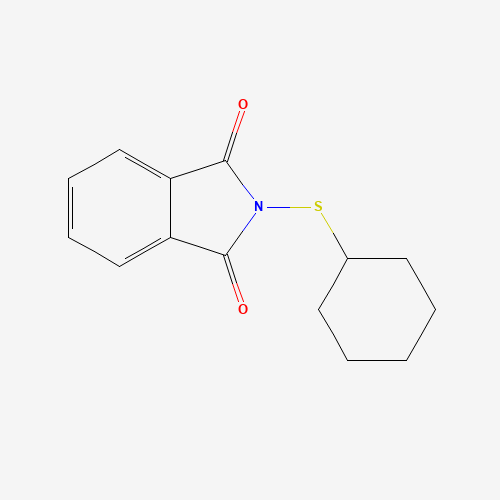
CAS17796-82-6
分子式C14H15NO2S
分子量261.34 g/mol
非危品
water pollutant
科学粮草官-词典编辑部,修订于:2026-07-06
Toxicity
ToxicityFate Summary
ATMOSPHERIC FATE: According to a model of gas/particle partitioning of semivolatile organic compounds in the atmosphere(1), N-(cyclohexylthio)phthalimide, which has an estimated vapor pressure of 3.8X10⁻⁸ mm Hg at 25 °C(SRC), determined from a fragment constant method(2), is expected to exist solely in the particulate phase in the ambient atmosphere. Particulate-phase N-(cyclohexylthio)phthalimide may be removed from the air by wet and dry deposition(SRC).
Soil Adsorption / Mobility
The Koc of N-(cyclohexylthio)phthalimide is estimated as 2,300(SRC), using a log Kow of 3.66(1) and a regression-derived equation(2). According to a classification scheme(3), this estimated Koc value suggests that N-(cyclohexylthio)phthalimide is expected to have slight mobility in soil. N-(Cyclohexylthio)phthalimide would be expected to hydrolyze in moist soil; a hydrolysis half-life of 23.3 hours at pH 7 and 25 °C has been reported for N-(cyclohexylthio)phthalimide(1).
Environmental Biodegradation
Soil microorganisms were found to not colonize on N-(cyclohexylthio)phthalimide in experiments using soil burial techniques(1). N-(Cyclohexylthio)phthalimide was found to degrade 99%+ after 160 hours in a semi-continuous activated sludge test (primary biodegradation) using adapted sewage(2). Ultimate biodegradation by a shake flask test showed 3.4% of the theoretical CO2 evolution after 32 days(2). N-(Cyclohexylthio)phthalimide was found to inhibit nitrification in wastewater(3).
Environmental Bioconcentration
An estimated BCF of 130 was calculated for N-(cyclohexylthio)phthalimide(SRC), using a log Kow of 3.66(4) and a regression-derived equation(2). According to a classification scheme(3), this BCF suggests the potential for bioconcentration in aquatic organisms is high(SRC); however, N-(cyclohexylthio)phthalimide is expected to undergo rapid hydrolysis in aquatic environments(4). A hydrolysis half-life of 23.3 hours at pH 7 and 25 °C has been reported for N-(cyclohexylthio)phthalimide(4).
Volatilization from Water / Soil
The Henry's Law constant for N-(cyclohexylthio)phthalimide is estimated as 6.4X10⁻⁸ atm-cu m/mole(SRC) using a fragment constant estimation method(1). This Henry's Law constant indicates that N-(cyclohexylthio)phthalimide is expected to be essentially nonvolatile from water surfaces(2). N-(Cyclohexylthio)phthalimide is not expected to volatilize from moist soil surfaces based on its estimated Henry's Law constant(SRC). N-(Cyclohexylthio)phthalimide would be expected to hydrolyze in moist soil and in water; a hydrolysis half-life of 23.3 hours at pH 7 and 25 °C has been reported for N-(cyclohexylthio)phthalimide(3). N-(Cyclohexylthio)phthalimide is not expected to volatilize from dry soil surfaces(SRC) based upon an estimated vapor pressure of 3.8X10⁻⁸ mm Hg(SRC), determined from a fragm...
Environmental Abiotic Degradation
A hydrolysis half-life of 23.3 hours at pH 7 and 25 °C has been reported for N-(cyclohexylthio)phthalimide(1). The primary hydrolysis product was identified as the carboxylic acid (ring-opened half-acid) derivative of the parent compound(1). N-(Cyclohexylthio)phthalimide is not expected to be susceptible to direct photolysis by sunlight, since a related compound, 1H-isoindole-1,3(2H)-dione, does not absorb light with wavelengths >290 nm(2).
Artificial Pollution Sources
N-(Cyclohexylthio)phthalimide's production and use as a pre-vulcanization inhibitor for synthetic and natural rubber(1) may result in its release to the environment through various waste streams(SRC).
Probable Routes of Human Exposure
NIOSH (NOES Survey 1981-1983) has statistically estimated that 18,053 workers (3,410 of these are female) are potentially exposed to N-(cyclohexylthio)phthalimide in the US(1). Occupational exposure to N-(cyclohexylthio)phthalimide may occur through inhalation and dermal contact with this compound at workplaces where N-(cyclohexylthio)phthalimide is produced or used(SRC). Exposure of the general population to N-(cyclohexylthio)phthalimide is not expected, since during the rubber vulcanization process N-(cyclohexylthio)phthalimide reacts and becomes polymer bound(2). N-(Cyclohexylthio)phthalimide is not used in rubber gloves, food containers or other food-contact applications, children's toys, pacifiers, baby bottle nipples, elastic, adhesives or medicals device applications(2).
Environmental Fate / Exposure Summary
N-(Cyclohexylthio)phthalimide's production and use as a pre-vulcanization inhibitor for synthetic and natural rubber may result in its release to the environment through various waste streams. If released to air, an estimated vapor pressure of 3.8X10⁻⁸ mm Hg at 25 °C indicates N-(cyclohexylthio)phthalimide will exist solely in the particulate phase in the ambient atmosphere. Particulate-phase N-(cyclohexylthio)phthalimide will be removed from the atmosphere by wet and dry deposition. If released to soil, N-(cyclohexylthio)phthalimide is expected to have slight mobility based upon an estimated Koc of 2,300. Volatilization from moist soil surfaces is not expected to be an important fate process based upon an estimated Henry's Law constant of 6.4X10⁻⁸ atm-cu m/mole. Volatilization of N-(cy...
Adverse Effects
Skin Sensitizer - An agent that can induce an allergic reaction in the skin.
Non-Human Toxicity Values
LD50 Rabbit (New Zealand white) dermal >5010 mg/kg bw/24 hr
Antidote and Emergency Treatment
Advanced treatment: Consider orotracheal or nasotracheal intubation for airway control in the patient who is unconscious, has severe pulmonary edema, or is in respiratory arrest. Positive pressure ventilation techniques with a bag valve mask device may be beneficial. Monitor cardiac rhythm and treat arrhythmias as necessary ... . Start an IV with D5W /SRP: "To keep open", minimal flow rate/. Use lactated Ringer's if signs of hypovolemia are present. Watch for signs of fluid overload. Consider drug therapy for pulmonary edema ... . For hypotension with signs of hypovolemia, administer fluid cautiously. Watch for signs of fluid overload ... . Treat seizures with diazepam (Valium) ... . Use proparacaine hydrochloride to assist eye irrigation ... . /Poison A and B/









