

 一键配货
一键配货
化合物详情
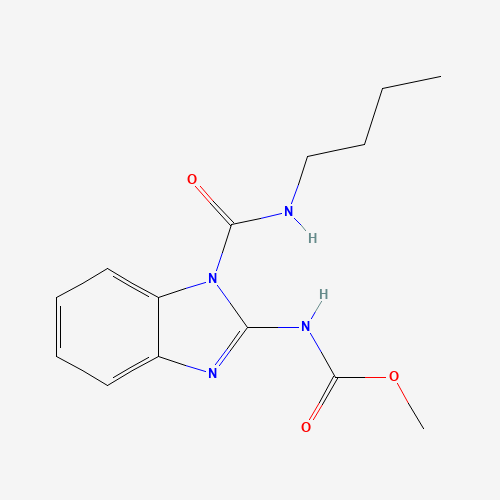
CAS17804-35-2
分子式C14H18N4O3
分子量290.32 g/mol g/mol
危化品
Benomyl can cause developmental toxicity and male reproductive toxicity according to an independent committee of scientific and health experts.
科学粮草官-词典编辑部,修订于:2026-07-06
Toxicity
ToxicityEPA Ecotoxicity
Pesticide Ecotoxicity Data from EPA: 80
Ecotoxicity Values
USDA APHIS Chemical Effects: collection=usda_chemeffect&query_type=synonym&query='^17804-35-2$'
Fate Summary
ATMOSPHERIC FATE: According to a model of gas/particle partitioning of semivolatile organic compounds in the atmosphere(1), benomyl, which has a vapor pressure of 3.7X10⁻⁹ mm Hg at 25 °C(2), is expected to exist solely in the particulate phase in the ambient atmosphere. Particulate-phase benomyl may be removed from the air by wet and dry deposition(SRC).
Soil Adsorption / Mobility
In a field study on the fate of benomyl applied to bare soil and to turf, benomyl and its degradation products showed little or no downward movement through the soil (Keyport silt loam, Cecil loamy sand, and Leon Immokalee fine sand)(1). Lab and greenhouse experiments showed that benomyl and its two soil metabolites, methyl 2-benzimidazole carbamate (MBC) and 2-aminobenzimidazole (2-AB), were immobile in soils (organic matter ranged from 0.7 to 83.5 percent) and did not leach or move significantly from the site of application(2). The Koc of benomyl measured in soil is 2,000(3). According to a classification scheme(4), this Koc value suggests that benomyl is expected to have slight mobility in soil(SRC).
Environmental Biodegradation
Mixed cultures from soil and water were able to use benomyl as a sole carbon source but the degradation rate was slow(1). A proposed pathway for the bacterial degradation of benomyl proceeds by 2-aminobenzimidazole(1). Strains of Psuedomonas were isolated from soil and water that could grow on a mineral salts medium with benomyl as the sole carbon source(2). In another study, four strains of bacteria and 2 of fungi, which decomposed benomyl to non-fungistatic compounds, were isolated from loamy garden soil(3). Decomposition (16-34%) of 14C ring-labeled benomyl, during 6 and 12 months incubation periods, occurred only in nonsterilized soil. Ring cleavage of the benzimidazole nucleus and metabolism of this moiety to CO2 is apparently related to the presence of microorganisms(4).
Environmental Bioconcentration
An estimated BCF of 9 was calculated for benomyl(SRC), from a log Kow of 2.12(1) and a regression-derived equation(2). According to a classification scheme(3), this BCF suggests the potential for bioconcentration in aquatic organisms is low(SRC).
Volatilization from Water / Soil
The Henry's Law constant for benomyl is 4.93X10⁻¹² atm-cu m/mole(1). This Henry's Law constant indicates that benomyl is expected to be essentially nonvolatile from water surfaces(2). Benomyl's Henry's Law constant(1) indicates that volatilization from moist soil surfaces is not expected to be an important fate process(SRC). Benomyl is not expected to volatilize from dry soil surfaces(SRC) based upon a vapor pressure of 3.7X10⁻⁹ mm Hg(3).
Environmental Abiotic Degradation
In aqueous solutions, especially under acidic conditions, benomyl is hydrolyzed to methyl 2-benzimidazole carbamate (carbendazim; MBC) and butyl isocyanate(1). In water, the conversion of benomyl to MBC is completed within one week(2). Benomyl in soil was shown to hydrolyze to MBC(3). The half-life of benomyl in water was reported as 2 hours(4). Since benomyl (dissolved in acetonitrile) has a light absorption maximum at 294 nm(5), benomyl may undergo direct photolysis(SRC).
Environmental Water Concentrations
Benomyl was detected in 3 rivers or streams from 485 samples of surface water collected in Arkansas from 1989-1991, at concns of 0.5-1.2 ug/l(1). Benomyl was detected at a mean concn of 2.7 ug/l in groundwater from the Patagonic Region, Argentina(2).
Food Survey Values
Benomyl has been detected as a food residue (concn or food not reported) during regulatory monitoring conducted by the US Food and Drug Administration and Dept of Agric for fiscal years 1983-1986(1). Benomyl was detected in 3 imported agricultural commodities in Canada at a max concn of 0.1 ppm(2). Benomyl was identified, not quantified, in almond crops in Kern, CA(3). Benomyl was detected in 248 of 769 domestic apples at a max concn of 0.48 ppm and in 149 of 1,062 imported apples at a max concn of 0.66 ppm(4).
Effluent Concentrations
Benomyl or its degradation products were detected in leachate near a pesticide plant in Barcelona, Spain in concns of 5-10 ppm(1).
ICSC Environmental Data
The substance is very toxic to aquatic organisms. This substance does enter the environment under normal use. Great care, however, should be taken to avoid any additional release, for example through inappropriate disposal.
Atmospheric Concentrations
Benomyl was detected in air from California at a max concn of 0.06 ug/cu m(1).
Artificial Pollution Sources
Benomyl's production and use as a fungicide(1) will result in its direct release to the environment through various waste streams(SRC).
Probable Routes of Human Exposure
Occupational exposure to benomyl may occur through inhalation and dermal contact with this compound at workplaces where benomyl is produced or used(SRC). Ten strawberry harvesters were monitored during working hours for dermal exposure to benomyl. The average dermal exposure rate was 5.39 mg/hr/person(1). Monitoring data indicate that the general population may be exposed to benomyl via ingestion of food products containing benomyl(SRC).
Environmental Fate / Exposure Summary
Benomyl's production and use as a fungicide will result in its direct release to the environment through various waste streams. If released to air, a vapor pressure of 3.7X10⁻⁹ mm Hg at °C indicates benomyl will exist solely in the particulate phase in the ambient atmosphere. Particulate-phase benomyl will be removed from the atmosphere by wet and dry deposition. If released to soil, benomyl is expected to have slight mobility based upon a Koc of 2,000. Volatilization from moist soil surfaces is not expected to be an important fate process based upon a Henry's Law constant of 4.93X10⁻¹² atm-cu m/mole. Benomyl is not expected to volatilize from dry soils based upon its vapor pressure. Biodegradation is not expected to be a major environmental fate process since benomyl hydrolyzes rapidly...
Symptoms
Skin redness and skin irritation. Fetuses exposed to high levels may exhibit microphthalmia (small eyes) or anaphthalmia (no eyes).
Treatment
For acute exposures and first aid: EYES: irrigate opened eyes for several minutes under running water. INGESTION: do not induce vomiting. Rinse mouth with water (never give anything by mouth to an unconscious person). Seek immediate medical advice. SKIN: should be treated immediately by rinsing the affected parts in cold running water for at least 15 minutes, followed by thorough washing with soap and water. If necessary, the person should shower and change contaminated clothing and shoes, and then must seek medical attention. INHALATION: supply fresh air. If required provide artificial respiration.
Interactions
A key limitation to the use of benomyl & other benzimidazoles is the development of fungal resistance. Resistance management can be achieved by using benomyl in combination with a non-benzimidazole companion fungicide.
Target Organs
Eyes, skin, respiratory system, reproductive system
Toxicity Data
Benomyl is of such a low toxicity to mammals, it has been impossible to administer doses large enough to establish an LD50. It has an arbitrary LD50 of "greater than 10,000 mg/kg/day for rats".
Health Effects
Skin irritation may occur through industrial exposure, and florists, mushroom pickers and floriculturists have reported allergic reactions to benomyl. Benomyl is a potential teratogen. Studies have shown eye defects can occur at relatively high doses. A test in which rats were dosed orally demonstrated evidence of microphthalmia at dose levels of 62.5 mg/kg and above. In 1996, a Miami jury awarded US$ 4 million to a child whose mother was exposed in pregnancy to Benomyl. The child was born without eyes. The mother had been exposed to an unusually high dose of Benomyl through her occupation, during pregnancy.
Adverse Effects
ACGIH Carcinogen - Confirmed Animal.
Exposure Routes
Inhalation (L793); oral (L793); dermal (L793)
Toxicity Summary
Benomyl targets beta tubulin in actively dividing cells. It binds to microtubules, interfering with cell functions, such as meiosis and intracellular transportation (A15332). Benomyl binds to brain tubulin with a dissociation constant of 11.9 +/- 1.2 microM. Further, benomyl binds to a novel tubulin beta binding site, distinct from the well-characterized colchicine and vinblastine binding sites. Benomyl inhibits the polymerization of brain tubulin into microtubules, with 50% inhibition occurring at a concentration of 70-75 microM (A15103)
Minimum Risk Level
The Occupational Safety and Health Administration has set a permissible exposure limit of 15 mg/m3 for total exposure over an eight-hour time-weighted average.
Average Daily Intake
FOOD: An estimate of benomyl exposure in Finnish populations is 38 ug/day(1).
RAIS Toxicity Values
Oral Slope Factor Reference: OPP
Human Toxicity Excerpts
Patch tests indicate that susceptible persons respond to low concns of benomyl. The threshold limit value of 10 mg/cu m indicates that occupational intake of about 1.4 mg/kg/day is considered safe for persons not sensitized to the compound.
Acceptable Daily Intakes
FAO/WHO ADI: 0.02 mg/kg
Carcinogen Classification
No indication of carcinogenicity to humans (not listed by IARC).
1 or Cancer Risk Level 1E-06
Fraction of Contaminant Absorbed Dermally from Soil: 0.1
Antidote and Emergency Treatment
Advanced treatment: Consider orotracheal or nasotracheal intubation for airway control in the patient who is unconscious or in severe respiratory distress patient. Hyperventilate if signs of cerebral edema are present. Monitor cardiac rhythm and treat arrhythmias if necessary ... . Start an IV D5W /SRP: "To keep open", minimal flow rate/. Use lactated Ringer's if signs of hypovolemia are present. Watch for signs of fluid overload. Treat seizures with diazepam ... . For hypotension with signs of hypovolemia, administer fluid cautiously. Consider vasopressors for hypotension with a normal fluid volume. Watch for signs of fluid overload ... . Use proparacaine hydrochloride to assist eye irrigation ... . /Dithiocarbamates and related compounds/
Hazard Quotient Level 3 or Cancer Risk Level 1E-04
Fraction of Contaminant Absorbed Dermally from Soil: 0.1
USGS Health-Based Screening Levels for Evaluating Water-Quality
Reference: Smith, C.D. and Nowell, L.H., 2024. Health-Based Screening Levels for evaluating water-quality data (3rd ed.). DOI:10.5066/F71C1TWP