

 一键配货
一键配货
化合物详情
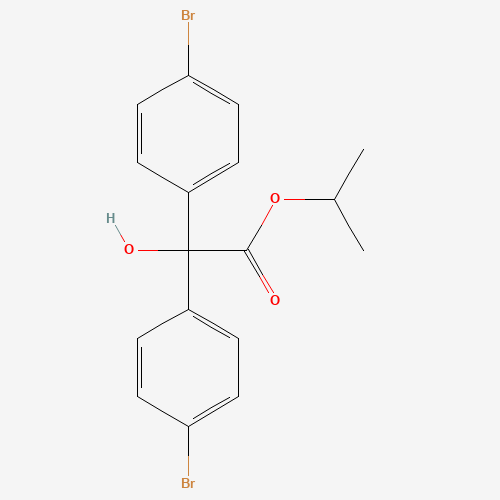
CAS18181-80-1
分子式C17H16Br2O3
分子量428.12 g/mol g/mol
危化品
active substance in fumigant strips for mites
科学粮草官-词典编辑部,修订于:2026-07-06
Toxicity
ToxicityEcotoxicity Values
USDA APHIS Chemical Effects: collection=usda_chemeffect&query_type=synonym&query='^18181-80-1$'
Fate Summary
ATMOSPHERIC FATE: According to a model of gas/particle partitioning of semivolatile organic compounds in the atmosphere(1), bromopropylate, which has a vapor pressure of 8.2X10⁻⁸ mm Hg at 20 °C(2), will exist in both the vapor and particulate phases in the ambient atmosphere. Vapor-phase bromopropylate is degraded in the atmosphere by reaction with photochemically-produced hydroxyl radicals(SRC); the half-life for this reaction in air is estimated to be 2.5 days(SRC), calculated from its rate constant of 6.5X10⁻¹² cu cm/molecule-sec at 25 °C(SRC) that was derived using a structure estimation method(3). Particulate-phase bromopropylate may be removed from the air by wet and dry deposition(SRC).
Soil Adsorption / Mobility
The Koc of bromopropylate is estimated as 21,000(SRC), using a log Kow of 5.40(1) and a regression-derived equation(2). According to a classification scheme(3), this estimated Koc value suggests that bromopropylate is expected to be immobile in soil.
Environmental Biodegradation
AEROBIC: Two sandy soil types from Florida were treated with bromopropylate and sampled at various intervals over 16 weeks(1); representative rates of biodegradation are given below. In the Lakeland soil sample with higher organic matter content, the concentration was reduced from 1.01 ppm to 0.65 after 1 week and 0.33 ppm after 8 weeks(1). In the Leon soil sample with lower organic matter content, bromopropylate was degraded more slowly from an initial concentration of 1.12 ppm to 0.99 after 1 week and 0.47 after 8 weeks(1). Half-lives of bromopropylate in Lakeland soil were 2.5, 8, and 12 weeks at bromopropylate concentrations of 1.0, 0.6, and 0.3 ppm, respectively(1). Half-lives of bromopropylate in Leon soil were 4, 13, and 12 weeks at bromopropylate concentrations of 1.0, 0.6, and...
Environmental Bioconcentration
An estimated BCF of 2,900 was calculated for bromopropylate(SRC), using a log Kow of 5.40(1) and a regression-derived equation(2). According to a classification scheme(3), this BCF suggests the potential for bioconcentration in aquatic organisms is very high(SRC).
Volatilization from Water / Soil
The Henry's Law constant for bromopropylate is estimated as 4.6X10⁻⁷ atm-cu m/mole(SRC) derived from its vapor pressure, 8.2X10⁻⁸ mm Hg(1), and water solubility, 0.1 mg/L(2). This Henry's Law constant indicates that bromopropylate is expected to be essentially nonvolatile from water surfaces(3). Bromopropylate's Henry's Law constant indicates that volatilization from moist soil surfaces may occur very slowly(SRC). Bromopropylate is not expected to volatilize from dry soil surfaces(SRC) based upon a vapor pressure of 8.2X10⁻⁸ mm Hg(1).
Environmental Abiotic Degradation
The rate constant for the vapor-phase reaction of bromopropylate with photochemically-produced hydroxyl radicals has been estimated as 6.5X10⁻¹² cu cm/molecule-sec at 25 °C(SRC) using a structure estimation method(1). This corresponds to an atmospheric half-life of about 2.5 days at an atmospheric concentration of 5X10+5 hydroxyl radicals per cu cm(1). A base-catalyzed second-order hydrolysis rate constant of 2.0X10⁻⁴ L/mole-sec(SRC) was estimated using a structure estimation method(2); this corresponds to half-lives of 110 and 1000 years at pH values of 7 and 8, respectively(2). Bromopropylate does not absorb sufficient energy from the environmental UV spectrum to directly photolyze.
Environmental Water Concentrations
SURFACE WATER: Water samples from the southern edge of the Dead Sea basin (Jordan) were analyzed for bromopropylate content; 4 samples were taken with an average level of bromopropylate of 62.5 ppb in each sample(1). A study conducted in Spain on the Segre River found 2 of 6 samples contained approximately 0.01 ng/L of bromopropylate (detection limit was 0.01 ng/L)(2).
Food Survey Values
From 1995 to 1999 a study conducted in Japan found 60 samples of oranges and grapefruit contained 4 samples with 0.05-0.1 micro gram/gram of acarol(1). The same study found 66 samples of Japanese pears contained 7 samples with 0.01-0.1 micrograms/gram of acarol(1). In a Belgian study from 1991 to 1993, 3064 food samples were analyzed for acarol residues, 8 food types (beans, radish, Lamb's lettuce, strawberries, apples, oranges, grapes and pears) were found to contain measurable quantities of acarol with concentrations ranging on average from 0.004-0.168 ppm and maximum measured quantities ranging from 0.08-2.0 ppm(2). A study from Egypt in 1996 reports that for 1579 food samples collected from open markets 2.02% of the samples contained acarol residues, the contaminated foods with aver...
Ecotoxicity Excerpts
/AQUATIC SPECIES/ It is highly toxic to fish...
Artificial Pollution Sources
Bromopropylate's former production and use in the US as an acaricide(1) may have resulted in its direct release to the environment(SRC).
Sediment/Soil Concentrations
SOIL: A study in the Jordan Valley in 1998 found 1 of 5 sampled areas was contaminated with 0.22-0.34 ppm bromopropylate while no bromopropylate was detected at the other 4 test sites(1).
Probable Routes of Human Exposure
Occupational exposure and general population exposure should be low or non-existent since bromopropylate is no longer used in the US. In the past, bromopropylate was applied directly to some fruit crops as an acaracide and exposure to this compound was primarily dermal and via inhalation for workers. However, recent monitoring data indicate that consumers may be exposed to bromopropylate via ingestion of some imported fruits and vegetables. (SRC)
Environmental Fate / Exposure Summary
Bromopropylate's former production and use as an acaricide may have resulted in its direct release to the environment. If released to air, a vapor pressure of 8.2X10⁻⁸ mm Hg at 20 °C indicates bromopropylate will exist in both the vapor and particulate phases in the ambient atmosphere. Vapor-phase bromopropylate will be degraded in the atmosphere by reaction with photochemically-produced hydroxyl radicals; the half-life for this reaction in air is estimated to be 2.5 days. Particulate-phase bromopropylate will be removed from the atmosphere by wet and dry deposition. If released to soil, bromopropylate is expected to have no mobility based upon an estimated Koc of 21,000. Volatilization from moist soil surfaces is not expected to be an important fate process based upon an estimated Henr...
Adverse Effects
Occupational hepatotoxin - Secondary hepatotoxins: the potential for toxic effect in the occupational setting is based on cases of poisoning by human ingestion or animal experimentation.
Non-Human Toxicity Values
LD50 Rabbit oral >6000 mg/kg bw /from table/
Antidote and Emergency Treatment
Advanced treatment: Consider orotracheal or nasotracheal intubation for airway control in the patient who is unconscious, has severe pulmonary edema, or is in respiratory arrest. Early intubation, at the first sign of upper airway obstruction, may be necessary. Positive pressure ventilation techniques with a bag valve mask device may be beneficial. Monitor cardiac rhythm and treat arrhythmias as necessary ... . Start an IV with D5W /SRP: "To keep open", minimal flow rate/. Use lactated Ringer's if signs of hypovolemia are present. Watch for signs of fluid overload. Consider drug therapy for pulmonary edema ... . For hypotension with signs of hypovolemia, administer fluid cautiously. Consider vasopressors if patient is hypotensive with a normal fluid volume. Watch for signs of fluid over...