

 一键配货
一键配货
化合物详情
CAS19044-88-3
分子式C12H18N4O6S
分子量346.36 g/mol g/mol
危化品
Oryzalin can cause cancer according to The Environmental Protection Agency (EPA).
科学粮草官-词典编辑部,修订于:2026-07-06
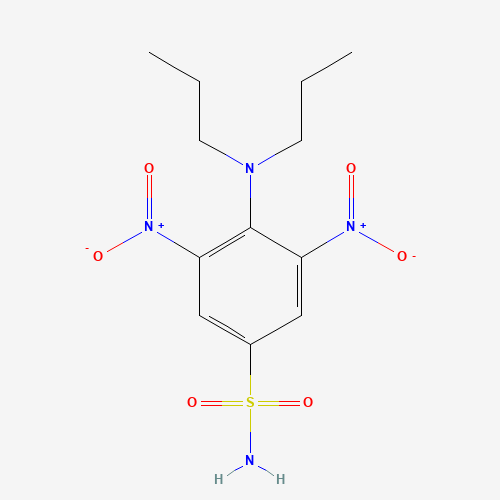
Toxicity
ToxicityEPA Ecotoxicity
Pesticide Ecotoxicity Data from EPA: 69
Ecotoxicity Values
LC50 Goldfish fingerlings >1.4 mg/l/96 hr /Conditions of bioassay not specified/
Fate Summary
ATMOSPHERIC FATE: According to a model of gas/particle partitioning of semivolatile organic compounds in the atmosphere(1), oryzalin, which has a vapor pressure of 9.75X10⁻⁹ mm Hg at 25 °C, is expected to exist solely in the particulate phase in the ambient atmosphere. Particulate-phase oryzalin may be removed from the air by wet and dry deposition(SRC). Oryzalin absorbs light in the environmental UV spectrum, and has the potential for direct photolysis in the atmosphere(2).
Soil Adsorption / Mobility
The avg Koc value is 600, with ranges from 93 to 2700(1). According to a classification scheme(2), the avg Koc value suggests that oryzalin is expected to have low mobility in soil. Results of field, greenhouse and laboratory studies have shown that oryzalin does not leach appreciably in soil(3,4). In several tests, surface applied oryzalin typically remained in the upper 7.5 cm soil profile with only minor amounts reaching the 15 cm depth(3,4). Soil movement appears to decrease with decreases in the moisture content(3).
Environmental Biodegradation
ANAEROBIC: Radiolabeled-oryzalin degraded with a 10 day half-life when anaerobic conditions were established after 23 days of aerobic incubation at 28 °C in sandy loam soil(1). An initial half-life of 1.2 months was calculated for the first 2 months of the study and a 3 month half-life was calculated for the last 4 months of the study(1). The major degradates formed during the anaerobic incubation were several benzeneimidazoles with a reduced nitro group and smaller amounts of benzenesulfonamides with 1 or 2 nitro groups reducing to amines(1). Oryzalin will degrade more rapidly under reducing than under oxidizing conditions(1).
Environmental Bioconcentration
A BCF range of 32-328 has been reported for oryzalin(1,2). According to a classification scheme(3), these BCFs suggests the potential for bioconcentration in aquatic organisms is moderate-to-high(SRC). Using 14C-labeled oryzalin and a terrestrial aquatic laboratory model ecosystem, oryzalin BCF values of 50 and 328 were determined for fish (Gambusia affinis) and snails, respectively(1). Oryzalin was not highly concentrated in bluegill sunfish: having a BCF of 32 in edible tissue, 106 in nonedible tissue, 66 in whole fish(2). Within 24 hrs depuration period for bluegill sunfish, there was 79%, 81% and 81% loss of radioactivity in edible, nonedible and whole fish respectively(2). By day 14, there was a loss of 89%, 95% and 94% in edible, nonedible and whole fish respectively(3).
Volatilization from Water / Soil
The Henry's Law constant for oryzalin is estimated as 1.9X10⁻⁹ atm-cu m/mole(SRC), derived from its vapor pressure, 9.75X10⁻⁹ mm Hg(1), and water solubility, 2.5 mg/l(2). This Henry's Law constant indicates that oryzalin is expected to be essentially nonvolatile from water surfaces(3). Under field conditions, herbicidal applications of oryzalin to soil surfaces do not volatilize appreciably(4,5). Vapor loss measurements from a moist Lakeland sand at 50 °C, with an air flow rate of 50 ml/min for 3 hr, revealed virtually no vapor losses of oryzalin(6,7). Actual loss was only 0.1% or less at 30, 40 and 50 °C(7). Oryzalin is not expected to volatilize from dry soil surfaces(SRC) based upon its vapor pressure(1).
Environmental Abiotic Degradation
Oryzalin is sensitive to UV light in the solar spectrum(1); using sun lamps and a constant 45 °C temperature, oryzalin losses from a thin layer surface of silt loam soil were 14% after a 24-hr irradiation period(1). In dark controls, only a 2% loss occurred(1). In another photodegradation study(2), 14-C labeled oryzalin was applied to air dried Hagerstown clay loam and exposed to unfiltered solar radiation for 7 days in July(2); comparison with 7-day dark controls indicated that 26% of initially applied oryzalin had photodecomposed(2). While it appears that most of the applied oryzalin either binds to soil or is fully mineralized, substantial quantities of oryzalin could also be available for runoff for several days to months post-application depending in part upon the degree of exposur...
Environmental Water Concentrations
Between the years 1971-1991 in the United States, oryzalin was detected in 2 of 428 discrete wells ranging from 0.06-0.87 ug/l(1).
Food Survey Values
In 1989 monitoring conducted by the California Dept of Food and Agric, oryzalin was not detected (detection limit not reported) in 2 almond, 4 grape or 4 plum samples(1).
Artificial Pollution Sources
Oryzalin's use as a pre-emergence herbicide(1) is expected to result in its direct release to the environment(SRC).
Probable Routes of Human Exposure
Occupational exposure to oryzalin may occur through inhalation of dust particles and dermal contact with this compound at places where oryzalin is produced or used (SRC). The general population may be exposed to oryzalin via its use as a residential outdoor herbicide (1).
Environmental Fate / Exposure Summary
Oryzalin's use as herbicide is expected to result in its direct release to the environment. If released to air, a vapor pressure of 9.75X10⁻⁹ mm Hg at 25 °C indicates oryzalin will exist solely in the particulate phase in the ambient atmosphere. Particulate-phase oryzalin will be removed from the atmosphere by wet and dry deposition. Oryzalin absorbs light in the in the environmental UV spectrum, and has the potential for direct photolysis. If released to soil, oryzalin is expected to have low mobility based upon an experimental Koc of 600. Volatilization from moist soil surfaces is not expected to be an important fate process based upon an estimated Henry's Law constant of 1.9X10⁻⁹ atm-cu m/mole. Microbial degradation and photodecomposition contribute to the degradation of oryzalin in...
Target Organs
Urinary
RAIS Toxicity Values
Oral Slope Factor Reference: OPP
Human Toxicity Excerpts
The International Chemical Workers Union requested an evaluation of dermatitis and reproductive system disorders among workers exposed to oryzalin, dichlorobenzidine, and benzidine at the Bofors-Nobel/Lakeway facility, Muskegon, Michigan. Exposure to dichlorobenzidine was measured from two personal breathing samples and the results ranged from not detectable to 6.5 ug/cu m. Area samples for dichlorobenzidine were also taken. Surface contamination samples revealed dichlorobenzidine on the packout locker room surfaces and inside the operator's personal protective equipment. Exposure to airborne oryzalin for six full shift workers ranged from not detectable to 130 ug/cu m, with a mean of 28 ug/cu m. Dinitrochlorobenzene was detected in air at 70 ug/cu m and on surfaces at 6 ug/100 sq cm. W...
Carcinogen Classification
Not listed by IARC.
Non-Human Toxicity Excerpts
Oryzalin is the active ingredient in the herbicide Surflan. The potential developmental toxicity of oryzalin was evaluated in rats and rabbits. Pregnant rats and rabbits were dosed once daily by gavage on gestation days 6-17 and 6-18, respectively. Doses for rats were 0, 50, 225, and 1000 mg/kg; doses for rabbits were 0, 10, 25, 55, and 125 mg/kg. Cesarean sections were performed on rats and rabbits on gestation days 20 and 28, respectively. In rats, maternal toxicity was indicated at the 225 and 1000 mg/kg dose levels by depression of body weight gain and food consumption. Fetal viability and morphology were not adversely affected at any dose level. Developmental toxicity was indicated at the 225 and 1000 mg/kg dose levels by depressed fetal weight. The NOEL for maternal and developmen...
1 or Cancer Risk Level 1E-06
Fraction of Contaminant Absorbed Dermally from Soil: 0.1
Antidote and Emergency Treatment
Supportive measures are ordinarily sufficient for successful management of excessive exposures to these herbicides ... . If the patient's condition deteriorates in spite of good supportive care, the operation of an alternative or additional toxicant should be suspected. /Other herbicides/
Hazard Quotient Level 3 or Cancer Risk Level 1E-04
Fraction of Contaminant Absorbed Dermally from Soil: 0.1
USGS Health-Based Screening Levels for Evaluating Water-Quality
Reference: Smith, C.D. and Nowell, L.H., 2024. Health-Based Screening Levels for evaluating water-quality data (3rd ed.). DOI:10.5066/F71C1TWP