


 一键配货
一键配货
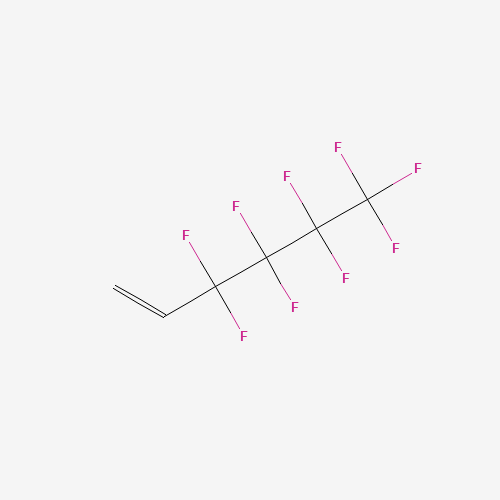
化合物详情
CAS19430-93-4
分子式C6H3F9
分子量246.07 g/mol
非危品
structure given in first source
科学粮草官-词典编辑部,修订于:2026-07-06
Toxicity
ToxicityFate Summary
ATMOSPHERIC FATE: According to a model of gas/particle partitioning of semivolatile organic compounds in the atmosphere(1), perfluorobutyl ethylene, which has a vapor pressure of 238 mm Hg at 20 °C(2), is expected to exist solely as a vapor in the ambient atmosphere. Vapor-phase perfluorobutyl ethylene is degraded in the atmosphere by reaction with photochemically-produced hydroxyl radicals(SRC); the half-life for this reaction in air is estimated to be 19 hours(SRC), calculated from its rate constant of 2.0X10⁻¹¹ cu cm/molecule-sec at 25 °C(SRC) that was derived using a structure estimation method(3). The rate constant for the vapor-phase reaction of perfluorobutyl ethylene with ozone has been estimated as 1.8X10⁻¹⁸ cu cm/molecule-sec at 25 °C(SRC) that was derived using a structure es...
Soil Adsorption / Mobility
Using a structure estimation method based on molecular connectivity indices(1), the Koc of perfluorobutyl ethylene can be estimated to be 7800(SRC). According to a classification scheme(2), this estimated Koc value suggests that perfluorobutyl ethylene is expected to be immobile in soil.
Environmental Bioconcentration
An estimated BCF of 370 was calculated in fish for perfluorobutyl ethylene(SRC), using an estimated log Kow of 4.4(1) and a regression-derived equation(2). According to a classification scheme(3), this BCF suggests the potential for bioconcentration in aquatic organisms is high(SRC), provided the compound is not metabolized by the organism(SRC).
Volatilization from Water / Soil
The Henry's Law constant for perfluorobutyl ethylene is estimated as 110 atm-cu m/mole(SRC) using a fragment constant estimation method(1). This Henry's Law constant indicates that perfluorobutyl ethylene is expected to volatilize rapidly from water surfaces(2). Based on this Henry's Law constant, the volatilization half-life from a model river (1 m deep, flowing 1 m/sec, wind velocity of 3 m/sec)(2) is estimated as 4.9 hours(SRC). The volatilization half-life from a model lake (1 m deep, flowing 0.05 m/sec, wind velocity of 0.5 m/sec)(2) is estimated as 6.2 days(SRC). However, volatilization from water surfaces is expected to be attenuated by adsorption to suspended solids and sediment in the water column. The volatilization half-life from a model pond is about 80 days when adsorption...
Environmental Abiotic Degradation
The rate constant for the vapor-phase reaction of perfluorobutyl ethylene with photochemically-produced hydroxyl radicals has been estimated as 2.0X10⁻¹¹ cu cm/molecule-sec at 25 °C(SRC) using a structure estimation method(1). This corresponds to an atmospheric half-life of about 19 hours at an atmospheric concentration of 5X10+5 hydroxyl radicals per cu cm(1). The rate constant for the vapor-phase reaction of perfluorobutyl ethylene with ozone has been estimated as 1.8X10⁻¹⁸ cu cm/molecule-sec at 25 °C(SRC) that was derived using a structure estimation method(1). This corresponds to an atmospheric half-life of about 6.5 days at an atmospheric concentration of 7X10+11 ozone molecules per cu cm(2). Perfluorobutyl ethylene is not expected to undergo hydrolysis in the environment due to th...
ICSC Environmental Data
Environmental effects from the substance have not been investigated adequately.
Artificial Pollution Sources
Perfluorobutyl ethylene's production and use in the manufacture of fluorinated polymers(1) may result in its release to the environment through various waste streams(SRC).
Probable Routes of Human Exposure
According to the 2006 TSCA Inventory Update Reporting data, the number of persons reasonably likely to be exposed in the industrial manufacturing, processing, and use of perfluorobutyl ethylene is 100 to 999; the data may be greatly underestimated(1).
Environmental Fate / Exposure Summary
Perfluorobutyl ethylene's production and use in the manufacture of fluorinated polymers may result in its release to the environment through various waste streams. If released to air, a vapor pressure of 238 mm Hg at 20 °C indicates perfluorobutyl ethylene will exist solely as a vapor in the atmosphere. Vapor-phase perfluorobutyl ethylene will be degraded in the atmosphere by reaction with photochemically-produced hydroxyl radicals; the half-life for this reaction in air is estimated to be 19 hours. The half-life for the vapor-phase reaction of perfluorobutyl ethylene with ozone has been estimated to be 6.5 days. Perfluorobutyl ethylene does not contain chromophores that absorb at wavelengths >290 nm, and therefore is not expected to be susceptible to direct photolysis by sunlight. If r...
Symptoms
Eye Exposure: Redness.
Effect Level
collection=toxvaldb&kind=^EL$
Lethal Dose
collection=toxvaldb&kind=^LD$
Toxicity Data
LC (mice) > 7,178 ppm/1h
Adverse Effects
Occupational hepatotoxin - Secondary hepatotoxins: the potential for toxic effect in the occupational setting is based on cases of poisoning by human ingestion or animal experimentation.
Effect Concentration
collection=toxvaldb&kind=^EC$
Reference and Risk Values
collection=toxvaldb&kind=^RRV$
Non-Human Toxicity Excerpts
/LABORATORY ANIMALS: Developmental or Reproductive Toxicity/ Pregnant CD rats were exposed 6 hours/day to PFBE at 0, 1,000, or 70,000 ppm on days 6 to 15 of gestation.(7) The 1000-ppm exposure did not cause any compound-related effects. Body weight gains in rats exposed to 70,000 ppm were significantly decreased (about 30%) during the exposure period. Mean food consumption in this group was lower than in controls during exposure and postexposure periods. No other adverse maternal effects were observed. No increase in malformation rate was observed in the treated groups during the fetal external or skeletal evaluations. During the soft tissue evaluations, a slight increase in the incidence of fetuses with malformations was observed only in the low dose group. The most common observation...
Antidote and Emergency Treatment
/SRP:/ Advanced treatment: Consider orotracheal or nasotracheal intubation for airway control in the patient who is unconscious, has severe pulmonary edema, or is in severe respiratory distress. Positive-pressure ventilation techniques with a bag-valve-mask device may be beneficial. Consider drug therapy for pulmonary edema ... . Monitor cardiac rhythm and treat arrhythmias if necessary ... . Start IV administration of D5W /SRP: "To keep open", minimal flow rate/. Use 0.9% saline (NS) or lactated Ringer's (LR) if signs of hypovolemia are present. For hypotension with signs of hypovolemia,administer fluid cautiously. Consider vasopressors if patient is hypotensive with a normal fluid volume. Watch for signs of fluid overload ... .Treat seizures with diazepam or lorazepam ... . Use propar...









