

 一键配货
一键配货
化合物详情
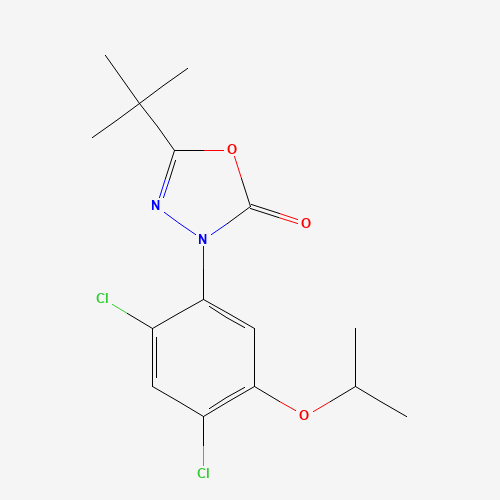
CAS19666-30-9
分子式C15H18Cl2N2O3
分子量345.22 g/mol
非危品
Oxadiazon can cause cancer according to an independent committee of scientific and health experts. It can cause developmental toxicity according to The Environmental Protection Agency (EPA).
科学粮草官-词典编辑部,修订于:2026-07-06
Toxicity
ToxicityEPA Ecotoxicity
Pesticide Ecotoxicity Data from EPA: 77
Fate Summary
ATMOSPHERIC FATE: According to a model of gas/particle partitioning of semivolatile organic compounds in the atmosphere(1), oxadiazon, which has a vapor pressure of 1.15X10⁻⁷ mm Hg at 22 °C(2), is expected to exist in both the vapor and particulate phases in the ambient atmosphere. Vapor-phase oxadiazon is degraded in the atmosphere by reaction with photochemically-produced hydroxyl radicals(SRC); the half-life for this reaction in air is estimated to be 16 hours(SRC), calculated from its rate constant of 24.3X10⁻¹² cu cm/molecule-sec at 25 °C(SRC) determined using a structure estimation method(3). Particulate-phase oxadiazon is removed from the air by wet and dry deposition(SRC). There is the potential for the photodegradation of oxadiazon in air based upon its photodegradation in wate...
Soil Adsorption / Mobility
The Koc of oxadiazon is reported as ranging from 676 to 3236(1-3). According to a classification scheme(4), this estimated Koc value suggests that oxadiazon is expected to have only low or slight mobility in soil. In laboratory studies using TLC(5) and column leaching(6) methods, oxadiazon was determined to be immobile in a total of six soils. In a study of the adsorption of oxadiazon (concn of 0.1-100 ppm) to soil and container (potting) media, 98-99% of the applied oxadiazon was adsorbed at all treatment rates, indicating that adsorption was not dependent on concn(7).
Environmental Biodegradation
ANAEROBIC: In an anaerobic degradation study using non-acclimated microbes in a mixed inoculum obtained from activated sludge, field soil and river sediment, oxadiazon was observed to be relatively stable to metabolic degradation, with reported half-lives of 107-577 days(1). Therefore, this compound is not expected to biodegrade rapidly in the environment under anaerobic conditions.
Environmental Bioconcentration
Oxadiazon was detected in fish tissue (flesh) samples of crucian carp (Carassius cuvieri) collected from Lake Kojima in Japan at 2,4 and 9 months postapplication at concns of 0.442 ppm, 0.046 ppm and 0.017 ppm, respectively(4). At the final sampling period, the concn of oxadiazon in the surface water (0.024 ppb) was much lower than that detected in the fish samples, indicating that bioconcentration (BCF = 708 based on the point-in-time values reported) had occurred(1). In a study in which oxadiazon was introduced into a model ecosystem, adsorbed to soil (at 1 and 10 ppm), for 48 days, total residues in algae, snails and daphnids accumulated with BCFs of approximately 39-58 at both treatment rates while the respective BCFs in fish were approximately 198-248; the final concns in the water...
Volatilization from Water / Soil
The Henry's Law constant for oxadiazon is estimated as 7X10⁻⁸ atm-cu m/mole(SRC) based upon its vapor pressure, 1.15X10⁻⁷ mm Hg(1), and water solubility, 0.7 mg/l(2). This Henry's Law constant indicates that oxadiazon is expected to be essentially nonvolatile from water surfaces(3). Oxadiazon's estimated Henry's Law constant indicates that volatilization from moist soil surfaces will not occur(4). Oxadiazon is not expected to volatilize from dry soil surfaces(SRC) based upon its vapor pressure(1).
Environmental Abiotic Degradation
The rate constant for the vapor-phase reaction of oxadiazon with photochemically-produced hydroxyl radicals has been estimated as 24X10-12 cu cm/molecule-sec at 25 °C(SRC) using a structure estimation method(1). This corresponds to an atmospheric half-life of about 16 hours at an atmospheric concentration of 5X10+5 hydroxyl radicals per cu cm(1). Oxadiazon is stable to hydrolysis at neutral and acidic pHs, but degrades slowly at pH 9, with a half-life of 38 days(2). Oxadiazon photodegrades in natural sunlight in water (1 ppm) and on soil, with respective half-lives of 2.65 days and 4.65 days; rate differences were attributed to the attenuation of light in soil(3). The photodegradation of oxadiazon results in three photoproducts with the loss of chlorine as the dominant process and the p...
Environmental Water Concentrations
SURFACE WATER: Oxadiazon was detected in river water samples collected from the Koise River tributaries in Japan during a rice cultivation period between May and September 1985 at a maximum concn of 6.3 ug/l(1). Oxadiazon was not detected (detection limit = 0.01 ug/ml) in water samples (500 ml) collected monthly from the mouth of the Shinano River in Niigata Prefecture, Japan, during May to September 1996(2). Oxadiazon was detected (detection limit = 0.01 ug/l) in water samples collected from the Arno River, Italy, during 1992-1995, at yearly maximums of 0.11 ug/l in 1993 and 0.06 ug/l in 1995; oxadiazon was not detected in river water samples in 1992 or 1994(3).
Food Survey Values
In a 1992-1993 FDA monitoring study of oxadiazon residues in pears, the compound was not detected in any of the 710 domestic or 949 imported pear samples tested(1). Oxadiazon was not detected in a monitoring study of 6970 samples (80% domestic, 20 % foreign) of 81 commodities, including 71 pear samples, collected in Texas during 1989-1991(2).
Atmospheric Concentrations
URBAN/SUBURBAN: Oxadiazon was not detected in the air in Kitakyashu City, Japan, an urban area 10 miles from an agricultural area, in samples collected during July 1991 and April 1992 using a single 24-hr sampling at a flow rate of 500 L/min(1).
Artificial Pollution Sources
Oxadiazon's production and use as an herbicide(1) is expected to result in its release to the environment through various waste streams(SRC).
Sediment/Soil Concentrations
SEDIMENT: Oxadiazon was detected in river sediment (organic carbon contents of 0.49-4.05 mg/g) samples collected from the Koise River tributaries in Japan during a rice cultivation period between May and September 1985 at a maximum concn of 10 ug/kg during August(1).
Probable Routes of Human Exposure
Occupational exposure to oxadiazon may occur through inhalation and dermal contact with this compound at workplaces where oxadiazon is produced or used. (SRC)
Environmental Fate / Exposure Summary
Oxadiazon's production and use as a herbicide is expected to result in its direct release to the environment. If released to air, a vapor pressure of 1.15X10⁻⁷ mm Hg at 22 °C indicates oxadiazon will exist in both the vapor and particulate phases in the ambient atmosphere. Vapor-phase oxadiazon will be degraded in the atmosphere by reaction with photochemically-produced hydroxyl radicals; the half-life for this reaction in air is estimated to be 16 hours. Particulate-phase oxadiazon will be removed from the atmosphere by wet and dry deposition. There is a potential for the photodegradation of oxadiazon in air; however, the rate at which this may occur is not known. If released to soil, oxadiazon is expected to have only low to slight mobility based upon reported Koc values ranging from...
Target Organs
Hepatic
Toxicity Data
LD50 >5000 mg/kg (oral, rat) (L2081); LD50 >2000 mg/kg (dermal, rabbit) (L2081); LC50 >1.94 mg/L (inhalation, rat) (L2081)
Adverse Effects
Occupational hepatotoxin - Secondary hepatotoxins: the potential for toxic effect in the occupational setting is based on cases of poisoning by human ingestion or animal experimentation.
Exposure Routes
Inhalation; dermal. (L2081)
Toxicity Summary
'Oxadiazon is a member of the oxadiazole class of herbicides. While current data are limited, EPA has evidence that compounds within a class may share a common mechanism of toxicity. At this time, the Agency does not have sufficient data concerning common mechanism issues to determine whether or not oxadiazon shares a common mechanism of toxicity with other substances, including other oxadiazoles or other probable human carcinogens.' (L2081)
RAIS Toxicity Values
Oral Slope Factor Reference: OPP
Carcinogen Classification
Not listed by IARC.
Non-Human Toxicity Values
LD50 Rat percutaneous >2000 mg/kg
Non-Human Toxicity Excerpts
The effect of oxadiazon on hepatic peroxisome proliferation was examined both in-vivo and in-vitro. Male Sprague-Dawley-CD rats were administered 0 to 500 mg/kg of oxadiazon by oral gavage for 14 days. Male CD1 mice received 0 to 200 mg/kg of oxadiazon by oral gavage for 28 days. Male beagle dogs were treated orally with 0 or 500 mg/kg of oxadiazon for 28 days. Following the last treatment, animals were sacrificed and livers were examined via electron microscopy. Hepatocytes isolated from Sprague-Dawley-rats and human liver biopsies were cultured with 2.5x10(-5), 5x10(-5), or 10(-4) molar oxadiazon for 72 hours. Various biochemical assays were conducted. No dose dependent effects on body weight were noted among treated rodents. Dose dependent increases in liver weights and liver to body...
1 or Cancer Risk Level 1E-06
Fraction of Contaminant Absorbed Dermally from Soil: 0.1
Hazard Quotient Level 3 or Cancer Risk Level 1E-04
Fraction of Contaminant Absorbed Dermally from Soil: 0.1