

 一键配货
一键配货
化合物详情
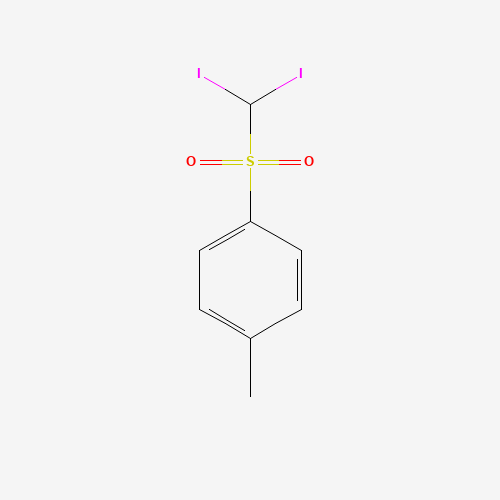
CAS20018-09-1
分子式C8H8I2O2S
分子量422.02 g/mol g/mol
危化品
RN given in first source
科学粮草官-词典编辑部,修订于:2026-07-06
Toxicity
ToxicityEPA Ecotoxicity
Pesticide Ecotoxicity Data from EPA: 9
Ecotoxicity Values
EC50; Species: Daphnia magna (Water Flea) age <24 hr; Conditions: freshwater, static; Concentration: 71 ug/L for 48 hr (95% confidence interval: 56-89 ug/L); Effect: intoxication, immobilization /95% purity formulation/
Fate Summary
ATMOSPHERIC FATE: According to a model of gas/particle partitioning of semivolatile organic compounds in the atmosphere(1), diiodomethyl p-tolyl sulfone, which has an average reported vapor pressure of 9.6X10⁻⁷ mm Hg at 25 °C(2), will exist in both the vapor and particulate phases in the ambient atmosphere. Vapor-phase diiodomethyl p-tolyl sulfone is degraded in the atmosphere by reaction with photochemically-produced hydroxyl radicals(SRC); the half-life for this reaction in air is estimated to be 2.9 days(SRC), calculated from its rate constant of 5.5X10⁻¹² cu cm/molecule-sec at 25 °C(SRC) that was derived using a structure estimation method(3). Particulate-phase diiodomethyl p-tolyl sulfone may be removed from the air by wet or dry deposition(SRC). Diiodomethyl p-tolyl sulfone is not...
Soil Adsorption / Mobility
The log Koc of diiodomethyl p-tolyl sulfone has been reported as 2.7(1), corresponding to a Koc of 500(SRC). According to a classification scheme(2), this Koc value suggests that diiodomethyl p-tolyl sulfone is expected to have moderate mobility in soil. Release to water from treated soil and wood are considered probable routes of dissipation to the environment(1).
Environmental Biodegradation
ANAEROBIC: Diiodomethyl p-tolyl sulfone is susceptible to microbial degradation in soil as indicated by the formation of monoiodomethyl p-tolylsulfone under anaerobic conditions. Monoiodomethyl p-tolylsulfone was also formed in an anaerobic aquatic degradation study, simulating anoxic sediment. Parent residues were detected up to seven days out from the initial incubation. A half-life of 21 days was reported in anaerobic soil for monoiodomethyl p-tolylsulfone(1).
Environmental Bioconcentration
An estimated BCF of 26 was calculated in fish for diiodomethyl p-tolyl sulfone(SRC), using a log Kow of 2.66(1) and a regression-derived equation(2). According to a classification scheme(3), this BCF suggests the potential for bioconcentration in aquatic organisms is low(SRC).
Volatilization from Water / Soil
The Henry's Law constant for diiodomethyl p-tolyl sulfone is estimated as 5.3X10⁻⁸ atm-cu m/mole(SRC) derived from its average vapor pressure, 9.6X10⁻⁷ mm Hg(1), and water solubility, 10 mg/L(1). This Henry's Law constant indicates that diiodomethyl p-tolyl sulfone is expected to be essentially nonvolatile from water surfaces(2). Diiodomethyl p-tolyl sulfone's estimated Henry's Law constant indicates that volatilization from moist soil surfaces is not expected to occur(SRC). Diiodomethyl p-tolyl sulfone is not expected to volatilize from dry soil surfaces based upon its vapor pressure(SRC).
Environmental Abiotic Degradation
The rate constant for the vapor-phase reaction of diiodomethyl p-tolyl sulfone with photochemically-produced hydroxyl radicals has been estimated as 5.5X10⁻¹² cu cm/molecule-sec at 25 °C(SRC) using a structure estimation method(1). This corresponds to an atmospheric half-life of about 2.9 days at an atmospheric concentration of 5X10+5 hydroxyl radicals per cu cm(1). Diiodomethyl p-tolyl sulfone degrades by hydrolysis and metabolism to form dehalogenated and demethylated compounds(2). It is stable to hydrolysis at pH 5, but degrades at pH 7 and 9 to form monoiodo-p-tolylsulfone with half-lives ranging from 1.5-9.6 days(2). Monoiiodomethyl p-tolyl sulfone was the terminal residue in hydrolysis and aqueous photodegradation studies(2). UV-visible spectra were observed at two absorptions pea...
Artificial Pollution Sources
Diiodomethyl p-tolyl sulfone's production may result in its release to the environment through various waste streams; its use as an algeacide, bactericide and fungicide(1) will result in its direct release to the environment(SRC).
Probable Routes of Human Exposure
NIOSH (NOES Survey 1981-1983) has statistically estimated that 8,631 workers (2,461 of these were female) were potentially exposed to diiodomethyl p-tolyl sulfone in the US(1). The NOES Survey does not include farm workers. Occupational exposure to diiodomethyl p-tolyl sulfone may occur through inhalation and dermal contact with this compound at workplaces where diiodomethyl p-tolyl sulfone is produced or used. Use data indicate that the general population may be exposed to diiodomethyl p-tolyl sulfone via dermal contact with consumer products treated with products containing diiodomethyl p-tolyl sulfone(SRC).
Environmental Fate / Exposure Summary
Diiodomethyl p-tolyl sulfone's production may result in its release to the environment through various waste streams; its use as an algeacide, bactericide and fungicide will result in its direct release to the environment. If released to air, a vapor pressure of 9.6X10⁻⁷ mm Hg at 25 °C indicates diiodomethyl p-tolyl sulfone will exist in both the vapor and particulate phases in the atmosphere. Vapor-phase diiodomethyl p-tolyl sulfone will be degraded in the atmosphere by reaction with photochemically-produced hydroxyl radicals; the half-life for this reaction in air is estimated to be 2.9 days. Particulate-phase diiodomethyl p-tolyl sulfone will be removed from the atmosphere by wet or dry deposition. Diiodomethyl p-tolyl sulfone is not expected to absorb at wavelengths >290 nm and, the...
Toxicity Data
LC50 (rat) = 960 mg/m3/4hr
Toxicity Summary
IDENTIFICATION AND USE: Diiodomethyl p-tolyl sulfone (DIMPTS) is a tan powder at room temperature. It is an algaecide, bactericide, and fungicide. DIMPTS is used as a materials preservative in paints, air duct coatings, fire-retardant coatings, pigment dispersions, inks, emulsions, extender slurries, adhesives, caulks, sealants, rubbers, plastic, textiles, leather, paper production to protect pulp and slurries, paper/paperboard, and wetlap. It is also used as a wood preservative. HUMAN EXPOSURE AND TOXICITY: Corrosive: causes irreversible eye damage. Harmful if absorbed through the skin. ANIMAL STUDIES: Male and female rats and dogs were administered DIMPTS for 90-days via the diet. In rats, the only treatment-related finding was squamous metaplasia of the salivary gland duct in the 80...
Human Toxicity Excerpts
/OTHER TOXICITY INFORMATION/ The mode of action (MOA) underpinning the reproductive toxicity of diiodomethyl-p-tolylsulfone (DIMPTS) is excess systemic iodide levels, resulting in hypothyroidism. This MOA evaluation also addresses the potential for toxicity and adverse health outcomes during critical windows of development for different tissues. The data indicate that testicular development in the neonate represents the tissue and life-stage that are most sensitive to iodide toxicity. Life-stage specific dosimetry appears to be a major determinant of this sensitivity, with the neonate being exposed to higher levels of iodide than the fetus during the period of testicular development, in particular Sertoli cell maturation and differentiation. While no reports could be found in the litera...
Non-Human Toxicity Values
LD50 Rat (male) dermal >20000 mg/kg
Non-Human Toxicity Excerpts
/LABORATORY ANIMALS: Developmental or Reproductive Toxicity/ Groups of 26 mated does /(New Zealand White rabbits)/ were dosed /by oral gavage/ with diiodomethyl-p-tolyl sulfone (AMICAL 48), purity 97.7% (in 0.5% methylcellulose vehicle) on gestation days 7-27 at 0, 0.05, 0.5, or 2.0 mg/kg/day. An increase in incidence of thyroid follicular dilatation (degree = "very slight") was observed in 2 mg/kg/day does as the only apparent maternal toxicity (maternal NOEL = 0.5 mg/kg/day). Developmental toxicity NOEL = 2 mg/kg/day (highest dose tested: no effects). ...
Antidote and Emergency Treatment
Advanced treatment: Consider orotracheal or nasotracheal intubation for airway control in the patient who is unconscious, has severe pulmonary edema, or is in severe respiratory distress. Positive-pressure ventilation techniques with a bag-valve-mask device may be beneficial. Consider drug therapy for pulmonary edema ... . Consider administering a beta agonist such as albuterol for severe bronchospasm ... . Monitor cardiac rhythm and treat arrhythmias as necessary ... . Start IV administration of D5W TKO. Use 0.9% saline (NS) or lactated Ringer's (LR) if signs of hypovolemia are present. For hypotension with signs of hypovolemia, administer fluid cautiously. Watch for signs of fluid overload ... . Treat seizures with diazepam (Valium) or lorazepam (Ativan) ... . Use proparacaine hydroch...