

 一键配货
一键配货
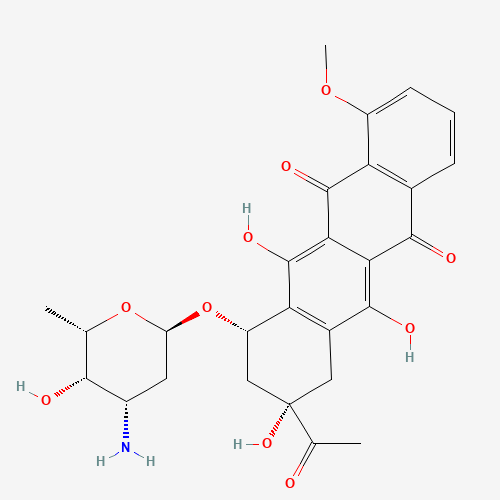
化合物详情
CAS20830-81-3
分子式C27H29NO10
分子量527.5 g/mol g/mol
危化品
Daunomycin can cause cancer according to an independent committee of scientific and health experts.
科学粮草官-词典编辑部,修订于:2026-07-06
Toxicity
ToxicityNatural Pollution Sources
Daunomycin is obtained from cultures of Streptomyces caeruleorubidus and Streptomyces peucetius, which occur in soil.
Probable Routes of Human Exposure
/PRECAUTIONS FOR ANTINEOPLASTIC AGENTS:/ The danger to health-care personnel from handling a hazardous drug stems from a combination of its inherent toxicity and the extent to which workers are exposed to the drug in the course of carrying out their duties. This exposure may be through inadvertent ingestion of the drug on foodstuffs (eg, workers' lunches), inhalation of drug dusts or droplets or direct skin contact. /Antineoplastic agents/
Symptoms
symptoms include gastrointestinal disturbances. (A723)
Treatment
Infuse 10 to 20 mL/kg isotonic fluid. If hypotension persists, administer dopamine. (A704)
Toxicity Data
LD50=20 mg/kg (mice, IV); LD50=13 mg/kg (rat, IV)
Health Effects
Antibiotic resistance. Toxic manifestations of Daunorubicin include bone marrow depression, stomatitis, alopecia, gastrointestinal disturbances, and dermatological manifestations. Cardiac toxicity is a pecular effect. (A723)
Hepatotoxicity
Likelihood score: E* (unproven but suspected cause of clinically apparent liver injury).
Adverse Effects
Rarely it causes secondary leukemias, hypersensitivity reactions, urticaria, local dermatitis, tumor lysis syndrome, and hyperuricemia.
Exposure Routes
Intravenous
Toxicity Summary
Daunorubicin has antimitotic and cytotoxic activity through a number of proposed mechanisms of action: Daunorubicin forms complexes with DNA by intercalation between base pairs, and it inhibits topoisomerase II activity by stabilizing the DNA-topoisomerase II complex, preventing the religation portion of the ligation-religation reaction that topoisomerase II catalyzes.
Carcinogen Classification
2B, possibly carcinogenic to humans. (L135)
Drug Induced Liver Injury
References: DOI:10.1016/j.drudis.2019.09.022
Populations at Special Risk
Recognition and analysis of distinct mechanisms by which primaquine and other hemolytic drugs activate the hexose monophosphate shunt (HMS) have suggested a hitherto unsuspected pharmacogenetic interaction between daunorubicin metabolism and glucose-6-phosphate dehydrogenase (G6PD) deficiency. Because this deficiency is very common, and because anthracyclines are indispensable antitumor antibiotics that are biotransformed mainly by carbonyl reductase, we have compared the reductase-mediated conversion of daunorubicin to daunorubicinol and the conversion of doxorubicin to doxorubicinol in G6PD-deficient and nondeficient erythrocytes. We found that even without G6PD deficiency, the HMS dehydrogenases selectively limited daunorubicin metabolism, as contrasted with that of doxorubicin. The...
Evidence for Carcinogenicity
No data are available in humans. Sufficient evidence of carcinogenicity in animals. OVERALL EVALUATION: Group 2B: The agent is probably carcinogenic to humans.
Antidote and Emergency Treatment
/SRP:/ Advanced treatment: Consider orotracheal or nasotracheal intubation for airway control in the patient who is unconscious, has severe pulmonary edema, or is in severe respiratory distress. Positive-pressure ventilation techniques with a bag valve mask device may be beneficial. Consider drug therapy for pulmonary edema ... . Consider administering a beta agonist such as albuterol for severe bronchospasm ... . Monitor cardiac rhythm and treat arrhythmias as necessary ... . Start IV administration of D5W /SRP: "To keep open", minimal flow rate/. Use 0.9% saline (NS) or lactated Ringer's if signs of hypovolemia are present. For hypotension with signs of hypovolemia, administer fluid cautiously. Watch for signs of fluid overload ... . Treat seizures with diazepam or lorazepam ... . Use...
Effects During Pregnancy and Lactation
◉ Effects on Lactation and Breastmilk