


 一键配货
一键配货
化合物详情
CAS1214-39-7
分子式C12H11N5
分子量225.25 g/mol g/mol
危化品
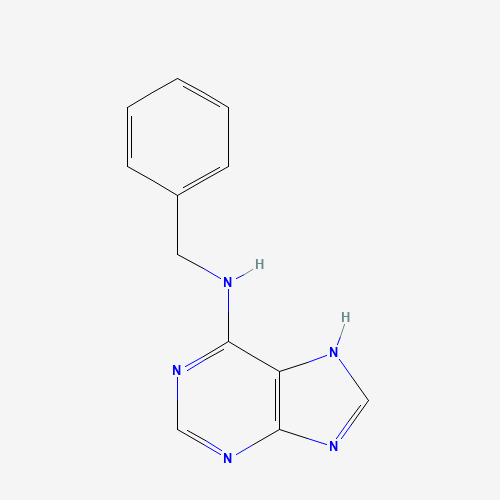
N-benzyladenine is a member of the class of 6-aminopurines that is adenine in which one of the hydrogens of the amino group is replaced by a benzyl group. It has a role as a cytokinin and a plant metabolite. It is functionally related to an adenine.
科学粮草官-词典编辑部,修订于:2026-07-06
Toxicity
ToxicityEPA Ecotoxicity
Pesticide Ecotoxicity Data from EPA: 5
Ecotoxicity Values
LC50; Species: Oncorhynchus mykiss (Rainbow trout); Conditions: freshwater, static; Concentration: 21400 ug/L for 96 hr (95% confidence interval: 19200-23800 ug/L) /formulated product/
Fate Summary
ATMOSPHERIC FATE: According to a model of gas/particle partitioning of semivolatile organic compounds in the atmosphere(1), benzyladenine, which has a vapor pressure of 1.79X10⁻¹¹ mm Hg at 20 °C(2), is expected to exist solely in the particulate phase in the ambient atmosphere. Particulate-phase benzyladenine may be removed from the air by wet or dry deposition(SRC). Benzyladenine does contain chromophores that absorb at wavelengths >290 nm(3) and therefore may be susceptible to direct photolysis by sunlight(SRC).
Soil Adsorption / Mobility
The Koc of benzyladenine is estimated as 170(SRC), using a log Kow of 1.57(1) and a regression-derived equation(2). According to a classification scheme(3), this estimated Koc value suggests that benzyladenine is expected to have moderate mobility in soil.
Environmental Bioconcentration
An estimated BCF of 3.2 was calculated for benzyladenine(SRC), using a log Kow of 1.57(1) and a regression-derived equation(2). According to a classification scheme(3), this BCF suggests the potential for bioconcentration in aquatic organisms is low(SRC).
Volatilization from Water / Soil
The Henry's Law constant for benzyladenine is estimated as 8.84X10⁻¹⁴ atm-cu m/mole(SRC) derived from its vapor pressure, 1.79X10⁻¹¹ mm Hg(1), and water solubility, 60 mg/L(1). This Henry's Law constant indicates that benzyladenine is expected to be essentially nonvolatile from water surfaces(2). Benzyladenine's estimated Henry's Law constant indicates that volatilization from moist soil surfaces is not expected to occur(SRC). Benzyladenine is not expected to volatilize from dry soil surfaces(SRC) based upon its vapor pressure(1).
Environmental Abiotic Degradation
The rate constant for the vapor-phase reaction of benzyladenine with photochemically-produced hydroxyl radicals has been estimated as 2.14X10⁻¹⁰ cu cm/molecule-sec at 25 °C(SRC) using a structure estimation method(1). This corresponds to an atmospheric half-life of about 1.8 hours at an atmospheric concentration of 5X10+5 hydroxyl radicals per cu cm(1). Benzyladenine is not expected to undergo hydrolysis in the environment due to the lack of functional groups that hydrolyze under environmental conditions(2). Benzyladenine does contain chromophores that absorb at wavelengths >290 nm(2) and therefore may be susceptible to direct photolysis by sunlight(SRC).
Ecotoxicity Excerpts
/AQUATIC SPECIES/ In a study entitled "Four-Day Static Acute Toxicity Studies with N6-Benzyladenine in Rainbow Trout" it was found that N6-benzyladenine was slightly toxic to rainbow trout (96 hr LC50=21.4 ppm). /The EPA found the study/ to be supplemental and does not fulfill the guideline requirement for a fish acute toxicty study. However, the deficiencies were minor and the results may be used to assess the risk to freshwater fish for a plant growth regulator with limited registered terrestrial uses. In another study entitled "6-Benzyladenine Code 16262: A 48 hr Static Daily Renewal Acute Toxicity Test with Cladoceran (Daphnia magna)" it was found that N6-benzyladenine was slightly toxic to freshwater invertebrates (EC50=20.5 mg/L). ... Ecological effects data suggest that N6-benzyl...
Artificial Pollution Sources
Benzyladenine's production may result in its release to the environment through various waste streams; its use as a plant growth regulator(1) will result in its direct release to the environment(SRC).
Probable Routes of Human Exposure
Occupational exposure to benzyladenine may occur through inhalation of dust and dermal contact with this compound at workplaces where benzyladenine is produced or used. (SRC)
Environmental Fate / Exposure Summary
Benzyladenine's production may result in its release to the environment through various waste streams; its use as a plant growth regulator will result in its direct release to the environment. If released to air, a vapor pressure of 1.79X10⁻¹¹ mm Hg at 20 °C indicates benzyladenine will exist solely in the particulate phase in the atmosphere. Particulate-phase benzyladenine will be removed from the atmosphere by wet or dry deposition. Benzyladenine does contain chromophores that absorb at wavelengths >290 nm and therefore may be susceptible to direct photolysis by sunlight. If released to soil, benzyladenine is expected to have moderate mobility based upon an estimated Koc of 170. Volatilization from moist soil surfaces is not expected to be an important fate process based upon an estim...
Toxicity Data
LC50 (rabbit) = 5,200 mg/m3/1hr
Non-Human Toxicity Values
LD50 Rat Oral 1.3 g/kg
Non-Human Toxicity Excerpts
/LABORATORY ANIMALS: Acute Exposure/ 6-Benzyladenine, at a concentration of 25% (w/v in acetone), was applied dermally (6 hrs) to 10 guinea pigs/sex (induction 3x + challenge 1x) and 5 Guinea pigs/sex (naive control [1x challenge]). No evidence of sensitization. No significant effect on body weight.[California Environmental Protection Agency/Department of Pesticide Regulation; SUMMARY OF TOXICOLOGY DATA CYTOKININ and 6-Benzyladenine
Antidote and Emergency Treatment
/SRP:/ Advanced treatment: Consider orotracheal or nasotracheal intubation for airway control in the patient who is unconscious, has severe pulmonary edema, or is in severe respiratory distress. Positive-pressure ventilation techniques with a bag valve mask device may be beneficial. Consider drug therapy for pulmonary edema ... . Consider administering a beta agonist such as albuterol for severe bronchospasm ... . Monitor cardiac rhythm and treat arrhythmias as necessary ... . Start IV administration of D5W /SRP: "To keep open", minimal flow rate/. Use 0.9% saline (NS) or lactated Ringer's if signs of hypovolemia are present. For hypotension with signs of hypovolemia, administer fluid cautiously. Watch for signs of fluid overload ... . Treat seizures with diazepam or lorazepam ... . Use...









