


 一键配货
一键配货
化合物详情
CAS21087-64-9
分子式C8H14N4OS
分子量214.29 g/mol g/mol
危化品
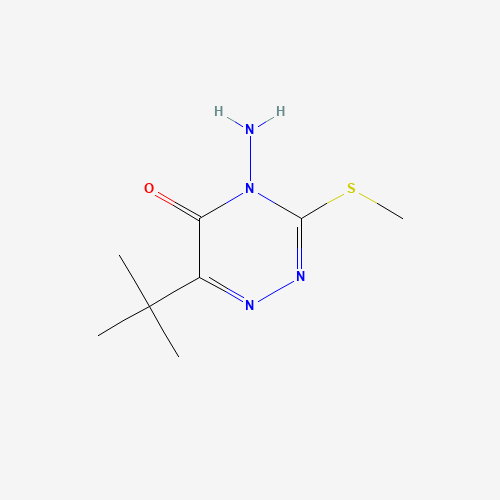
Physical Description | Metribuzin is a colorless crystalline solid. Used as an herbicide. (NIOSH, 2024)
科学粮草官-词典编辑部,修订于:2026-07-06
Toxicity
ToxicityEPA Ecotoxicity
Pesticide Ecotoxicity Data from EPA: 53
Ecotoxicity Values
USDA APHIS Chemical Effects: collection=usda_chemeffect&query_type=synonym&query='^21087-64-9$'
Fate Summary
ATMOSPHERIC FATE: According to a model of gas/particle partitioning of semivolatile organic compounds in the atmosphere(1), metribuzin, which has a vapor pressure of 4.35X10⁻⁷ mm Hg at 20 °C(2), will exist in both the vapor and particulate phases in the ambient atmosphere. Vapor-phase metribuzin is degraded in the atmosphere by reaction with photochemically-produced hydroxyl radicals(SRC); the half-life for this reaction in air is estimated to be 21 hrs(SRC), calculated from its rate constant of 1.8X10⁻¹¹ cu cm/molecule-sec at 25 °C(SRC) determined using a structure estimation method(3). Particulate-phase metribuzin may be removed from the air by wet and dry deposition(SRC).
Soil Adsorption / Mobility
The average Koc of metribuzin is 60(1). Parent metribuzin was very mobile in sandy (0.58% OC), sandy loam (0.64% OC), silt loam (1.7% OC), and clay loam (1.3% OC) soils with adsorption(1). Freundlich constant values of 0.25, 0.02, 0.22, and 0.20, respectively desorption Freundlich values were 0.56, 0.14, 0.51, and 0.41, respectively(1). Adsorption Koc were 47, 3, 15, and 17 and desorption Koc values were 106, 24, 33, and 36, respectively(1). The Koc values for metribuzin in Alaskan subarctic agricultural silt loam soils ranges from 34-56(2). Experimental Koc values have been measured for sand (Koc=47; 1% OM, pH 4.3), sandy loam (Koc=3; 1.1% OM, pH 6.6), silt loam (Koc=14; 3% OM, pH 5.9), and clay loam (Koc=17; 2.2% OM, pH 6.4) soils(1). Metribuzin has high affinity for soil organic matt...
Environmental Biodegradation
ANAEROBIC: Metribuzin had a half-life of 112 days following 30 days of anaerobic incubation(1). During the anaerobic portion of the study, the degradates identified were deaminated diketo metribuzin (DADK), deaminated metribuzin (DA), diketo metribuzin (DK), and 2-methyl-DADK(1). Seventy-eight to 88% of all radioactivity was in the organic phase from the methanol extractions of soil and <5 % was in the aqueous phase(1). In another study, anaerobic degradation of metribuzin in riparian wetland soils was determined to be slow under the conditions of this study ranging from 200-360> days under nitrate reducing conditions and 120-360> days under non-nitrate reducing conditions(2); complete disappearance of metribuzin was not observed under either nitrate or non-nitrate reducing conditions(2).
Environmental Bioconcentration
The bioconcentration factor (BCF) of metribuzin in the Golden ide fish (Leuciscus idus melanotus) was experimentally determined to be 10 in a 3 day static test(1). According to a classification scheme(2) and this BCF value, metribuzin is not expected to bioconcentrate in aquatic organisms(SRC).
Volatilization from Water / Soil
The Henry's Law constant for metribuzin is estimated as 1.2X10⁻¹⁰ atm-cu m/mole(SRC) derived from its vapor pressure, 4.35X10⁻⁷ mm Hg(1), and water solubility, 1050 mg/l(1). This Henry's Law constant indicates that metribuzin is expected to be essentially nonvolatile from water surfaces(2). In growth chamber studies using Ontko and Chehalis soils, volatilization rates of applied metribuzin over a 12 day period were negligible(1). However, using glass plates, it was shown that approximately 50% of applied metribuzin volatilized within 24 hrs, slowing to a 15-20% loss over the next 11 days. A field study was conducted using a Charlottetown fine sandy loam (2.1% OM, 55.1% sand, 30.2% silt, 14.7% clay, pH=6.1) and Berwick loamy sand (4.2% OM, 71.2% sand, 10.8% silt, 18.0% clay, pH=5.2), Pri...
Environmental Abiotic Degradation
The rate constant for the vapor-phase reaction of metribuzin with photochemically-produced hydroxyl radicals has been estimated as 1.8X10⁻¹¹ cu cm/molecule-sec at 25 °C(SRC) using a structure estimation method(1). This corresponds to an atmospheric half-life of approximately 1 day at an atmospheric concn of 5X10+5 hydroxyl radicals per cu cm(1). The hydrolysis half-life of metribuzin is 90 days according to the California Department of Food and Agriculture; conditions and experimental procedure not reported(2). Metribuzin has a half-life of 4.3 hours in pH 6.6 water irradiated with natural sunlight in Kansas City, MO at 25 °C(3). The identified degradate was deaminated metribuzin (DA; major degradate), and 3 unknown degradates each comprised <5.2%(3). Metribuzin had a half-life of 2.5 d...
Food Survey Values
Metribuzin was qualitatively identified in 1 root vegetable composite from Total Diet samples taken in 1975(1). Metribuzin was found in 1 of 1219 samples of domestic and imported tomatoes at trace quantities (Trace, present but below the level of detection)(2).
Milk Concentrations
Dairy cattle fed a diet of 3 and 10 ppm metribuzin had ranges of concns of total metribuzin residues(metribuzin and metabolites) in milk of <4-6 and <4-7 ppb, respectively(1).
Animal Concentrations
Beef and dairy cattle fed a diet of 10 ppm metribuzin had total metribuzin residues (metribuzin and metabolites) in the muscle, liver, kidney, and fat tissues ranging from non-detectable, 0.55-1.01 ppm, 0.08-0.17 ppm, and 0.06-1.13 ppm respectively(1). Poultry feed a diet of 15 ppm metribuzin had total metribuzin residues (metribuzin and metabolites) in eggs, giblet, muscle, fat, and skin ranging from 0.032-0.053 ppm, 0.23-0.27 ppm, 0.06-0.07 ppm, 0.04-0.08 ppm, and 0.03-0.08 ppm respectively(1).
ICSC Environmental Data
The substance is harmful to aquatic organisms. This substance does enter the environment under normal use. Great care, however, should be taken to avoid any additional release, for example through inappropriate disposal.
Atmospheric Concentrations
RURAL/REMOTE: The maximum concn and percent detections of metribuzin in air over the Mississippi River from New Orleans, LA to St. Paul, MN during June 1994 was 6.6 ng/cu-m and 100%, respectively(1).
Artificial Pollution Sources
Metribuzin's use as an herbicide(1,2) is expected to result in its direct release to the environment(SRC).
Sediment/Soil Concentrations
SOIL: In 1989, the mean concn of metribuzin in soil at agrochemical facilities in Illinois was determined to be 92 ug/kg(1).
Probable Routes of Human Exposure
Baseline inhalation exposure values of metribuzin for workers ranged from 0.006-91.14 mg/day for various uses (as herbicide) and application methods(1).
Environmental Fate / Exposure Summary
Metribuzin's use as herbicide is expected to result in its direct release to the environment. If released to air, a vapor pressure of 4.35X10⁻⁷ mm Hg at 20 °C indicates metribuzin will exist in both the vapor and particulate phases in the ambient atmosphere. Vapor-phase metribuzin will be degraded in the atmosphere by reaction with photochemically-produced hydroxyl radicals; the half-life for this reaction in air is estimated to be 21 hrs. Particulate-phase metribuzin will be removed from the atmosphere by wet and dry deposition. Metribuzin absorbs light in the environmental UV spectrum and has a photolysis half-life of 2.5 days on sandy loam soil irradiated outdoors. If released to soil, metribuzin is expected to have high mobility based upon an average experimental Koc of 60. Volatili...
Symptoms
In Animals: central nervous system depression; thyroid, liver enzyme changes
Target Organs
central nervous system, thyroid, liver
Adverse Effects
ACGIH Carcinogen - Not Classifiable.
Exposure Routes
inhalation, ingestion, skin and/or eye contact
RAIS Toxicity Values
Oral Chronic Reference Dose Reference: IRIS Current
Human Toxicity Excerpts
Single and repeated patch tests in humans showed no irritation or dermal sensitization.
Carcinogen Classification
No indication of carcinogenicity to humans (not listed by IARC).
1 or Cancer Risk Level 1E-06
Fraction of Contaminant Absorbed Dermally from Soil: 0.1
Antidote and Emergency Treatment
Intravenous fluids: If serious dehydration and electrolyte depletion have occurred as a result of vomiting and diarrhea, monitor blood electrolytes and fluid balance and administer intravenous infusions of glucose, normal saline, Ringer's solution, or Ringer's lactate to restore extracellular fluid volume and electrolytes. Follow this with oral nutrients as soon as fluids can be retained.
Hazard Quotient Level 3 or Cancer Risk Level 1E-04
Fraction of Contaminant Absorbed Dermally from Soil: 0.1
USGS Health-Based Screening Levels for Evaluating Water-Quality
Reference: Smith, C.D. and Nowell, L.H., 2024. Health-Based Screening Levels for evaluating water-quality data (3rd ed.). DOI:10.5066/F71C1TWP









