


 一键配货
一键配货
化合物详情
CAS21145-77-7
分子式C18H26O
分子量258.4 g/mol
非危品
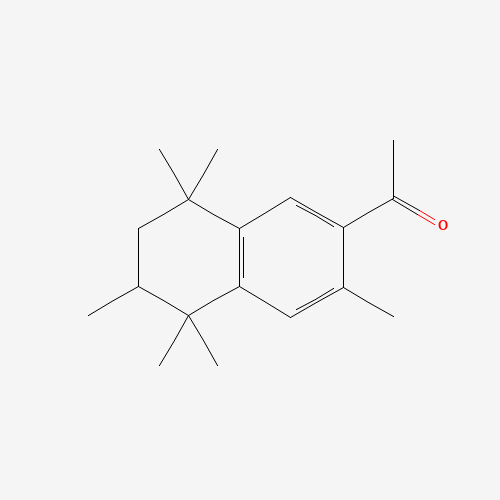
2-Acetyl-3,5,5,6,8,8-hexamethyl-5,6,7,8- tetrahydronaphthalene is a member of tetralins.
科学粮草官-词典编辑部,修订于:2026-07-06
Toxicity
ToxicityBody Burden
... An increasing number of studies show that /7-acetyl-1,1,3,4,4,6-hexamethyl-1,2,3,4-tetrahydro-naphthaline/ (AHTN) accumulates in surface water and fish and can be detected in human adipose tissue, as well in human milk.
Ecotoxicity Values
LC50; Species: Acartia tonsa (calanoid copepod); Concentration: 2.5 mg/L for 48 hr /Conditions of bioassay not specified in source examined/
Fate Summary
ATMOSPHERIC FATE: According to a model of gas/particle partitioning of semivolatile organic compounds in the atmosphere(1), tonalide, which has a vapor pressure of 5.12X10⁻⁴ mm Hg(2), will exist in both the vapor and particulate phases in the ambient atmosphere. Vapor-phase tonalide is degraded in the atmosphere by reaction with photochemically-produced hydroxyl radicals(SRC); the half-life for this reaction in air is estimated to be 22 hours(SRC), calculated from its rate constant of 1.8X10⁻¹¹ cu cm/molecule-sec at 25 °C(SRC) that was derived using a structure estimation method(3). Particulate-phase tonalide may be removed from the air by wet and dry deposition(SRC). Tonalide contains chromophores that absorb at wavelengths >290 nm(4) and, therefore, it may be susceptible to direct pho...
Soil Adsorption / Mobility
The Koc of tonalide is estimated as 1.9X10+4(SRC), using a log Kow of 5.7(1) and a regression-derived equation(2). According to a classification scheme(3), this estimated Koc value suggests that tonalide is expected to be immobile in soil. Experimental Koc values for tonalide include, 9,550 L/kg, reported from a laboratory desorption experiment utilizing 25 mg suspended matter spiked with approx 10 ug/g tonalide(4) and 6,309 L/kg calculated using sludge from a sewage treatment plant in DeBilt, Germany(5).
Environmental Biodegradation
PURE CULTURE: Tonalide was degraded 80% in 3 weeks by the fungus Aureobasidium pollulans and was totally degraded in 6 days by Phanerochaete chrysosporium(1).
Environmental Bioconcentration
An average BCF of 1,069 was given for eel (Anguilla anguilla) and 600 for zebra fish (Brachydonio rerio)(1). A BCF was given for bluegill sunfish (L. Macrochirus) as 597(2). According to a classification scheme(3), these BCF suggest the potential for bioconcentration in aquatic organisms is high to very high(SRC). Tonalide had a BCF of 50 in midge larvae (Chironomus riparius) and 6918 in worms (Lumbriculus variegatus)(4).
Volatilization from Water / Soil
The Henry's Law constant for tonalide is estimated as 1.4X10⁻⁴ atm-cu m/mole(SRC) derived from its vapor pressure, 5.12X10⁻⁴ mm Hg(1), and water solubility, 1.25 mg/L(1). This Henry's Law constant indicates that tonalide is expected to volatilize from water surfaces(2). Based on this Henry's Law constant, the volatilization half-life from a model river (1 m deep, flowing 1 m/sec, wind velocity of 3 m/sec)(2) is estimated as 15 hours(SRC). The volatilization half-life from a model lake (1 m deep, flowing 0.05 m/sec, wind velocity of 0.5 m/sec)(2) is estimated as 9 days(SRC). However, volatilization from water surfaces is expected to be attenuated by adsorption to suspended solids and sediment in the water column. The estimated volatilization half-life from a model pond is 230 days if ads...
Environmental Abiotic Degradation
Thirteen pharmaceutical and cosmetic compounds have been surveyed along the different units of a municipal sewage treatment plant (STP) to study their fate across each step and the overall removal efficiency. The STP studied corresponds to a population of approximately 100,000 inhabitants located in Galicia (northwest Spain), including three main sections: pre-treatment (coarse and fine screening, grit and fat removal); primary treatment (sedimentation tanks); and secondary treatment (conventional activated sludge). Among all the substances considered (galaxolide, tonalide, carbamazepine, diazepam, diclofenac, ibuprofen, naproxen, estrone, estradiol, ethinylestradiol, roxitromycin, sulfamethoxazole and iopromide), only significant concentrations were found for two musks (galaxolide and...
Environmental Water Concentrations
SEAWATER: Polycyclic musks, including chemicals such as tonalide, have been detected in sea water at concentration ranges 0.3 to 1 ng/L(1).
Food Survey Values
Continually detected biologically persistent nitromusks; galaxolide (HHCB), tonalide (AHTN) and musk ketone (MK), antimicrobial triclosan (TCS), and antihistamine diphenhydramine (DPH) were examined for the first time in edible fillets originating from eight fish species grown in salt- and fresh-water. The sampled fish collected from local grocery stores were homogenized, extracted, pre-concentrated and analyzed by gas chromatography-mass spectrometry (GC-MS) using selected ion monitoring (SIM). The presence of the target compounds in fish extracts was confirmed based on similar mass spectral features and retention behavior with standards. Internal standard based calibration plots were used for quantification. The HHCB, AHTN, TCS and DPH were consistently observed with concentration of...
Milk Concentrations
... An increasing number of studies show that /7-acetyl-1,1,3,4,4,6-hexamethyl-1,2,3,4-tetrahydro-naphthaline/ (AHTN) accumulates in surface water and fish and can be detected in human adipose tissue, as well in human milk.
Ecotoxicity Excerpts
/AQUATIC SPECIES/ Synthetic musks are widely used as perfuming agents in products, such as cosmetics, detergents, and soaps. The increased detection of these substances in the aquatic environment and their high bioconcentration potential raises concerns about potential effects on aquatic species. This work aimed at assessing the interactions of the most widely used musks: nitromusks (musk xylene, musk ketone) and polycyclic musks (celestolide, galaxolide, and tonalide) with fish enzymatic systems involved in both xenobiotic and endogenous metabolism. Therefore, CYP catalyzed pathways were investigated in carp liver microsomes (CYP1A, CYP3A), ovarian microsomes (CYP19) and testicular mitochondria (CYP17 and CYP11beta) using standard substrates. Phase II activities (UDP-glucuronosyltransf...
Animal Concentrations
Tonalide was detected in blubber from 8 finless porpoise (Neophocaena phocaenoides) and 3 porpoise fetus samples, collected from the Ariake Sea and Yatsushire Sea, Japan, at concentrations of less than 2.3 ng/g(1).
Effluent Concentrations
The polycyclic musk fragrance compounds HHCB (1,3,4,6,7,8-hexahydro-4,6,6,7,8,8-hexamethylcyclopenta-(g)-2-benzopyran; trade name, e.g. galaxolide) and AHTN (7-acetyl-1,1,3,4,4,6-hexamethyl-1,2,3,4-tetrahydronaphthalene, trade name, e.g. tonalide) and the transformation product of HHCB (HHCB-lactone) were analysed in surface water samples and sewage treatment plants (STP) effluents in the Ruhr megalopolis. The STPs were the dominant source for these pollutants. In the part of the river where the drinking water is extracted from the river, about 60 ng/L HHCB, 10 ng/L AHTN and 20-30 ng/L HHCB-lactone were found as typical riverine concentrations, while none of the compounds were detected near the spring of the river. On the other hand sewage treatment plant effluents exhibited concentrati...
Atmospheric Concentrations
[Table#7207]: IkFyZWEiLCJQYXJ0aWN1bGF0ZS1waGFzZSAobWcvY3UgbSkiLCJHYXMtcGhhc2UgKG1nL2N1IG0pIgoiSW5zaWRlIHRoZSB3b3Jrc2hvcCIsIjIyLjcxIiwiNzI0LjgyIgoiT3V0c2lkZSB0aGUgd29ya3Nob3AiLCIxLjI1IiwiMjIuMDciCiJEb3dud2luZCAyMDBtIGZyb20gcGxhbnQiLCIxLjE5IiwiMi41MSIKIlVwd2luZCAyNSBrbSBmcm9tIHRoZSBwbGFudCIsIjAuODUiLCIxLjAxIgo=
Fish/Seafood Concentrations
Tonalide was detected in 17 fish samples (crusian carp (Carassius auratus), silver carp (Hypophthalmichthys molitrix), common carp (Cyrpinus carpio)) collected in 2008 from Haihe River in China at concentrations of 3.0-6.8 ng/g(1). Tonalide was detected in brown bullhead (Ameiurus nebulosus) (mean 2.9 ng/g), gizzard shad (Dorosoma cepedianum) (mean 22.3 (ng/g), white perch (Morone americana) (mean 16.7 ng/g), and yellow perch (Perca fluviatilus) (mean 96.8 ng/g) sampled from Hamilton Harbor of Lake Ontario, the Detroit River, and western Lake Erie, in Spring 2002(2). Tonalide was detected in blubber from 5 hammerhead shark (Sphyrna lewini) samples, collected from the Ariake Sea and Yatsushire Sea, Japan, at concentrations of less than 2.3 ng/g wet wt(3). Tonalide was detected in fish (b...
Artificial Pollution Sources
Tonalide's production may result in its release to the environment through various waste streams; its use as a fragrance in cosmetics, detergents, fabric softeners, household cleaning products and air fresheners(1) will result in its direct release to the environment(SRC).
Sediment/Soil Concentrations
SEDIMENT: Tonalide was found in suspended solids from the River Elbe, Germany, at concentration ranges of 148 to 770 ug/L(1). Tonalide was found in 36 of 59 sediment samples from Berlin Germnay, with average concentration of 0.22 and 0.92 ug/kg in moderate and high sewage input water bodies, respectively(2). 19 Sites from the Lippe River bottom in Westphalia, Germany, sampled Aug 16-17, 1999 contained <2 to 1,399 ug/kg of tonalide; suspended particles from the Lippe River had 823 ug/kg of tonalide(3). Tonalide was detected but not quantified in 2 of 9 sediment samples from Havel river, Germany, 5 of 14 samples from Spree river, Germany and 4 of 6 sediment samples from Teltow Canal, Germany(5). Tonalide was found at all 6 sites from the German Bight(6). Suspended particulate matter sampl...
Probable Routes of Human Exposure
NIOSH (NOES Survey 1981-1983) has statistically estimated that 73 workers (all of these are female) are potentially exposed to tonalide in the US(1). Occupational exposure to tonalide may occur through dermal contact with this compound at workplaces where tonalide is produced or used(SRC). Monitoring and use data indicate that the general population may be exposed to tonalide via inhalation of ambient air, ingestion of fish and drinking water, and dermal contact with this compound and other consumer products containing tonalide(SRC).
Other Environmental Concentrations
Tonalide was found in sewage samples with a mean concentration of 2.24 ug/L and a maximum of 4.36 mg/L in Berlin, Germany(1). Tonalide was found in United Kingdom sewage sludge samples at 0.12-16 ng/kg dry weight with a mean of 4.7 ng/kg(2). Tonalide concentrations in a sewage sludge sampled on July 29, 1997 was 4,800 ug/kg wet weight(1); concentrations in two sediment samples from this sewage pond were 75 and 140 ug/kg wet weight, sampled on July 5, 1997(3).
Environmental Fate / Exposure Summary
Tonalide's production may result in its release to the environment through various waste streams; its use as a fragrance in cosmetics, detergents, fabric softeners, household cleaning products and air fresheners will result in its direct release to the environment. If released to air, a vapor pressure of 5.12X10⁻⁴ mm Hg indicates tonalide will exist in both the vapor and particulate phases in the atmosphere. Vapor-phase tonalide will be degraded in the atmosphere by reaction with photochemically-produced hydroxyl radicals; the half-life for this reaction in air is estimated to be 22 hours. Particulate-phase tonalide will be removed from the atmosphere by wet and dry deposition. Tonalide contains chromophores that absorb at wavelengths >290 nm and, therefore, may be susceptible to direct...
Effect Level
collection=toxvaldb&kind=^EL$
Interactions
... In the present study the subchronic hepatotoxicity of AHTN administered to rats at doses within the human exposure range was evaluated. For this purpose female and male juvenile Wistar rats were exposed to AHTN (300 ug/kg body weight per day, i.p.) alone or to a single dose of diethylnitrosamine (DEN) (100 mg/kg body weight, ip) followed by AHTN (1, 10, 100 or 300 ug/kg body weight per day, ip) for 90 days. Thereafter the liver architecture as well as the presence of placental glutathione S-transferase (GST-P)-positive hepatic lesions was assessed. In male animals receiving AHTN alone or in combination with DEN the number of GST-P-positive single hepatocytes was similar to that in untreated rats, while GST-P-positive mini-foci and foci were not observed. In the case of female rats t...
Lethal Dose
collection=toxvaldb&kind=^LD$
Adverse Effects
Occupational hepatotoxin - Secondary hepatotoxins: the potential for toxic effect in the occupational setting is based on cases of poisoning by human ingestion or animal experimentation.
Toxicity Summary
IDENTIFICATION AND USE: Tonalide is a solid with a musk odor. It is used as a fragrance in cosmetics, detergents, fabric softeners, household cleaning products and air fresheners. HUMAN STUDIES: No irritation was observed after repeated occlusive applications as well as no phototoxic reactions. High concentrations of tonalide can affect steroidogenesis in vitro using the H295R cell line. Tonalide was not genotoxic in the micronucleus test with human lymphocytes in vitro with or without metabolic activation. ANIMAL STUDIES: Tonalide did not produce erythema or edema when tested on the skin of rabbits. In tests for photoirritation in the rabbit clear phototoxicity was seen at 5% in ethanol. Moderate redness and slight to moderate chemosis of the conjunctivae was seen in rabbits in an eye...
Other Toxicity Values
collection=toxvaldb&kind=^Other$
Human Toxicity Excerpts
/ENDOCRINE MODULATION/ 1,3,4,6,7,8-Hexahydro-4,6,6,7,8,8-hexamethylcyclopenta-(gamma)-2-benzopyran (HHCB) and 7-acetyl-1,1,3,4,4,6-hexamethyl-1,2,3,4-tetrahydronaphthalene (AHTN) are widely used in personal care products. Previous studies showed that HHCB and AHTN can be found in various environmental matrices and have potential endocrine disrupting effects. However, the effects on adrenocortical function of HHCB and AHTN are not fully understood. This study evaluated the influences of HHCB and AHTN on seven steroid hormones (progesterone, aldosterone, cortisol, 17alpha-OH-progesterone, androstenedione, 17beta-estradiol, and testosterone) and 10 genes involved in steroidogenic pathways (HMGR, StAR, CYP11A1, 3betaHSD2, CYP17, CYP21, CYP11B1, CYP11B2, 17betaHSD, and CYP19) using the H295R...
Non-Human Toxicity Values
LD50 Rabbit dermal >5 g/kg
Reference and Risk Values
collection=toxvaldb&kind=^RRV$
Non-Human Toxicity Excerpts
/LABORATORY ANIMALS: Acute Exposure/ ... One of the most important synthetic musks is 7-acetyl-1,1,3,4,4,6-hexamethyl-1,2,3,4-tetrahydro-naphthaline+ ++.(AHTN). ... In the present report it is shown that a single high dose of AHTN leads to acute hepatic damage in rats, characterized by single cell necrosis, inflammation, swelling of liver parenchymal cells, and the presence of cytoplasmic condensations in the hepatocytes, while at the ultrastructural level disorganization of the rough endoplasmic reticulum and mitochondria as well as focal cytolysis is evident. ...
Antidote and Emergency Treatment
/SRP:/ Advanced treatment: Consider orotracheal or nasotracheal intubation for airway control in the patient who is unconscious, has severe pulmonary edema, or is in severe respiratory distress. Consider drug therapy for pulmonary edema ... . Positive-pressure ventilation techniques with a bag valve mask device may be beneficial. Consider drug therapy for pulmonary edema ... . Consider administering a beta agonist such as albuterol for severe bronchospasm ... . Monitor cardiac rhythm and treat arrhythmias if necessary ... Start IV administration of D5W /SRP: "To keep open", minimal flow rate/. Use 0.9% saline (NS) or lactated Ringer's (LR) if signs of hypovolemia are present. For hypotension with signs of hypovolemia, administer fluid cautiously. Watch for signs of fluid overload ... .T...
USGS Health-Based Screening Levels for Evaluating Water-Quality
Reference: Smith, C.D. and Nowell, L.H., 2024. Health-Based Screening Levels for evaluating water-quality data (3rd ed.). DOI:10.5066/F71C1TWP









