


 一键配货
一键配货
化合物详情
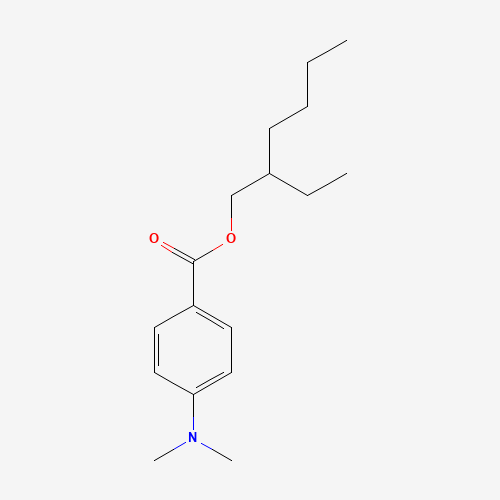
CAS21245-02-3
分子式C17H27NO2
分子量277.4 g/mol g/mol
危化品
Padimate O is a benzoate ester.
科学粮草官-词典编辑部,修订于:2026-07-06
Toxicity
ToxicityFate Summary
ATMOSPHERIC FATE: According to a model of gas/particle partitioning of semivolatile organic compounds in the atmosphere(1), Padimate O, which has an estimated vapor pressure of 5.1X10⁻⁴ mm Hg at 25 °C(SRC), determined from a fragment constant method(2), is expected to exist primarily as a vapor in the ambient atmosphere at 25 °C. At temperatures below 10 °C, the model of gas/particle partitioning(1) indicates that Padimate O will exist in both the vapor and particulate phases(SRC). Vapor-phase Padimate O is degraded in the atmosphere by reaction with photochemically-produced hydroxyl radicals(SRC); the half-life for this reaction in air is estimated to be 2.9 hours(SRC), calculated from its rate constant of 1.3X10⁻¹⁰ cu cm/molecule-sec at 25 °C(SRC) that was derived using a structure es...
Soil Adsorption / Mobility
Using a structure estimation method based on molecular connectivity indices(1), the Koc of Padimate O can be estimated to be 2200(SRC). According to a classification scheme(2), this estimated Koc value suggests that Padimate O is expected to have slight mobility in soil.
Environmental Bioconcentration
An estimated BCF of 2960 was calculated in fish for Padimate O(SRC), using an estimated log Kow of 5.77(1) and a regression-derived equation(1). According to a classification scheme(2), this BCF suggests the potential for bioconcentration in aquatic organisms is very high(SRC), provided the compound is not metabolized by the organism(SRC).
Volatilization from Water / Soil
The Henry's Law constant for Padimate O is estimated as 4X10⁻⁶ atm-cu m/mole(SRC) using a fragment constant estimation method(1). This Henry's Law constant indicates that Padimate O is expected to volatilize from water surfaces(2). Based on this Henry's Law constant, the volatilization half-life from a model river (1 m deep, flowing 1 m/sec, wind velocity of 3 m/sec)(2) is estimated as 15 days(SRC). The volatilization half-life from a model lake (1 m deep, flowing 0.05 m/sec, wind velocity of 0.5 m/sec)(2) is estimated as 117 days(SRC). However, volatilization from water surfaces may be attenuated by adsorption to suspended solids and sediment in the water column. The volatilization half-life from a model pond is about 1400 days when adsorption is considered(3). Padimate O's Henry's Law...
Environmental Abiotic Degradation
The rate constant for the vapor-phase reaction of Padimate O with photochemically-produced hydroxyl radicals has been estimated as 1.3X10⁻¹⁰ cu cm/molecule-sec at 25 °C(SRC) using a structure estimation method(1). This corresponds to an atmospheric half-life of about 2.9 hours at an atmospheric concentration of 5X10+5 hydroxyl radicals per cu cm(1). A base-catalyzed second-order hydrolysis rate constant of 3.7X10⁻⁴ L/mole-sec(SRC) was estimated using a structure estimation method(1); this corresponds to half-lives of 590 and 59 days at pH values of 7 and 8, respectively(1). Padimate O absorbs UV light in the sunlight spectrum(2) and, therefore, may be susceptible to direct photolysis by sunlight(SRC). Aromatic amines are susceptible to sensitized photolysis in natural waters exposed to...
Environmental Water Concentrations
SURFACE WATER: In surface seawater samples collected from Folly Beach, South Carolina in the summer of 2010, Padimate O was detected at concentrations ranging from <1 to 111 ng/L(1).
Food Survey Values
Industry reported the results of analytical tests on the occurrence of Padimate O (2-ethylhexyl-4-dimethylaminobenzoate) in a number of food products packaged in cartons printed with UV-cured inks containing Padimate O as a photoinitiator(1); in the milk and soy based products tested, not specifically intended for babies, the level of Padimate O ranged from 27 to 134 ug/L, for pack sizes of 1000 mL; in a chocolate milk sample (200 mL pack size) Padimate O level was 148 ug/L(1); in fruit juices, fruit nectars and drinks indicated as "cloudy" due to the presence of fruit pulp and fibres, the levels of Padimate O ranged from <5 ug/L to 125 ug/L(1).
Milk Concentrations
Researchers in Europe analyzed samples of human milk for the presence of sunscreens and other chemicals with possible endocrine activity. Mothers were asked about their use of sunscreens and cosmetics that contained sunscreen ingredients (benzophenone 2, benzophenone 3, 3-benzylidene camphor, 4-MBC, OMC, homosalate, octocrylene, and octyl-dimethyl PABA). Responding to questionnaires, 78.8% of the women reported using products that contained sunscreens; 76.5% of human milk samples contained these chemicals. There was a high correlation reported between mothers' use of these chemicals and their concentrations in human milk. The authors concluded that except for lipsticks (the ingestion of which is probably important), their results agree with studies in animals and humans showing dermal a...
Artificial Pollution Sources
Padimate O's production and use as an ultraviolet absorber in sunscreens and cosmetics(1,2) and as a synergistic agent-photoinitiator for UV-curable inks(3) may result in its release to the environment through various waste streams(SRC).
Probable Routes of Human Exposure
NIOSH (NOES Survey 1981-1983) has statistically estimated that 7,828 workers (7,210 of these were female) were potentially exposed to Padimate O in the US(1). Occupational exposure to Padimate O may occur through dermal contact with this compound at workplaces where Padimate O is produced or used. The general population may be exposed to Padimate O via dermal contact with this compound in consumer products, such as cosmetics and sunscreens, and through ingestion of foods(SRC) where Padimate O has migrated from inks in the food packaging into the food(2).
Environmental Fate / Exposure Summary
Padimate O's production and use as an ultraviolet absorber in sunscreens and cosmetics and as a synergistic agent-photoinitiator for UV-curable inks may result in its release to the environment through various waste streams. If released to air, an estimated vapor pressure of 5.1X10⁻⁴ mm Hg at 25 °C indicates Padimate O will exist primarily as a vapor in the atmosphere. At temperatures below 10 °C, Padimate O will exist in both the vapor and particulate phases. Vapor-phase Padimate O will be degraded in the atmosphere by reaction with photochemically-produced hydroxyl radicals; the half-life for this reaction in air is estimated to be 2.9 hours. Particulate-phase Padimate O will be removed from the atmosphere by wet and dry deposition. Padimate O absorbs UV light in the sunlight spectrum...
Interactions
Diminish the penetration of ultraviolet (UV) light through the epidermis by absorbing UV radiation within a specific wavelength range. The amount and wavelength of UV radiation absorbed are affected by the molecular structure of the sunscreen agent. /Sunscreen agents, topical/
Adverse Effects
Skin Sensitizer - An agent that can induce an allergic reaction in the skin.
Average Daily Intake
Based on a potential concentration of 125 ug/L of Padimate O in affected food products, potential dietary exposure in adults is 3 ug/kg bw/day(1); based on a potential concentration of 62 ug/L in affected products, potential dietary exposure in adults is 1.5 ug/kg bw/day(1). Based on a potential concentration of 63 ug/L of Padimate O would lead to a potential dietary exposure of 6 ug/kg bw/day in young children at the 95th percentile of consumption(1).
Human Toxicity Excerpts
/OTHER TOXICITY INFORMATION/ The manufacturers of sunscreen preparations with propellants warn that concentrating and subsequently inhaling the fumes from these preparations may be harmful or fatal. /Propellants/
Populations at Special Risk
Because the absorptive characteristics of skin of children younger than 6 months of age may differ from those of adults and because the immaturity of metabolic and excretory pathways of these children may limit their ability to eliminate any percutaneously absorbed sunscreen agent, sunscreen products should be used in children younger than 6 months of age only as directed by a clinician. It is possible that the characteristics of geriatric skin also differ from those of skin in younger adults, but these characteristics and the need for special considerations regarding use of sunscreen preparations in this age group are poorly understood. /Sunscreens/
Antidote and Emergency Treatment
/SRP:/ Advanced treatment: Consider orotracheal or nasotracheal intubation for airway control in the patient who is unconscious, has severe pulmonary edema, or is in severe respiratory distress. Positive-pressure ventilation techniques with a bag valve mask device may be beneficial. Consider drug therapy for pulmonary edema ... . Consider administering a beta agonist such as albuterol for severe bronchospasm ... . Monitor cardiac rhythm and treat arrhythmias as necessary ... . Start IV administration of D5W /SRP: "To keep open", minimal flow rate/. Use 0.9% saline (NS) or lactated Ringer's if signs of hypovolemia are present. For hypotension with signs of hypovolemia, administer fluid cautiously. Watch for signs of fluid overload ... . Treat seizures with diazepam or lorazepam ... . Use...









