


 一键配货
一键配货
化合物详情
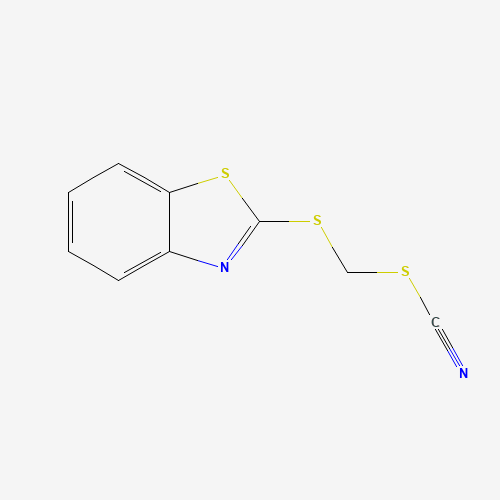
CAS21564-17-0
分子式C9H6N2S3
分子量238.35 g/mol
非危品
TCMTB is a wood preservative, marine biocide, contact fungicide, and as a preservative in paint.
科学粮草官-词典编辑部,修订于:2026-07-06
Toxicity
ToxicityBody Burden
A previously unknown pollutant in river water was identified to be 2-mercaptobenzothiazole (2-MBT) by interpretation and simulation of its GC/LRMS spectrum. Further GC/HRMS measurement of the isotope composition of the molecular ion verified this structure. 2-MBT is a well-known agent for corrosion inhibition and a stable metabolite of several other benzothiazoles. The present 2-MBT trace was most probably a metabolite of the wood preservative TCMTB which leaked from an upstream sawmill. The metabolite had been detected earlier in urine of the sawmill workers, but now was identified in the recipient water environment for the first time.
EPA Ecotoxicity
Pesticide Ecotoxicity Data from EPA: 46
Fate Summary
ATMOSPHERIC FATE: According to a model of gas/particle partitioning of semivolatile organic compounds in the atmosphere(1), 2-(thiocyanomethylthio)benzothiazole, which has a vapor pressure of 9X10⁻⁶ mm Hg at 25 °C(2) will exist in both the vapor and particulate phases in the ambient atmosphere. Vapor-phase 2-(thiocyanomethylthio)benzothiazole is degraded in the atmosphere by reaction with photochemically-produced hydroxyl radicals(SRC); the half-life for this reaction in air is estimated to be 4 hrs(SRC), calculated from its rate constant of 1.0X10⁻¹⁰ cu cm/molecule-sec at 25 °C(SRC) that was derived using a structure estimation method(3). Particulate-phase 2-(thiocyanomethylthio)benzothiazole may be removed from the air by wet and dry deposition(SRC). 2-(Thiocyanomethylthio)benzothiazo...
Soil Adsorption / Mobility
The adsorption of 2-(thiocyanomethylthio)benzothiazole was measured in five different soil types (sand, sandy loam, silt loam, clay and clay loam) with resulting Koc values ranging from 282 to 7896(1). Two soil adsorption studies conducted using OECD guidelines in four soil types determined Koc values of 633, 1,730, 2,060 and 2,270(2). According to a classification scheme(3), these Koc values suggest that 2-(thiocyanomethylthio)benzothiazole is expected to have moderate to no mobility in soil.
Environmental Biodegradation
ANAEROBIC: The half-life of 2-(thiocyanomethylthio)benzothiazole in a sediment-water test system, calculated by linear regression, was reported to be 3.7 days(1).
Environmental Bioconcentration
Using carp (Cyprinus carpio) which were exposed over an 8-week period, a BCF range was of <14-20 and <153 to 268 was measured for 2-(thiocyanomethylthio)benzothiazole at concentrations of 2 and 0.2 ug/L, respectively(1). Using bluegill sunfish (Lepomis macrochirus) and a 28-day exposure period, BCF values of 44 and 184 were determined in the fillet and whole fish respectively(2). According to a classification scheme(3), BCF values of <30 are low, 30-100 are moderate and from 100 to 1,000 are high(SRC).
Volatilization from Water / Soil
The Henry's Law constant for 2-(thiocyanomethylthio)benzothiazole is estimated as 7.1X10⁻⁸ atm-cu m/mole(SRC) derived from its vapor pressure, 9X10⁻⁶ mm Hg(1), and water solubility, 40 mg/L(2). This Henry's Law constant indicates that 2-(thiocyanomethylthio)benzothiazole is expected to be essentially nonvolatile from water surfaces(3). 2-(Thiocyanomethylthio)benzothiazole's estimated Henry's Law constant indicates that volatilization from moist soil surfaces is not expected to occur(SRC). 2-(Thiocyanomethylthio)benzothiazole is not expected to volatilize from dry soil surfaces(SRC) based upon its vapor pressure.
Environmental Abiotic Degradation
The rate constant for the vapor-phase reaction of 2-(thiocyanomethylthio)benzothiazole with photochemically-produced hydroxyl radicals has been estimated as 1.0X10⁻¹⁰ cu cm/molecule-sec at 25 °C(SRC) using a structure estimation method(1). This corresponds to an atmospheric half-life of about 4 hours at an atmospheric concentration of 5X10+5 hydroxyl radicals per cu cm(1). The compound was stable to hydrolysis in a sterilized buffer aqueous system at pH of 5 and 7; however, hydrolysis half-lives of 1.8 and 2.1 days (ring and side-chain labeled, respectively) at pH 9 and 25 °C were measured for 2-(thiocyanomethylthio)benzothiazole at a concentration of 10 ug/mL(2). At pH 8 using a dilute borax-phosphate buffer at 24 °C, the hydrolysis half-life was 750 hr, 740 hr in seawater, pH 7.8 to 8...
Environmental Water Concentrations
SEAWATER: A compilation of the results of a monitoring program of the recently used antifouling pesticides diuron (3-(3,4-dichlorophenyl)-1,1-dimethylurea), Irgarol 1051 (2-methylthio-4-tertiary-butylamino-6-cyclopropylamino-s-triazine), seanine 211 (4,5-dichloro-2-n-octyl-4-isothazolin-3-one), chlorothalonil (2,4,5,6-tetrachloro-\sophthalonitrile), dichlofluanid (N'-dimethyl-N-phenylsulphanamide), TCMTB ((2-thiocyanomethylthio) benzothiazole), and three degradation products demethyldiuron (3-(3,4-dichlorophenyl)-1-methylurea),3,4-dichlorophenylurea and 2-methylthio-4-tert-butylamino-s-triazine (Irgarol degradation product) that was carried out between April 1996 and February 2000 in enclosed seawaters from Catalonia and Almeria (Spanish Mediterranean coast) is reported. Nine points wer...
Ecotoxicity Excerpts
/AQUATIC SPECIES/ The toxicity of the wood preservative agent 2-(thiocyanomethylthio)benzothiazole (TCMTB) was evaluated in three species of juvenile salmonids (Oncorhynchus kisutch, O. tshawytscha and O. mykiss). Gill tissues were examined for quantitative structural changes after a 96-hr LC50 acute test. TCMTB was found to have both a concentration and time dependent effect on gill histology with damage apparent at concentrations as low as 6 ug/L. The residual effect on swimming performance of a 12 to 48 hr sublethal TCMTB exposure was also examined. Concentration dependent reductions in swimming speed were observed with thresholds of 5 to 10 ug/L. The inhibitory effect on swimming performance was also found to be intensified by an increase in exposure duration. The relationship betwe...
Effluent Concentrations
A previously unknown pollutant in river water was identified to be 2-mercaptobenzothiazole (2-MBT) by interpretation and simulation of its GC/LRMS spectrum. Further GC/HRMS measurement of the isotope composition of the molecular ion verified this structure. 2-MBT is a well-known agent for corrosion inhibition and a stable metabolite of several other benzothiazoles. The present 2-MBT trace was most probably a metabolite of the wood preservative TCMTB which leaked from an upstream sawmill. The metabolite had been detected earlier in urine of the sawmill workers, but now was identified in the recipient water environment for the first time.
ICSC Environmental Data
The substance is very toxic to aquatic organisms. Avoid release to the environment in circumstances different to normal use.
Artificial Pollution Sources
2-(Thiocyanomethylthio)benzothiazole's production and use as a biocide in the leather, paper and pulp industries(1) may result in its release to the environment through various waste streams; its use as a wood preservative, marine biocide, fungicide(2) and as a preservative and biocide in antifouling paints(3) will result in its direct release to the environment(SRC).
Sediment/Soil Concentrations
SEDIMENT: 2-(Thiocyanomethylthio)benzothiazole was not detected in sediments collected monthly from May to October, 1984 on an 8 km reach of Canagagigue Creek downstream from a water pollution control plant in Elmira, Ontario, Canada, which receives effluent from a chemical plant that manufactures benzothiazole compounds(1).
Probable Routes of Human Exposure
NIOSH (NOES Survey 1981-1983) has statistically estimated that 27,975 workers (11,764 of these are female) are potentially exposed to 2-(thiocyanomethylthio)benzothiazole in the US(1). Occupational exposure to 2-(thiocyanomethylthio)benzothiazole may occur through inhalation and dermal contact with this compound at workplaces where 2-(thiocyanomethylthio)benzothiazole is produced or used(2). Use data indicate that the general population may be exposed to 2-(thiocyanomethylthio)benzothiazole via dermal contact with consumer products, such as antifouling paint or treated wood, containing 2-(thiocyanomethylthio)benzothiazole(SRC).
Environmental Fate / Exposure Summary
2-(Thiocyanomethylthio)benzothiazole's production and use as a biocide in the leather, paper and pulp industries may result in its release to the environment through various waste streams; its use as a wood preservative, marine biocide, fungicide and as a preservative and biocide in antifouling paints will result in its direct release to the environment. If released to air, a vapor pressure of 9X10⁻⁶ mm Hg at 25 °C indicates 2-(thiocyanomethylthio)benzothiazole will exist in both the vapor and particulate phases in the ambient atmosphere. Vapor-phase 2-(thiocyanomethylthio)benzothiazole will be degraded in the atmosphere by reaction with photochemically-produced hydroxyl radicals; the half-life for this reaction in air is estimated to be 4 hrs. Particulate-phase 2-(thiocyanomethylthio)b...
Symptoms
Eye Exposure: Redness. Pain. Severe deep burns.
Toxicity Data
LC50 (rat) > 170 mg/m3
Adverse Effects
Skin Sensitizer - An agent that can induce an allergic reaction in the skin.
Exposure Routes
The substance can be absorbed into the body by inhalation of its aerosol and by ingestion.
Toxicity Summary
Organic nitriles decompose into cyanide ions both in vivo and in vitro. Consequently the primary mechanism of toxicity for organic nitriles is their production of toxic cyanide ions or hydrogen cyanide. Cyanide is an inhibitor of cytochrome c oxidase in the fourth complex of the electron transport chain (found in the membrane of the mitochondria of eukaryotic cells). It complexes with the ferric iron atom in this enzyme. The binding of cyanide to this cytochrome prevents transport of electrons from cytochrome c oxidase to oxygen. As a result, the electron transport chain is disrupted and the cell can no longer aerobically produce ATP for energy. Tissues that mainly depend on aerobic respiration, such as the central nervous system and the heart, are particularly affected. Cyanide is also...
RAIS Toxicity Values
Oral Subchronic Chronic Reference Dose Reference: HEAST Current
Human Toxicity Excerpts
/EPIDEMIOLOGY STUDIES/ Recently, many British Columbia sawmills stopped using traditional chlorophenate anti-sapstain fungicides and substituted 2-(thiocyanomethylthio) benzothiazole (TCMTB) and copper-8-quinolinolate (Copper 8). /A/ ... cross-sectional study /was conducted/ ... to ascertain which acute health effects, if any, were associated with the use of the substitute fungicides ... . Workers in five coastal sawmills were asked to complete a self-administered questionnaire about symptoms considered potentially related and unrelated to fungicide exposure, and about injuries commonly reported in sawmills. In addition, ... first-aid records from the mills /were collected/, and ... senior workers /were asked/ to estimate the duration of exposure to fungicides for each job. Symptoms ......
Carcinogen Classification
No indication of carcinogenicity to humans (not listed by IARC).
1 or Cancer Risk Level 1E-06
Fraction of Contaminant Absorbed Dermally from Soil: 0.1
Antidote and Emergency Treatment
/SRP:/ Advanced treatment: Consider orotracheal or nasotracheal intubation for airway control in the patient who is unconscious, has severe pulmonary edema, or is in severe respiratory distress. Positive-pressure ventilation techniques with a bag-valve-mask device may be beneficial. Consider drug therapy for pulmonary edema ... . Monitor cardiac rhythm and treat arrhythmias if necessary ... . Start IV administration of D5W /SRP: "To keep open", minimal flow rate/. Use 0.9% saline (NS) or lactated Ringer's (LR) if signs of hypovolemia are present. For hypotension with signs of hypovolemia, administer fluid cautiously. Consider vasopressors if patient is hypotensive with a normal fluid volume. Watch for signs of fluid overload ... . Use proparacaine hydrochloride to assist eye irrigation...
Hazard Quotient Level 3 or Cancer Risk Level 1E-04
Fraction of Contaminant Absorbed Dermally from Soil: 0.1









